Thursday, July 12, 2007

The 1930s - Part 4 - A Mysterious Doctor on Vox Pop

The year 1937 was an eventful one on the Houston radio scene. Two big developments concerning KXYZ will be reported on in the next post in the chronology but this post deals with a big development in KTRH's locally produced Vox Pop program.

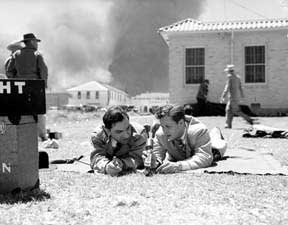
During July a new feature began on the program on Monday evening on KTRH. The listings for the program each week had been getting very brief and on Sunday, July 11th, a Chronicle story headlined ‘Vox Pop Moves to Met Stage’ announced half of the program scheduled the next evening would move off the streets and onto the stage of the Metropolitan Theater on Main Street with the ‘mysterious Dr. I.Q. shooting questions at the audience.’ There would be three announcers roaming the audience with portable microphones. A $5 prize was to be given for correct answers but anyone who participated in the program would get a consolation prize. Lee Segall was to handle the street portion of the program, the ‘mysterious Dr. I.Q.’ segment would begin at 8:15, half way thru the program.


The listing for Monday, July 12, just called the program Vox Pop but thereafter the program was listed as ‘Vox Pop with Dr. I.Q.’ The following week, the Chronicle reported that the segment had been judged a tremendous success and for the show on the 19th the Dr. I.Q. segment would take up 2/3rds of the show. The word ‘mysterious’ was not used again in newspaper accounts. Listeners and participants had liked the new format because more people could take part and, of course, because they could win cash. The story also said that in one week, KTRH had developed a new radio personality in the person of Ted Nabors, who was the original Dr. I.Q. Nabors was to have a long career in Houston radio, later serving as Program Director of both KTRH and KTHT. In the 1950s, before I became aware of top-40 djs, I probably recognized only 2 names of Houston radio personalities, Fred Nahas, Mr. First-Nighter as he was called, and Ted Nabors.

Dr. I.Q. was sold to Mars Candy Co. in 1939 and put on the air as a summer replacement for Jack Benny and was an even bigger hit than Vox Pop had been and was to run on NBC until 1949, then ABC for one year. There was also a short-lived Dr. I.Q. Jr. series and two times in the 50s, ABC-TV aired a TV version of the show.

The show is remembered for the jingling of silver dollars falling into the hands of the winners, the announcer’s graphic descriptions of the delights of Mars candies and the phrase ‘I have a lady in the balcony, Dr.’ and its many variations.

The show was one of many network shows that traveled to different cities, as did Vox Pop. In March, 1942, it returned to Houston for a six week run in its regular Monday evening time slot on NBC, once again originating from the Metropolitan Theater where it had been born, with KPRC announcers working the microphones. The Chronicle interviewed Lee Segall who at that time was President of Segall Weedin Advertising in Houston and controlled the rights to Dr. IQ throughout his life. He said he still submitted 100 to 200 questions per week to the show of which many were used.

Segall was to sell two other shows to the networks as well as apply for broadcast licenses here and receive an FM permit but by the late 1940s he had relocated to Dallas and put KIXL-AM/FM on the air (see the section on the 1940s) and by the time of his death in 1984 his connection to early Houston radio and the fact the Dr. I.Q. show originated here had been forgotten.

During the TV Quiz Show scandals of the late 50s, Howard Stentz, Radio/TV Editor of the Chronicle, who always did a great job of covering radio during his tenure, remembered Segall and interviewed him about the scandals. Not surprisingly Segall predicted game shows would continue to be around but the feature story mostly concerned Segall’s recollections about Vox Pop and Dr. I.Q. Segall recalled he had been working for the Vox Pop sponsor, Metzger’s Dairy, and they had asked him to come up with a replacement they could sponsor so he came up with two changes - moving the show indoors and adding cash prizes. He recalled that the most anyone could win at any time was originally $20 because they wanted to have lots of small winners instead of one big one, and initially, all the questions were very easy ones. He also stated that when he had taken over producing Vox Pop, he had changed the questions from interview and opinion type queries to questions of simple fact and trivia.

For the initial broadcasts from the Metropolitan, Harry Grier, Tom Jacobs and Ben Weedin, all of KTRH, handled the microphones in the audience. Segall was later to form an advertising agency in partnership with Weedin and the latter was the producer of the Dr. I.Q. show in its last run on TV.

The images above are from the archives of the Houston Chronicle at the Houston Public Library.

Tuesday, July 10, 2007

The 1930s - Part 3 - A Shared Antenna

In March of 1935 KXYZ signed up as an affiliate of the World Broadcasting System. Not much is known about this short lived ‘network’ but apparently the programming supplied was on electrical transcriptions (disks like long playing albums) and there was no interconnection. The station also upped power to 500 watts and moved into new facilities in the Gulf Building from the Texas State Hotel; they were to occupy those studios for 3 decades. Newspaper listings indicated there were many interludes of ‘Popular Music’ filling gaps in the program schedule.

Sometime in 1935 Gerald Chinski, who had been the chief operator of WEAY in the 20s, became the Chief Engineer of KYYZ, a post he was to hold until 1961.

Late that year KTRH and KPRC spent $250,000 on a new transmitting plant to be shared by the both of them at Deepwater on the La Porte Highway where KTRH had been located since going on the air; KPRC was to move from its Sugar Land location. The expenses included nearly $100,000 for 2 brand new 5000 watt RCA transmitters as well as a new type of antenna. There was also 16,000 feet of lead wire and 13 and a half miles of copper wire. None of the old equipment at either site would be used.

The antenna was a 375' tower mounted on a triangular base. Called the tallest in the southwest, it was almost as tall as the Gulf Building, Houston’s tallest skyscraper. It would replace the old style flat top antenna system and both stations would operate from the same antenna, something that had only been done by two other stations up until then, in Massachusetts.

The old flat top antennas, with the actual antenna slung between two towers something like a curtain rod, had produced an oblong pattern of coverage; it was estimated the new antenna would improve the coverage area of both stations by 75-125%. The new transmitters were to be ‘automatic’ also, not requiring constant attention by engineers to keep them operating and they would re-start themselves if knocked off the air. The grounding system - the extensive wire grid laid in the ground - was supposed to eliminate fading, a frequent problem with radio broadcasts.

Test broadcasts started on the 4th of January, 1936. A big open house was planned on Sunday the 12th; KPRC switched over to the new transmitter sometime on Thursday afternoon and by the 12th the papers reported the station had received hundreds of calls complimenting the stronger signal. Just when KTRH switched over was never mentioned. Hundreds, perhaps thousands, attended the open house, which was to be in effect ‘whenever the stations are on the air.’ The door to the transmitter building was not to be locked; passersby could just ‘walk right in.’

Deepwater was a small town that has since been absorbed by Pasadena. The present KXYZ transmitter on Texas 225, just west of Beltway 8, is on the original KTRH site and that location was also used by KRCT/KIKK 650am.

Though he was not involved in ownership after his problems with XED, Will Horwitz continued his involvement in broadcasting. He sponsored the Will Horwitz Amateur Hour on KXYZ, broadcast live from his Texan Theater. Once he staged a ‘Juneteenth Jubilee’ featuring all Black performers and installed a special bank of 30 phones to take calls from listeners to determine a winner.

Frank Tilton, the blind pianist, had a daily 15 minute program on KTRH, sponsored, ironically, by an optical company. Mrs. John Wesley Graham also had a regular program on KTRH and KXYZ.

In January of 1936 Horwitz installed an electric organ in his Uptown Avenue amusement center connected to his Uptown Theater. With typical flair he had dubbed it the ‘Radio Mystery Organ.’ Sounds were generated by radio tubes rather than pipes and the organist gave daily concerts.

Though no new stations made it on the air during the decade there were at least two applications. In February of 1936, Bayou Broadcasting applied to the FCC for a station. The principals were James W. Rockwell, a lumberman, Charles Reinhard, an attorney, and R.A. Talbot of Bankers Mortgage Co. In January, 1937, there were news reports on a hearing being held by the FCC on an application by Reverend Williams States Jacobs for a Houston station. Jacobs had apparently operated an unlicensed station from his ranch at Webster and that was complicating matters. Other than the fact neither of these stations ever made it on the air, it is not known what happened to the applications.

Thursday, July 5, 2007

WCM, KUT, KTRH Update

This is an update to remarks included in previous posts concerning the history of KTRH, Houston.

The fact is known that KUT, Austin, became KTRH, Houston in 1929/30 but the information available from government sources has left it open to question whether KUT was a continuation of WCM or a new station, i.e., whether KTRH can trace it’s history to WCM licensed March 22, 1922, and therefore qualify as the 35th oldest radio station in the country, or only from KUT, which was first licensed under those calls as a new station, operating on a different frequency and with different power authorization than WCM, in October, 1925.

I have corresponded both with Barry Mishkind and Thomas White on this question. While both see the possibility of interpreting the records either way White points out that in the Active Stations file at the FCC, the WCM, KUT and KTRH licenses are all kept in the same folder; in other words, the government considers them the same station even if some of their records indicate otherwise.

Over the years, WCM had funding problems which led to some lapses in the license (it was an era of 3 month licenses and lapses were commonplace, especially among university owned stations that might not have any staff at all in the summer). S. E. Frost’s Education’s Own Stations indicates a lack of funding was the reason the license lapsed in 1924 and the Markets and Warehouses Department made arrangements to refurbish and use the equipment to continue broadcasting market reports while the university was allowed to use the facilities, also. A lack of funding also led to the cessation of operations and lapse of the license in 1925 for several months before KUT was authorized.

Still, the government considers the 3 stations to be continuous.