If KATL had been a something of a stealth entry onto the Houston radio scene the next new AM station in town was to make quite a splash. In early 1946, Houston businessman W. Albert Lee had decided to make a foray into broadcasting. He received a permit in May 1947 and got his station on the air Saturday, January 31, 1948, timed to coincide with the opening of the Fat Stock show that year. Studios were to be in the San Jacinto Hotel, which was being remodeled, but work went faster on a similar project at the Milby at Travis and Texas and the studios wound up there. Lee put a 62 foot Translux animated sign on the exterior of the hotel, the first of its kind in Houston, a smaller version of the famous one in Times Square in Manhattan. As he had done with 2 of his hotels and was to do with his television station less than a year later, Lee used his name for the call letters. KLEE operated at 610 kc with 5000 watts from a 4 tower array. Hilton Waldo Hearn, Jr.'s 1971 Masters Thesis on Lee placed the transmitter on Airline Drive but a Chronicle story placed it on the Dallas Highway. John B. Hill, an engineer at KILT from 1960-1964 who started as an engineer at the transmitter says it was on West Rd., just west of I-45, across 45 from Aldine High, which sits near the intersection of Airline at West. Lee still owned the station at the time of his death in late November, 1951.
As part of the build-up to the launch of the station, Lee turned on the Translux sign two weeks before broadcasting began, staging a big ceremony. The sign was on the Texas Avenue side of the Hotel, facing Jesse Jones’ Rice Hotel but was to be turned off at 10:30 every night. There were big stories in the newspapers almost every day in the week leading up to the launch.
KLEE received front page coverage in the Saturday morning Houston Post on the day the station signed on and the station placed a full page ad concerning the opening ceremonies scheduled for 5pm. The ad included pictures of station personnel and facilities, but has been difficult to reproduce from the microfilms or I would post it here. Gene Autry and his entire troupe were to be on hand, as well as actor Michael O’Shea, Virginia Mayo, Wild Bill Elliot, Albino Torres and his Orchestra and others. There was to be a special live, remote broadcast from the Fat Stock show, and, in the midst of all that, coverage of that day’s election returns on a vote on the subject of zoning for the city of Houston (the zoning proposal lost - duh).
Lee had purchased an 8000 disc library and subscribed to a music transcription service but the first song aired on the new station was performed live: Gene Autry's Cass County Boys played 'The Eyes of Texas,' punctuated by pistol shots and cries of 'Yippee,' to open the ceremony and Autry later sang his signature song ‘I’m Back in the Saddle Again,’ the first song sung on 610. All the show business people stuck around for more appearances on the station for a couple of days, with live broadcasts in one of the big studios starting at 6:10pm, open to the public.

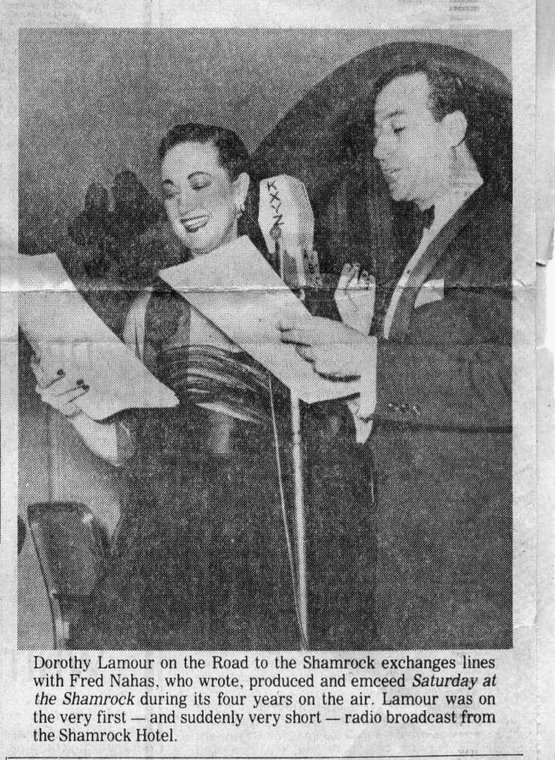
Lee received congratulatory messages from many of his famous and rich friends plus his radio competitors, including Jesse Jones, the Hobbys, Glenn McCarthy and Coke Stephenson. Fred Nahas, who was to become a Houston radio legend in his own right, wrote that he was most impressed that Lee had four ministers pray at the dedication ceremony, a Rabbi, a Catholic priest, a Greek Orthodox priest, and a Methodist minister. Nahas had just launched Houston’s first Muzak-like piped-in music service.
The Chronicle ran a full length column in the Sunday paper on the launch under the headline 'Crowds view KLEE official opening here.' Ray Bright, Commercial Manager of KTRH across the street, had been hired as General Manager. WInthrop 'Bud' Sherman of WOC, Washington, DC, and the Mutual Radio Network had been hired as Program Director. He had also worked at KNOW, WBAP, WACO and KMOX. Paul Huhndorff was picked as the chief engineer; he would go on to put KLEE-TV on the air for Lee in less than a year and stay with the TV station when it was sold to KPRC. The chief announcer was Charles Rashall whom the Chronicle article said 'formerly was heard on coast-to-coast shows originating in the film capital.' Lee's biographer credits Lee with hiring a young Dick Gottlieb out of Texas A&M to do play-by-play of high school football games on Thursday and Friday nights for $25 per game, thus giving Gottlieb and entry into Houston radio. He was to go on to serve as an off-camera announcer on KLEE-TV and stay with the television station when it was sold, becoming known as 'Mr. Television' in Houston for the first decade and a half of Houston TV. However, the claim has also been made that Gottlieb first worked in Houston for Roy Hofheinz' KTHT.
Lee was apparently pretty difficult to work for. He went through 3 program directors in 3 years with Sherman leaving just 3 weeks after the station signed on. Ted Hills, who had been program director of early Houston radio station KFVI in the 1920s and KTHT in the mid 40s was one of the PDs. Without a network affiliation the station had to rely on local advertising sales completely for revenue. According to his biographer Lee attempted to motivate his sales staff but instead drove them away. He was known to fire announcers on the spot for an on-air comment he didn’t like.
Even before KLEE was on the air, Lee had traveled to the East coast, negotiating for talent to appear at the Rodeo, and been exposed to television. He came back to Houston determined to put a television station on the air and filed for a permit on October 8, 1947. The announcement of his intentions appeared in Television Magazine in November, 1947, and that same month in Houston Magazine. Approval by the FCC was to take only 3 months with approval on January 30, 1948, the day before his radio station signed on, although Lee apparently didn’t get the news for a couple of days. Studios were to be in the Milby Hotel with the radio station and the transmitter on South Post Oak near the Pin Oak Horse stables. KLEE-TV was to sign on New Year’s Day, 1949, Houston’s first television station, on Channel 2. There's more on KLEE-TV in the TV section on the sidebar.
The year following Lee’s death, KLEE-AM was sold to Gordon and B.R. McLendon’s Trinity Broadcasting of Dallas who changed the call letters to KLBS and made it a part of his Liberty Broadcasting System. McLendon announced plans to move the headquarters of the network to Houston and use KLBS as the flagship station, according to McLendon’s biographer, but they fell apart when McLendon had to give up the baseball game recreations which formed the backbone of the network programming. According to the History of KLIF website, McLendon owned the station from 1952 to 1954 and repurchased it to flip it to KILT in May, 1957. The studios were still located in the Milby Hotel when the call letters changed, but later moved to 500 Lovett Blvd. in the Montrose area where they stayed for almost 40 years. KILT has been the call on 610 ever since 1957. The station was a Top 40 station for many years and flipped to Country in 1981, then to Sports around 1995.
When I first read of the supposed intentions of moving the headquarters of Liberty to Houston I was skeptical. I have always thought of McLendon as a Dallas broadcaster and it was difficult to even imagine him abandoning Dallas and given his penchant for promotional hype, I thought he was probably just blowing smoke. However it becomes more believable when considering that, according to McLendon's biographer, Ronald Garay, Houstonian Hugh Roy Cullen had invested $1,000,000 in Liberty in August, 1951, to help prop it up. Cullen was considered by some the richest man in Texas at the time and had been expanding his influence politically. He had asked an aid to look into investing in Liberty but canceled the due diligence after just one meeting with Gordon. The two men had similar political ideologies and found they admired each other very much. Cullen extended another loan of $175,000 the next year as the network was collapsing and was one of the major creditors suing for a share of the assets after the collapse (the other was B. R. McLendon).
The Houston Post typically found a way to put it's own radio station on the front page during all the build up to the launch of KLEE. On Thursday, January 29, a front page story pointed out KPRC would be celebrating 20 years of being an NBC affiliate the next Thursday with a special concert at the Music Hall and on Friday, January 30, another front page story advised riders of the Houston Transit Company buses that they would soon be among the first in the nation to hear music as they rode the buses. In an experimental program sponsored by KPRC-FM, special receivers would be installed in buses to allow reception of KPRC-FM’s signal (and presumably no others). The receivers were eventually installed in 250 buses and the ‘experiment’ lasted until 1950.