Showing posts with label KOST-FM. Show all posts

Monday, October 24, 2011

A KILT Tour - 1961

My correspondent, John Hill, has provided me with a wealth of information about KILT in the early 1960s, including a description of the equipment in use at this time. This is fascinating information for radio and equipment geeks and for everyone who worked in the McLendon building over the years, and so I am reproducing it here as John related it to me. Note: KILT first occupied the facility in 1957 and moved out in 1995. Although the building is still standing, there is no broadcast equipment or operation at this location now.

In 1961, the KOST-FM (now KILT-FM) transmitter, a Gates 5KW kit, was located in the engineering workshop on the 2nd floor of the McLendon Building at 500 Lovett Blvd. The antenna was a 4-bay horizontally polarized "V" array atop the tower immediately behind the building. The UHF (News COMM) antenna was also mounted on the tower.

We ran KOST-FM from 6-midnight (the minimum time to keep a license current) and John Trotter would sign it on as "This is KOST'n KILT in Houston. At the time, KOST was "costing" KILT but, Gordon McLendon had the foresight to know what a more significant role FM would play in the future of broadcasting.

There was a lot of old paperwork at the AM transmitter site that indicated it was the original site. The Collins 5V main transmitter, and the 1V back-up transmitter, were not original. Since the McLendon's were pro-Collins, I'll guess the Collins gear was installed after they purchased the station. The antenna phasing cabinet, between the two transmitters, was earlier vintage than the Collins transmitters, but had been well maintained. The board and turntables at the transmitter site were definitely 'early marriage.'

With regard to the studio layout at the McLendon building, as you looked at the building, there were two sides. KILT occupied the left side. (John believes an insurance company occupied the right half of the building). The receptionist, copy, sales and management offices were on the first floor. The stairway, near the left front lobby glass window before the atrium, went upstairs to the studios.

On the second floor, the break room faced Lovett Blvd. Following the hallway toward the back of the building, on the left, there was the newsroom, On-Air studio #1, another much larger studio that we called "Studio B," On-Air studio #2/Recording Studio/Master Control Room, Engineering Office, and Engineering Shop. The right side of that hallway was solid wall.

Between the Newsroom and Studio #1, there was a double glass window so that the on-air newsman and on-air DJ were facing each for "tighter" production. Both had their boards in front of them.

There was another double glass window between Studio 1 and Studio B, which had a table and chairs. The back wall of Studio B had a double glass window so those at the table (voice talent) were normally looking up and through the double glass to the recording engineer, who had a board in front of him. Or, when in Studio B, the on-air DJ would have eye contact with me as I operated the on-air board in #1, there again for hand signals, nods...whatever cue, for tighter production.

With all that glass, we had visibility from the Master Control Room to the Newsroom so that the on-air newsman had eye contact with whomever was at the board of the Master. (In those instances, lights were usually turned off in Studios #1 and B...otherwise field glasses helped!)

Occasionally, the on-air jock would be in Studio B and I would be operating the on-air board while the jock was (usually) doing an interview, such as the train wreck we had when Dean Martin and Jerry Lewis came in. (We finally had to break that off, get John Trotter back in the on-air #1 and tape the interview which took over an hour for a 10 minute "clean" interview...not to mention the tape edit time). All our interviews were...uh, interesting.?!!

Equipment-wise, the Newsroom had 5-Model 19 teletypes, 4 on line and a back-up, a Collins board, several rack mounted recorders, patch panels, a Collins cartridge playback machine and our UHF transmitter/receiver for mobile news unit COMM.

On-Air #1 had a Collins board, 4 Gates turntables, 4 Collins cartridge playback machines, a rack/cabinet mounted Schaffer remote control system (AM transmitter remote controls), an FM transmitter control panel, and a rotating cartridge bin. It was pretty much a full house.

Studio B was for voice work only; it had a table with several phased mics, two wall mounted play-back speakers and about a dozen chairs. It was more like a small conference room.

On-Air #2/Recording Studio/Master Control had a Collins board, 2 Gates turntables, 2 Ampex 361 recorders on wheels, 2 Collins ATC record/playback machines, two racks with patch panels, McIntosh audio amplifiers and two rack mounted receivers for on-air monitoring. (The DJ was listening to the AM receiver, rather than his console output, so we would have another indicator if we went off the air.) On the back wall we had a cabinet with a disc cutter, its McIntosh driver amplifier and our cartridge and tape erasing devices, all of which I'm sure are long since dust-biters.

The engineering office was rather small with a desk, chairs and filing cabinets.

In the engineering shop, there was the 5KW KOST-FM Gates transmitter and the controls for the natural gas powered Onan generator that was mounted inside the FM tower base behind the building. There was also a sizable work bench with various test equipment and spare parts bins.

We replaced the older cartridge machines and all studio mics with the relatively new Collins ATC's and Telefunken microphones that were removed from the M/V Mi Amigo, which was home to McLendon’s ‘pirate’ radio ship operation off the coast of Norway, when Radio Nord was disassembled at Pier 37 in Galveston. KILT was the recipient of a good bit of studio gear.

Note: Although it was not a Houston radio station, its connection to Gordon McLendon and KILT warrants more information; for more on Radio Nord and it’s successor ship, see:

Radio Nord in Wikipedia

Pictures of Radio Nord, more pictures, and still more pictures.

Radio Atlanta in Wikipedia


Note: the Soundscapes site says the ship was outfitted at Copenhagen; John was told it was outfitted at Galveston by KILT transmitter supervisor Frank Maher. This was before John joined the station. Although both operations were referred to as 'pirate' radio stations, both actually operated under the laws of that time.

See also the KILT staff directory, the story of Bob Horn/Bob Adams, and the Hooper Ratings for this era.

Monday, September 20, 2010

FM Chronology - The 1960s - Part I - KQUE-FM, KARO-FM, KOST-FM, KXYZ-FM

This article was edited 10/1/10 to include some new information about the programming of KXYZ-AM/FM in the 1960s.

The decade of the 1960s would prove to be a very active one on the FM dial in Houston with many new stations signing on, but it was not until the end of the decade that FM began to make an impact in the ratings. A year and a half after KHGM-FM moved off the 102.9 frequency to 99.1, Veterans Broadcasting launched an FM in its place. KQUE-FM signed on at 6am, Tuesday, October 1, 1960, to broadcast 18 hours a day, 7 days a week. Webb Hunt was the first Program Director. Teaser ads in the papers ran heavily; ‘Cue – for the best in FM Radio. K-Que. Coming.’

An early program schedule in the newspaper listings had Webb Hunt, 6a-10a, KQ Music Hall, 10a-12N, Felix Martin, 12-2pm, Bob Brock, 2p-4p, Joe Walker, 4p-6p, Felix Martin, 6p-9p, and Bob Brock, 9p-12M.

The second new FM of the decade came on the air just 2 weeks later. KARO-FM took to the airwaves the weekend of the 15th and 16th of October with 8000 watts on 94.5 Megacycles. The studios were on the 11th floor of the American Investors Building at 600 Fannin and the transmitter was atop the building. Robert L. Weeks was the Station Manager and Bert Wiel Assistant Manager. The schedule printed in the papers showed the station was only on the air from noon to midnight originally but by years’ end the broadcast day had been extended to start at 9am. It’s been alleged the call letters were taken from Karo syrup because the programming was sweet, sappy music. The 1962 Houston telephone directory gave Mr. Weeks’ address as San Diego, CA.


KARO lasted just over 4 years before becoming KLEF-FM, a full-time classical music station. However, it’s not clear that KARO was on the air continuously during the 4 years; there were many times when program listings for the station were missing in the papers.

By mid-1961, Gordon McLendon’s FM took to the air waves. KOST-FM first appeared in the radio listings in the Chronicle the weekend of July 15-16; there was no story. The station operated at 100.3 megacycles and simulcast KILT-AM. Broadcasting Yearbook confirms the year 1961 but whether this station had previously been known as KZAP-FM as early as 1959 is not known. Other call letters that have been used on this frequency include KILT-FM and KXAS-FM, ‘Texas 100.’ It has been a country station since the Spring of 1981. (Spring 81 ARB was KILT-FMs first as country).

The Broadcasting Yearbook for 1979 gives 1960 for the first year of KXYZ-FM but it was not until the last quarter of 1961 that the station returned to the air after a hiatus of eight years. In a story about Gerald Chinski’s resignation as Chief Engineer on October 1, Chronicle Radio-TV Editor Howard Stentz noted Chinski would be leaving after 26 years with the station as soon as the FM station was on the air in a few days. KXYZ-FM first appeared in the Chronicle listings on Wednesday, October 4, simulcasting the AM 24 hours a day.

The stations had just changed hands that summer. The sale of the combo from N.A.F.I. Corporation of Los Angeles to Public Radio Corporation of Houston for $1,000,000 was finalized in early June. Public Radio Corporation was Lester and Max Kamin of Houston and Morris Kamin of Victoria; they also had stations in Tulsa and Kansas City. Lester Kamin had been a DJ in Houston in the 1940s and had owned an advertising and public relations firm locally. Sam Bennett, former GM of KTHT came on board as new GM and Milt Willis, former PD of KTHT became the new programming head.

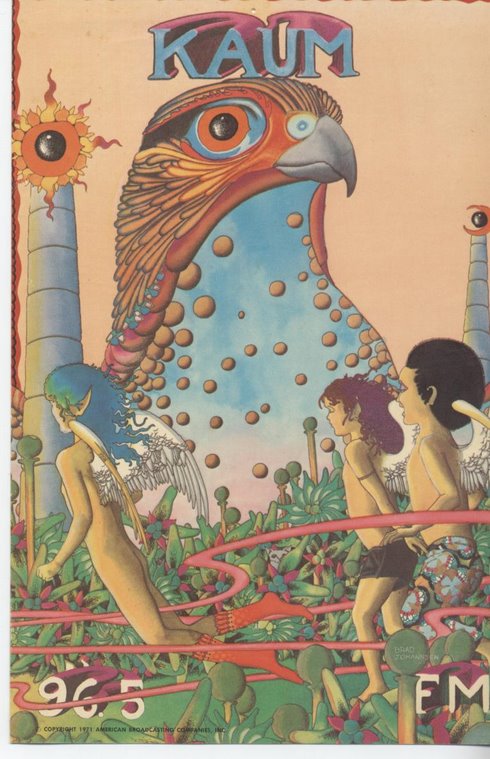
KXYZ-AM and and FM was locally owned and simulcast a heavily proudced beautiful music format until mid-decade when a heavy personality format was installed. In 1968 the stations were purchased by the American Broadcasting Company which returned a produced, matched-flow beautiful music format on the air under the direction of Paul Mitchell. This did well in the ratings until the first matched-flow beautiful music FM came on the air, KYND, the one-time KLVL-FM on 92.9, began to eat away at the numbers. By the spring of 1970, KXYZ-FM was broadcasting the ABC Love format which consisted of syndicated tapes of album-oriented rock programming. KXYZ-FM flipped call letters to KAUM and went live and local with the album rock format the first week of September, 1970. KAUM dropped the album rock format after just a few years and went through several format changes before changing call letters to KSRR in mid-1980. (KAUM last noted in Apr/May 1980 ARB; KSRR shown in Oct/Nov 1980 ARB). The station changed call letters again in the 80s to KKHT and then to KNRJ. (I first have KNRJ in 1989 RnR Ratings Report, Vol II) and by the Spring of 1991 had adopted KHMX-FM. (Spring 1991 ARB). More will be posted on this site on the history of KAUM.

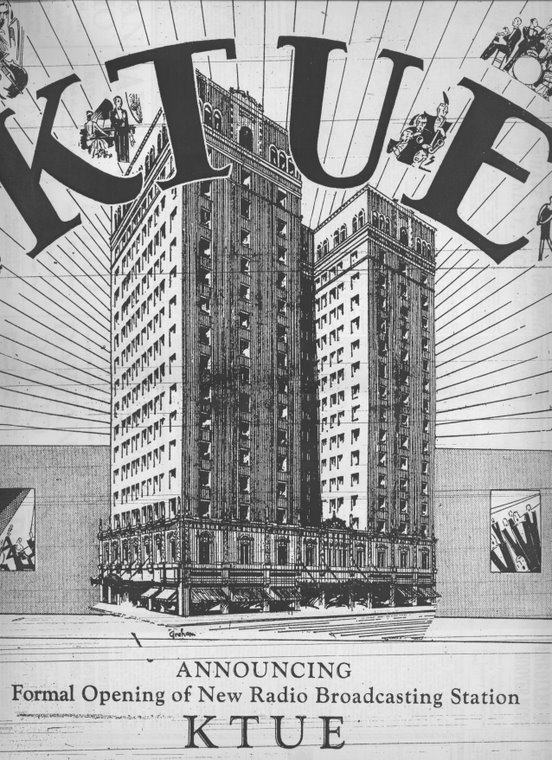
The image above comes from the Houston Press in 1961.

Saturday, October 24, 2009

FM Chronology - The 1950s - Part 2 - KFMK-FM, KHGM-FM, KHUL-FM, KRBE-FM and a Gordon McLendon permit

It was not until 1958 that there were any further changes on the FM dial in Houston. A list from ‘North American Radio and TV Station Listings’ by Vane A. Jones for that year has four FMs again listed for Houston: KFMK, 97.9; KPRC-FM, 102.9; KTRH-FM, 101.1, and KUHF, 91.3 KFMK-FM was the first commercial FM on the air in Houston without a sister AM. The station was apparently ready to go on the air in mid-January, 1958 but had to await regulatory approval and finally got on the air Sunday, February 2nd at 5pm. The station operated with 10,000 watts from the Medical Towers Building at 1709 Dryden. The newspaper listings showed the frequency just as 98 mc but later as 97.9; the format was popular music. Bob Gardner, who had previously worked at KLBS before it was taken over by McLendon and in Beaumont radio and at KTRK-TV, was the General Manager.

Interest in FM broadcasting was beginning to pick up around the country and before the year was over there were more developments on the FM dial in Houston. In November of 1958, Paul Taft purchased KPRC-FM and changed the call letters to KHGM-FM which stood for ‘Home of Good Music’ or ‘Houston’s Good Music.’ The call letter switch took place at 1pm on Sunday, the 9th of November. Taft had resigned as General Manager of KGUL-TV, channel 11, earlier in the year and formed Taft Broadcasting.

Just before the switchover, KPRC-FM had been operating only from 6pm to 11pm daily and the new ownership meant an expansion of broadcast hours. KTRH-FM was on from 1pm to 12 Mid, KFMK-FM from 8am 12 Mid and KUHF-FM from 7am to 9:30pm.

On April 26th of the following year, KHGM-FM moved to 99.1 mc, signing on at 12 Noon after being off the air for 24 hours to complete the changeover of equipment. The station boasted 49,000 watts and claimed to be the most powerful FM in Houston. This apparently coincided with a move to a new facility at 4810 San Felipe on the city’s far west side. Ads highlighted the station was to be a showcase of ‘tasteful music,’ 17 hours a day with the library having been selected as a result of a survey of 2000 homes. The regular broadcast day was to start at 7am.

On July 1, 1961, the call letters of KHGM-FM were changed to KODA-FM to match an AM sister station. KODA-FM is still on the air today on 99.1 MHz and as the heir to KPRC-FM is believed to be the oldest FM in Houston and either the first or second oldest FM in Texas, depending on whether KPRC-FM was on the air continuously in the 1950s. KODA-FM was later to claim to be only the second station in the nation to broadcast full-time in stereo. Meanwhile the KHGM-FM call letters were later used on a station on 95.1 mc in the Beaumont-Port Arthur-Orange area.

Taft Broadcasting was also to operate the Muzak franchise for Houston in addition to an AM station, KODA-AM, and was also involved with the first sound system at the Astrodome and as a contractor for NASA. Taft Broadcasting LLC is still in business, run by Paul Taft’s son, Philip, although they have not owned any broadcast properties in Houston since 1978.

At least two more and possibly three new FMs started broadcasting before the end of the decade. A story in the Chronicle in eary September said KHUL-FM would be on the air on September 22 but it was not until 7am on October 4, 1959, that the station started broadcasting on 95.7 mc. The call letters of this station were pronounced ‘cool’ and initially it operated 24 hours a day. Studios were located on the 15th floor of the Park Towers, a high rise apartment building at 1700 Holcombe Blvd. at Braeswood which is no longer standing. T. A. Robinson, Jr., President and owner, said the station would program ‘tasteful arrangements’ of music by George Gershwin, Cole Porter, Rogers and Hart, Oscar Hammerstein, Vernon Duke, James Van Heusen, Lerner and Lowe and Duke Ellington.

KHUL has been remembered fondly as a jazz station by many but that can not be confirmed from the newspaper accounts and early listings; it may have evolved into a jazz station later. An ad in 1963 touted ‘All Night Jazz’ and ‘Swinging Standards all day and evening.” An ad for the station in 1964 mentioned ‘Jazz after Midnight’ in addition to other special programs and did not claim it was a full time Jazz station.

A typical program schedule in the papers in late 1959 showed KHUL Start at 6am, KHUL, Calm and Collected at 12:05pm, KHUL and Refreshing at 3:05pm, KHUL of the Evening at 6pm and KHUL All Night at 12M with news 4 times a day. Those program titles could refer to easy listening programming.

The twenty-four hour a day broadcast schedule did not last at KHUL-FM. An ad for the station in early 1962 said KHUL ‘Stays up til 2am, Friday Saturday and Sunday, Midnight Monday thru Thursday’ and could be found ‘Just Under 96 on Your Dial,’ for ‘Good Music and News.’

The station changed hands and call letters in the mid to late 60s becoming KIKK-FM and operating as a country station for more than three decades before becoming a smooth jazz station, KHJZ-FM, The Wave, in 2001. It is now Hot Hits 95-7 (KKHH).

On the same day the paper announced KHUL’s impending launch it also noted KUHF-FM was installing the first stereo control room in the city and KHGM-FM had published a program guide.

At 6pm on November 8, 1959, KRBE-FM came on the air at 104.1mc. This was originally a full-time classical music station with studios in the 1400 Hermann Drive high rise apartment building across from the Rose Garden in Hermann Park. Some have asserted the calls were because the station was located on Kirby drive just north of US 59 but the station did not move there for almost a decade. Ads appearing in the papers the day the station launched indicated the call letters stood for ‘The Key to Radio Broadcasting Excellence” but it has also been noted the calls happened to be the initials of the owner’s business, Roland Baker Enterprises.

Ellis W. Gilbert was the President and General Manager and also had an air shift. Gilbert had just recently resigned as manager of KTRH-FM, which also scheduled a lot of classical music, and according to a story, had been known as ‘Mr. FM’ in the early 50s when he hosted ‘House of Music’ on the ‘now defunct’ KYXZ-FM. Other air personalities included Roy Landers, Eamon Grant and Eddie Bates. The station has had the same calls throughout its history.

According to the history of Dallas radio station KLIF Gordon McLendon owned an FM in Houston in 1959 with the call letters KZAP-FM but exactly how those calls figure into Houston radio history is not clear. Gordon McLendon was one of the first to recognize the value of ‘parking’ call letters that he wanted to use and that may be what happened in this case. When McLendon bought a San Francisco AM and flipped it to KABL, the previous call letters KROW were assigned to his proposed FM in Houston. Later, McLendon switched the KROW calls with his proposed calls for an FM in Dallas, KOST-FM, and that is the call the Houston FM signed on with. Just how KZAP figures into to this is not clear. The first mention of KOST-FM, 100.3 mc, is not found in radio listings until mid-1961 and when it actually first got on the air is not known. I have found only one listing in the Houston papers for a KZAP-FM, much later in the 1960s.