KGUL-TV, Channel 11, Galveston

“Local Television comes of age” the Houston Chronicle proclaimed Sunday, March 22, 1953, on the cover of its special TV section devoted to the launch of the area’s second TV station, KGUL-TV, Channel 11, Galveston. The station was set to go on the air that evening at 6pm with a 30 minute introductory show from the studios at 2002 45th Street, also referred to as 11 Video Lane. The studio was so small that only those who would appear on camera would be present; other dignitaries including stockholders in Gulf Television Co., would be at the Galveston Club across the street.
Paul Taft of Houston was President and chief stockholder of Gulf Television. He was the son-in-law of the founder of Houston’s Duncan Coffee Co. and had previously formed Sabine Televison to put a station on the air in Beaumont. That project foundered due to the FCC freeze on TV applications and while waiting, Taft had realized the potential for a station in Galveston serving a much larger target audience. There were two applicants for the allocation; Taft had forged a merger with Mirador Television-Radio Corporation owned by R. Lee Kempner and Associates and the other company withdrew its application. The permit was granted January 28 and the station was given 2 months by the FCC to start construction; instead, the station was starting operations 6 days before that deadline.
Stockholders in Gulf Television included mostly Galveston and Houston businessmen including James Bradner, the head of Galveston radio station KGBC. Actor James Stewart was also a stockholder and Stewart was in town on that day to host the opening ceremony which would introduce the station principals and programming.
The antenna was located at Arcadia, a town on State Highway 6 now within the boundaries of Santa Fe; the Chronicle described the location as ‘about half way between Houston and Galveston.’ In fact, the 500 foot tower topped by a 50 foot antenna was much closer to Galveston. The Chronicle also said the coverage area basically included the ‘tri-city’ area of Houston, Galveston and Freeport. With 235,000 watts, KGUL-TV was the most powerful TV station in Texas at that time. A coverage map printed in the Chronicle’s special section indicated the Grade-A coverage area would probably barely have reached past Loop 610 North in Houston while the Grade-B coverage area probably would not have reached Intercontinental Airport (neither of these landmarks was in existence at that time). It was estimated there were 237,000 TV sets in use in the coverage area with potentially 1 million viewers.
The station’s primary affiliation would be with CBS-TV with back-up arrangements with ABC and DuMont. Originally all programming would be either live and local or on film but a microwave link from Houston to Arcadia would bring the availability of live network feeds; that was expected to be completed in about 3 weeks. Network and telephone company officials in New York would work out which station, KPRC-TV or KGUL-TV, got to use the sole cable link from Dallas to Houston at any given time. A second coaxial link was expected to be completed by the end of the year. At that time, the new station planned to air a full-day schedule.
The station had 2 cameras, 2 film chains and 2 slide projectors. Initially it would be on the air starting at 4pm daily but that would expand once the cable connection was completed.
Some shows would be moving from Channel 2 to Channel 11 including Studio One, Godfrey and Friends, I’ve Got a Secret, Racket Squad, Mr. And Mrs. North, Private Secretary, Toast of the Town, Ken Murray and Alan Young. Jack Harris of KPRC-TV said most of those had been airing on Channel 2 late at night and would be replaced by feature movies. New shows on KGUL-TV never before seen in Houston included Captain Video, Plainclothesman, Jane Froman, City Hospital, Crime Syndicated, Danger, The Ruggles, Quick as a Flash, Four Star Playhouse, Video Theater, Big Town, Life Begins at 80, My Friend Irma, Beat the Clock, Jackie Gleason, Chance of a Lifetime and Gene Autry. Shows that had aired previously in Houston but weren’t currently on the KPRC-TV schedule included Bishop Fulton J. Sheen, Perry Como, Burns and Allen, You Asked for It, Man Against Crime, Blue Ribbon Bouts, Big Town, Playhouse of Stars and Quiz Kids.
The station planned 3 local shows plus 2 daily newscasts. A homemaking hour would consist of a 30 minute cooking show presided over by George Young, chef of Galveston’s Jean Lafitte Hotel, followed by Wilma Rutherford, formerly of KRLD-TV, Dallas, who would discuss homemaking tips, fashion and decorating, etc. A musical show would be offered in the near future, alternating between the Al Pliner Trio of Galveston and Margie, Wink and Everest, a trio from Houston. Margie was identified as Margie Crumbaker, perhaps the same person who was later a columnist for the Houston Post.
Some accounts have claimed the first evening’s programming was to be a festival of James Stewart movies but that is not what was reported in the Houston Chronicle or Galveston Daily News. A line-up of CBS network shows was due after the brief opening show, followed by the feature presentation of the night, "Oil Town USA," a film which had been shot by the Billy Graham Evangelical Crusade at Rice Stadium in Houston.
What actually happened however was a breakdown in the equipment which left actor Stewart ad libbing in the lobby of the small building, holding a lavalier microphone, trying to fill. I was watching at this point - for some reason, I had some control over the TV though I was the youngest family member. I don’t remember that we had tuned in and caught the opening formalities but I was watching at this point and got bored. Stewart was not very good at ad libbing; I hardly knew who he was, anyway, as he had not been featured in many of the movies I saw at the Lake Theater in Lake Jackson at the weekly Saturday afternoon double-feature. Besides, there were now 2 stations to choose from and I switched the set over to watch Channel 2, thus becoming one of the earliest and youngest channel surfers in Houston.
Meanwhile on Channel 11, desperate measures were undertaken to save the evening. A local country western artist, Utah Carl, was summoned and he and his band showed up within minutes and performed an impromptu concert in the station’s lobby. The story of Utah Carl is recounted in this article by Galvestonian Bill Cherry for the Rockabilly Hall of Fame. Station officials were so grateful for his efforts and so impressed with his showmanship that he was given a regular slot on the station, adding to the local programming. Live country music programming was actually quite common in early TV; long running Grand Ol’ Opry stars Curly Fox and Miss Texas Ruby had a program on KPRC-TV that lasted for 7 years and they had earlier had a show on WNBC-TV, New York.
The 16 page Chronicle special section included numerous articles about the pending launch of KUHT-TV, Channel 8, plus KNUZ-TV and plans at KPRC-TV to boost power when it moved into new studios on Post Oak Road in Houston.
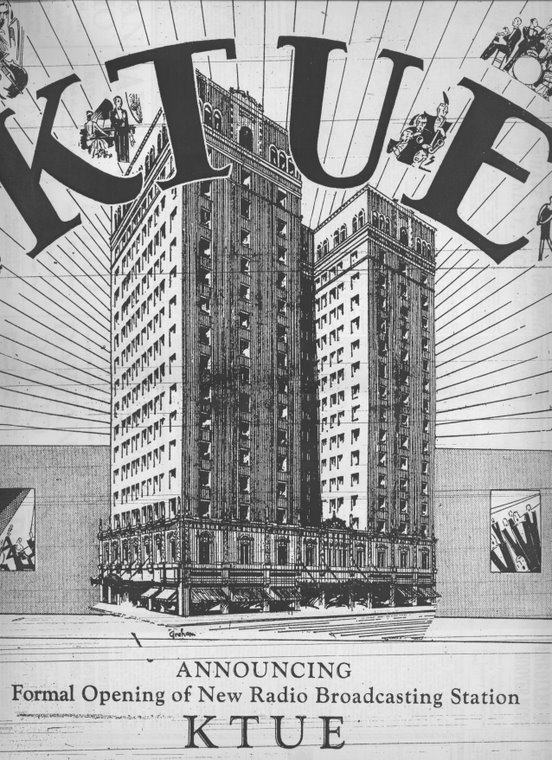
The image above comes from the archives of the Galveston Daily News on microfilm at the Rosenberg Library in Galveston.