Showing posts with label KILT. Show all posts

Sunday, June 1, 2014

Bill Young - RIP

As posted on Bill Young Productions -

a dominant force on the Houston radio scene for decades as talent, program director, production specialist and voice, passed early Sunday, June 1.

No obituary posted yet nor arrangements for a service.

I am in shock.

For those who do not know of Bill, I highly recommend his book.

UPDATE, ONE YEAR LATER:  BILL'S SON, SCOTT, HAS POSTED A TRIBUTE VIDEO ON YOUTUBE.  WELL WORTH WATCHING.

Also, see Scott's comment (# 14) here about his mom. 

Thursday, October 18, 2012

Russ 'Weird Beard' Knight - RIP

Mike McGuff broke the news the other day.  Here's a link to an obit in a Connecticut newspaper.

J.R. Gonzales chimed in with a post including a picture on his Bayou City History blog in the Chronicle.

Sunday, November 20, 2011

Another Historical Site of Interest

I always assume that many of the readers of this site are interested in the history of Houston beyond just the history of radio and television, hence the section on the sidebar devoted to History Links. Here's another site I just learned about, a personal reminiscence of growing up in Houston, primarily in the 50s and 60s. It's a great collection of photos and facts drawn from many different sources and tied together with a narrative. I particularly appreciate the fact that the sources are always documented; too many people assume anything they find on the web they can use as though it was their own without crediting or asking permission. (Yes, there is some material from this site on there).

For those just interested in broadcast history, there's material related to radio on the page entitled The End of the Journey. Material concerning Houston TV in that era is on the page entitled More Life in Houston. And some of Marving Zindler's career is detailed on the page entitled More Memories.

Monday, October 24, 2011

A KILT Tour - 1961

My correspondent, John Hill, has provided me with a wealth of information about KILT in the early 1960s, including a description of the equipment in use at this time. This is fascinating information for radio and equipment geeks and for everyone who worked in the McLendon building over the years, and so I am reproducing it here as John related it to me. Note: KILT first occupied the facility in 1957 and moved out in 1995. Although the building is still standing, there is no broadcast equipment or operation at this location now.

In 1961, the KOST-FM (now KILT-FM) transmitter, a Gates 5KW kit, was located in the engineering workshop on the 2nd floor of the McLendon Building at 500 Lovett Blvd. The antenna was a 4-bay horizontally polarized "V" array atop the tower immediately behind the building. The UHF (News COMM) antenna was also mounted on the tower.

We ran KOST-FM from 6-midnight (the minimum time to keep a license current) and John Trotter would sign it on as "This is KOST'n KILT in Houston. At the time, KOST was "costing" KILT but, Gordon McLendon had the foresight to know what a more significant role FM would play in the future of broadcasting.

There was a lot of old paperwork at the AM transmitter site that indicated it was the original site. The Collins 5V main transmitter, and the 1V back-up transmitter, were not original. Since the McLendon's were pro-Collins, I'll guess the Collins gear was installed after they purchased the station. The antenna phasing cabinet, between the two transmitters, was earlier vintage than the Collins transmitters, but had been well maintained. The board and turntables at the transmitter site were definitely 'early marriage.'

With regard to the studio layout at the McLendon building, as you looked at the building, there were two sides. KILT occupied the left side. (John believes an insurance company occupied the right half of the building). The receptionist, copy, sales and management offices were on the first floor. The stairway, near the left front lobby glass window before the atrium, went upstairs to the studios.

On the second floor, the break room faced Lovett Blvd. Following the hallway toward the back of the building, on the left, there was the newsroom, On-Air studio #1, another much larger studio that we called "Studio B," On-Air studio #2/Recording Studio/Master Control Room, Engineering Office, and Engineering Shop. The right side of that hallway was solid wall.

Between the Newsroom and Studio #1, there was a double glass window so that the on-air newsman and on-air DJ were facing each for "tighter" production. Both had their boards in front of them.

There was another double glass window between Studio 1 and Studio B, which had a table and chairs. The back wall of Studio B had a double glass window so those at the table (voice talent) were normally looking up and through the double glass to the recording engineer, who had a board in front of him. Or, when in Studio B, the on-air DJ would have eye contact with me as I operated the on-air board in #1, there again for hand signals, nods...whatever cue, for tighter production.

With all that glass, we had visibility from the Master Control Room to the Newsroom so that the on-air newsman had eye contact with whomever was at the board of the Master. (In those instances, lights were usually turned off in Studios #1 and B...otherwise field glasses helped!)

Occasionally, the on-air jock would be in Studio B and I would be operating the on-air board while the jock was (usually) doing an interview, such as the train wreck we had when Dean Martin and Jerry Lewis came in. (We finally had to break that off, get John Trotter back in the on-air #1 and tape the interview which took over an hour for a 10 minute "clean" interview...not to mention the tape edit time). All our interviews were...uh, interesting.?!!

Equipment-wise, the Newsroom had 5-Model 19 teletypes, 4 on line and a back-up, a Collins board, several rack mounted recorders, patch panels, a Collins cartridge playback machine and our UHF transmitter/receiver for mobile news unit COMM.

On-Air #1 had a Collins board, 4 Gates turntables, 4 Collins cartridge playback machines, a rack/cabinet mounted Schaffer remote control system (AM transmitter remote controls), an FM transmitter control panel, and a rotating cartridge bin. It was pretty much a full house.

Studio B was for voice work only; it had a table with several phased mics, two wall mounted play-back speakers and about a dozen chairs. It was more like a small conference room.

On-Air #2/Recording Studio/Master Control had a Collins board, 2 Gates turntables, 2 Ampex 361 recorders on wheels, 2 Collins ATC record/playback machines, two racks with patch panels, McIntosh audio amplifiers and two rack mounted receivers for on-air monitoring. (The DJ was listening to the AM receiver, rather than his console output, so we would have another indicator if we went off the air.) On the back wall we had a cabinet with a disc cutter, its McIntosh driver amplifier and our cartridge and tape erasing devices, all of which I'm sure are long since dust-biters.

The engineering office was rather small with a desk, chairs and filing cabinets.

In the engineering shop, there was the 5KW KOST-FM Gates transmitter and the controls for the natural gas powered Onan generator that was mounted inside the FM tower base behind the building. There was also a sizable work bench with various test equipment and spare parts bins.

We replaced the older cartridge machines and all studio mics with the relatively new Collins ATC's and Telefunken microphones that were removed from the M/V Mi Amigo, which was home to McLendon’s ‘pirate’ radio ship operation off the coast of Norway, when Radio Nord was disassembled at Pier 37 in Galveston. KILT was the recipient of a good bit of studio gear.

Note: Although it was not a Houston radio station, its connection to Gordon McLendon and KILT warrants more information; for more on Radio Nord and it’s successor ship, see:

Radio Nord in Wikipedia

Pictures of Radio Nord, more pictures, and still more pictures.

Radio Atlanta in Wikipedia


Note: the Soundscapes site says the ship was outfitted at Copenhagen; John was told it was outfitted at Galveston by KILT transmitter supervisor Frank Maher. This was before John joined the station. Although both operations were referred to as 'pirate' radio stations, both actually operated under the laws of that time.

See also the KILT staff directory, the story of Bob Horn/Bob Adams, and the Hooper Ratings for this era.

Saturday, October 15, 2011

Red Jones - KILT

Another KILT Ex has checked in.

Red Jones worked for KILT from 1957 to 1962, with a stint as Program director from ‘59 to ‘62. He got out of the Army in September, 1956, and joined KXYZ doing evenings in November of that year, working with Chuck Dunaway and Larry Kane among others. About a month after KILT signed on in March, ‘57, Don Keyes hired Red to do overnights but he soon moved up to Noon to 3 pm. After Keyes left to go back to Dallas, Jack Sharp was PD; Red replaced him in 1959 and moved to 3pm-7pm for the rest of his time in Houston.

Red says when he made PD, Bill Weaver told him ‘You run the upstairs and I’ll run the downstairs’ and he never went back on his word. As far as he remembers, they never had staff meetings - everybody did their own thing and it paid off. They had great Hooper and Pulse numbers and a dominant staff including the likes of John Trotter, Rob McLeod, Bob Presley, Bill Slater, Joel A Spivak., Cecil Tuck, John Land, and Thom Beck. Glen Cook was CE and Hank Poole was production engineer. It was fun times according to Red (and fun to listen to, too).

He was invited to interview for a gig at WABC, New York, and did. He didn’t get the job but when KILT heard about it he was ‘eased out.’ News Director Cecil Tuck took over as PD for a brief spell.

Red was hired by Kent Burkhart, another KILT alumnus, as PD of WQXI, Atlanta, and spent the rest of his career in Georgia radio. He’s retired now after 63 years in radio and living in Georgia. He was inducted into the Georgia Radio Museum and Hall of Fame in 2008 and recently celebrated his 80th birthday, still going strong.

His Georgia Radio Museum and Hall of Fame page (a much more impressive site than out TRHOF) contains more biographical information about his early years in South Texas and Austin and his stint with AFN in Germany before coming to Houston, plus much more about his long career in radio in Georgia, in a collection of clippings from his career.

The picture above is from the GRHOF site.

Thursday, October 13, 2011

A KILT Footrace

J.R. Gonzales' Bayou City History blog in the Chronicle has posted a story about a big promotional event staged by KILT in the Astrodome in 1969 between Roy Hofheinz, owner of the Astros, and Mayor Louie Welch, a foot race to promote physical fitness and the KILT Jog Corps.

The Great Indoor Contest


It's a great little story about an event I never had heard of with pictures of Hudson and Harrigan and probably some other KILT staffers of that day.

Saturday, June 25, 2011

Bob Horn/Philly Bandstand - Bob Adams/KILT

This is a story I only recently learned of, a small part of Houston radio history, brought to my attention by John Hill. It’s the story of how the creator of Bandstand, as in American Bandstand, wound up a deejay on KILT, then an ad agency and bar owner in Houston.

The details have been spelled out, not without contradictions, in several accounts online and in a book, Bandstand: The Untold Story, by Stan Blitz.

Briefly, Bob Horn was a popular deejay on Philadelphia’s WIP in the late 40s with a late nite program called ‘C’mon And Dance.’ He was hired away by rival WFIL to create a similar show on that station which became known as Bob Horn’s Bandstand. He also got his first taste of TV, hosting a game show that bombed.

It’s not clear who’s idea it was but the late nite radio show was given a television spinoff on WFIL-TV, also called Bob Horn’s Bandstand, which featured Horn introducing film clips of artists performing their songs and occasional interviews with artists passing through Philly. It bombed, and was taken off the air after a month and the station started running movies in its stead.

Conflicting claims have been made as to whether station management or Horn himself suggested the show be moved to a larger studio and teens invited in to dance on-air, but the idea went over with management and a new version of Bob Horn’s Bandstand premiered on WFIL-TV on October 7, 1952, heavily promoted by the radio and TV outlets and their parent, the Philadelphia Inquirer. Teens were slow to respond on the first day but by the third day, it was said there were a thousand waiting to get into the studio and Bob Horn’s Bandstand was on it’s way. The first advertiser was Earl ‘Madman’ Muntz of Muntz television fame.

Over the next four years, the show garnered as much as 60% of the daytime Philly TV audience according to some accounts and caught the attention of TV executives elsewhere. There was even talk of going national. Early on, the teens danced to artists like Joni James and Frankie Laine but as the music changed during the decade, so did the show. At times it ran as long as two hours a day, five days a week, all done live.

Then in 1956, Horn’s career hit a couple of major road bumps. First, the Philly PD, the Inquirer and WFIL-TV were conducting a month-long drive against drunk driving and Bob Horn was caught driving drunk and assessed a $300 fine. Then he was involved in a minor accident driving the wrong way on a one way street, resulting in some injuries. He was adjudged intoxicated, but not enough to impair his driving, and his insurance company paid $100,000 in claims.

In addition charges of statutory rape were brought against him by a teen-aged dancer or would be dancer on the show. Horn’s family has said there was an extortion attempt that preceded the charges and the prosecutors knew of it and cooperated in amassing the money for the payoff but took the case to court anyway. A first trial resulted in a hung jury while a second trial found Horn innocent.

But he was finished in Philly radio and TV. He had been taken off Bandstand and a producer had filled in as host for a short time while the station sifted through it’s other deejays for a replacement, finally selecting a 26 year old named Dick Clark, who had to be given a crash course in rock ‘n roll. A year after taking over for Horn, Clark pitched the show to ABC which picked it up for a trial run then took it on as a permanent fixture of their afternoon schedule, renaming the show American Bandstand.

Meanwhile, Horn was out of work when an old employer, Gordon McLendon, called. He had heard of Horn’s predicament and offered him a job at his new station in Houston. Horn accepted and made the trek across country, changing his name to Bob Adams for his new career.

According to the schedule published in the Chronicle, March 14, 1957, Bob Adams was on the air from 9pm to Midnight on the first day of the new station. In an accompanying article, Bill Weaver was quoted as naming Bob Adams as one of the new announcers but also mentioned other deejays who would be joining the staff, including Bob Horn of Philadelphia. One of the online accounts of Horn’s life says he didn’t get to Houston until July of 1957. It’s not known if the Chronicle reporter misunderstood Weaver or if someone else began the use of the name Bob Adams on KILT, but it didn’t matter much, because Horn/Adams didn’t last long as an announcer on KILT. His East Coast style didn’t sit well with KILT’s audience and he was taken off the air and put in sales before long, becoming according to one account the top producer in the KILT sales staff. It was said the audience may not have liked his sound but advertisers loved hearing his stories of how he created Bandstand.

Eventually he left the station and opened his own agency, Bob Adams Associates, credited with creating Houston’s first Midnight Madness Sale. He also bought a ranch in the country and a bar in Bellaire called the Town and Country Lounge. John Hill’s contact with Adams came when he visited the recording studio that John ran at the back of the second floor of the McLendon Building at 500 Lovett Blvd. to record spots for his clients. He preferred to use Bob Presley and Rob McLeod to voice his spots.

Bob Adams life seemed to be going very well in Houston until the summer of 1966 when he suffered a heat-stroke induced heart attack while mowing his lawn and died. He is buried at Forest Park on Lawndale where his simple grave marker includes the epitaph ‘Bandstand.’

The History of Rock website has the most thorough account of Horn’s career, including photos, reproductions of newspaper clippings concerning the trials, and a shot of the grave marker. The original article is in bold while additions to the story credited to Peter Horn, Bob Horn’s son, are in un-bold typeface.

Philadelphia’s City Paper did a story on American Bandstand for the fortieth anniversary a few years back including some references to the early incarnation of Bandstand, and this article in the Tucson Sun introduced me to Stan Blitz and his book, which I have not seen.

I’m hoping some readers of this blog who were around back then, those who were just listeners or old radio pros or advertisers, can provide some more details of his career in Houston. I wonder, for instance, if any of the local TV teen dance show hosts, Larry Kane, Bob Byron, etc., knew of his role in the creation of the genre and ever conferred with him and where his bar was.

Thursday, June 9, 2011

KILT Staff DIrectory

I have been corresponding with John Hill, CSRTE, an engineer at KILT from 1960 to 1964, who has been filling me in on a lot of facts and data from that era. He lost almost all his family, musical career and radio memorabilia thanks to tropical storm Claudette in 1979 and only a few pieces survive, among them a staff directory. I have organized it by department instead of alphabetically and added a few facts on some of the personalities I have from my own research.


Beverly Bales - Secretary to GM
Sabra Hall - General office
Dino Thompson - Receptionist

Bruno Leonardt - Sales Manager
Paul Fielding, Dickie Rosenfeld, Charlie Trub and Ted Van Brunt - Sales
Sue Reid - Sales Secretary
Sandra Arnold - Traffic
Barbara Van Horn - Continuity

Glenn Cook - Chief Engineer
John Hill - Recording Engineer
Tim Milton Kingston - Transmitter Engineer
Frank J Maher - Transmitter Superintendent

Rob McLeod - Program Director
Chuck Benson - Assistant to the PD
Gene Kelly, Dick Lahm, Bob Presley, Bill Slater, John Trotter - Disc Jockeys
Milton Allen (Graves) - Weekend Disc Jockey

Cecil Tuck - News Director, Program Manager
Thom Beck - News Editor
Dick Dobbin, Rick Eiser, Gary Fuller - Newsmen

Reed Robinson, Larry Thomas - Porters

Missing from the list was Bill Weaver, General Manager.

Also missing were two other transmitter engineers, Bryan Burne and Sam Warren, working at the transmitter on West Rd., west of the Dallas highway (US 75/I-45).

As John remembers it at the time of this list, the air shifts were: Gene Kelly, Midnight to 6 A. M.; Chuck Benson 6-9 AM; Rob McLeod 9-12 Noon; Bob Presley from 12 Noon-3 P. M. (with his KILT Pool & Patio show); Bill Slater 3-6 P. M.; "Honest John" Trotter 6 PM.-Midnight.

I had in my notes from the Chronicle that Trotter had been brought in to do mornings in January, 1961, replacing Joel A. Spivak, I believe, but was demoted to the 6 to Midnight shift as a way of suggesting it was time for him to leave. He did shortly thereafter for KEWB in Oakland, CA. In 1965 he was one of the original group of Western Gentlemen who brought country music radio to WJJD, Chicago and later he worked at KBOX, Dallas. He died in Abilene in 1976 and was inducted into the Country Radio Broadcasters DJ and Radio Hall of Fame in 1996.

Bob Presley went on to a long career in Houston radio at KPRC and KILT.

Bill Weaver left KILT to work for Cap Cities Broadcasting in 1966; he had married his secretary. He touched base with John in Nashville in 1982 at which time he was Executive Vice President at WWCO, a 24 hour station in Waterbury, CT. He died in retirement in San Antonio in February, 2008.

Both Bob Presley and Bill Weaver were inducted into the Texas Radio Hall of Fame in 2003.

Milton Allen (Graves) left for WNOE, New Orleans, one of McLendon's wife's stations; Chuck Benson left for WGR in Buffalo, NY, followed by Bill Slater. John left shortly thereafter, too. After WGR, Bill Slater went to KFWB, Los Angeles (64-65), KRLA (64-67), and KPPC (69-70) according to a Los Angeles radio website. He died in 2002 at age 67 and there were probably some other radio gigs. I have not had any luck finding more information about the other personalities and will appreciate hearing from anyone who can fill in the details of their careers.

See also the Hooper Ratings for the Houston market from this era, courtesy of John. There will be more posts on the blog soon based on the communications I'm having with John.

Updated 7/29/11.

Friday, May 20, 2011

Joel A. Spivak, RIP

I'm a little late with this but just recently came across the news myself.

The Washington Post obituary.

This is not a name familiar to many today, probably, but if you were around Houston radio in the late 50s early 60s, especially if you were a teen and listened to KILT, you'll remember Joel. I remember him doing evenings on KILT; he was my favorite jock of all the voices brought to town by Gordon McLendon when he purchased KLBS. Later he did mornings before being demoted again to evenings and then leaving town. I believe he left once in the late 50s to join Eliot Field at KFWB in Los Angeles from what I've read. He was low key, funny, weird, sardonic, in an era before boss jocks. There's one anecdote in the obit about his career in Houston and I'll have a few more in an upcoming article from a former co-worker. I remember the time he joined the Salt Grass Trail Ride, broadcasting his show each evening from along the trail, one night from the studios of KWHI, Brenham, after it had signed off. I lived to hear his faux commercials, especially a running series about Polly Pelham Pizza - "look for it wrapped in old newspaper in the freezer section of a grocery near me."

ETA:  Here is another obituary and resume from the Campaign for Tobacco Free Kids, which Spivak worked for in his final years.  The link includes not only more detail on Spivak's antics in Houston but also an embedded link to an extended excerpt from Marc Fisher's Something in the Air:  Radio,  Rock, and the Revolution That Shaped a Generation with much about the launch of Top 40 radio, Todd Storz and Gordon McLendon.  The excerpt is worth reading even if it didn't mention Spivak or KILT.

Monday, April 26, 2010

The Beatles in Houston and KILT

Postcards from Texas on Houston's 55 has done a feature on the Beatles only appearance in Houston, in August 1965. They talked with a couple of sisters who got to go to the show and interviewed Texas Radio Hall of Fame member Chuck Dunaway, who grew up in Houston and started his career in the Houston area and who was a disc jockey at KILT at the time, the station which sponsored the concert. Chuck reveals why Ringo Starr was so eager to come to Houston.

The show will be rebroadcast this Friday, April 30, at 1:30 pm or you can watch Part I of the feature online in this clip and Part II here.

Friday, August 28, 2009

The 1950s Part II - KILT, KILE, Galveston, KRCT,Pasadena

Updated 6/18/11 to add information about the change of ownership of KRCT.

Around the end of February, 1957, the McLendon Investment Corp. completed purchase of KLBS from the Howard Broadcasting Corporation for $535,000, thus repurchasing the station Trinity Investments had owned from 1952-1954. It was said to be the largest cash transaction in Houston radio history. Glenn Douglass, General Manager of KLBS, told the Chronicle there was much speculation on the part of the staff about what was to happen as McLendon was known for making wholesale personnel changes when he took over a station. The line-up included Bob Yongue doing mornings, Bob Gwyn, Dave Chase, Mark Noble and Mike McKay. The station was airing a number of paid religious programs daily including Rev. Lester Roloff at 7am, an Assembly of God program at 9am, Unity Viewpoint at 9:15 and a Dr. Weber from 9:30 to 10am.

On the fifth of May, Jack Harris, GM of KPRC-AM/FM/TV announced the radio stations would begin Houston’s first regular stereo broadcasts that week, from 9:05 to 10pm, five nights a week. Listeners were to tune one station to the AM, another to the FM to get the stereo effect. KPRC-FM PD Ronald Schmitt had secured more than 80 hours of programming that would include music outside the regular Classical fare of the FM station.

The same day, Bill Weaver, a new GM at KLBS, told the Chronicle changes at that station would be coming in a couple of weeks. Weaver had been brought in from KTSA, San Antonio. The big changes were announced just a week later on May 11 and occurred on May 14, a Tuesday, although the new calls, KILT, appeared in the Chronicle the previous afternoon.

The new line-up included Eliot Field from Boston doing mornings, Bob Stephens of Miami on 9a-12N, Art Nelson from Dallas on early afternoons. Don Keyes of San Antonio was the Program Director and did afternoon drive. The newspaper schedules showed Buddy McGregor, 6-9pm, and Bob Adams, 9pm-12M. Other deejays announced included Tom Fallon of Kansas City, Mike Whalen and Bob Horn of Philadelphia and Joe Long of Knoxville as News Director. Mike McKay and Mark Noble were the only holdovers from the old staff; McKay did overnights while Noble was not listed in any slot for several weeks. All the religious programming was dropped.

A full page ad in the Post was designed to look like a Wanted Poster with six pictures bearing only serial numbers and warned Houstonians to be on the lookout for

‘...these men. They are about to steal the Houston radio audience. These men have begun operations on Color Channel 61 Today. These colorful characters are highly entertaining. Their deep resonant voices will ‘con’ you into listening to KILT, Houston’s new radio voice, around the clock every day.

REWARD: Twenty four full hours of daily listening pleasure
.

After Field left for a gig in Los Angeles, Keyes took over as morning man.

The same week of the big flip, Tim Nolan moved from the job as morning host on KXYZ to the same post at KPRC where he soon was to be teamed upwith Bob Byron, a KLBS-ex, to form Houston’s first duo team in morning drive, Tim and Bob; they were to be together for more than a decade.

For more on my memories as a kid of listening to KLBS and KILT, see my ‘Thanks for the Memories’ segment here:

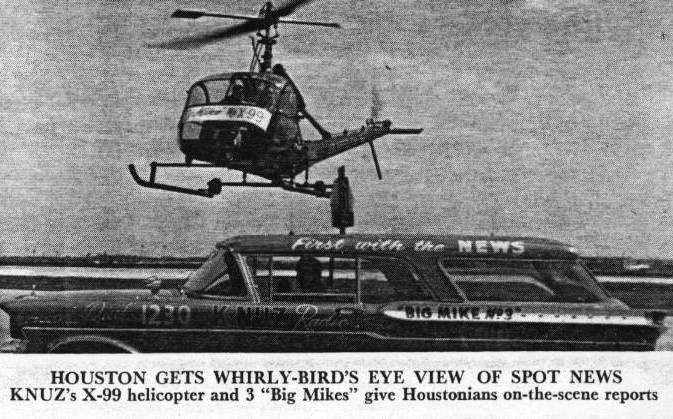
KNUZ, expecting tough competition from the new station, had just purchased a helicopter and ran ads promoting itself as Houston’s only radio station with wings and touting its top ranking. The helicopter had just been put in use when some heavy flooding hit the area and was used in exclusive reports.

Toward the end of the summer a group of Galveston businessmen completed the acquisition of KLUF from it’s founder and owner George Roy Clough and his sons. Clough, whose name was pronounced cluff, hence the call letters, was, even by his own admission, a contentious man who made many enemies and brought a lot of attention to Galveston, not all of it favorable. The son of a telegraph operator and former race car driver, Clough’s knowledge of radio had led him into the field but by this time he was serving as Mayor of Galveston, said to have run initially because he was angered over a city water bill and vowed retribution. He served two terms as Mayor but lost a re-election bid for a third term and a subsequent try for city council. For years he operated a radio and television shop next to his home at 34th and Ave P. He died in November, 1966.


The new call letters for the station were KILE and it debuted on September 2, 1957, at 6am. According to GM Robert. L. McClellan there was all new equipment and programming. Tim Lewis was News Editor and the staff also included Bill Bance, Tom Beck and Warren Anderson. The morning show was called Hit the Deck while an afternoon program was called Teen Tempos. Most old-timers in the Houston/Galveston area will remember KILE as a Top 40 station and it has had many alumni working in Houston radio.

The call letters of this station are now KHCB and it has recently been relicensed to League City.

The first week of October, 1957, KRCT began broadcasting from new studios at 227 East Sterling in Pasadena. The station always ran lots of ads in the Chronicle with the first concerning the changeover appearing on October 2 proclaiming a Grand Opening going on the 3rd thru the 6th with everyone invited to stop by to visit the new facilities. $1000 worth of door prizes were to be given away. The on-air schedule included Hal Harris from 6a-10a, Gabe Tucker, formerly of KATL and KLEE from 10a-1p and Sleepy Bob (Bob Everson) from 1-5pm. Leroy Gloger liked to claim that 650 was Houston’s only ‘clear channel’ station but the clear was assigned to WSM, Nashville, the Houston station was always limited to daytimes only. Over the years the station was also promoted as the ‘Voice of Labor.’ The format was always country.

An application for approval of the sale of the station was announced November 18, from W. D. Christmas to John H. Touchstone and Leroy J. Gloger for $175,000. Touchstone had been a 7 % owner; he and Gloger were to be equal partners under the new ownership. The transfer was approved a month later. In March of 1959 they sought approval of a transfer of the license and CP from Bay Broadcasting to Industrial Broadcasting noting this was a corporate change only, not a change of control. This was granted in mid-May. Touchstone was President, Gloger was Vice President and General Manager.

KRCT was to become KIKK in 1961.

The image above is from the Galveston Daily News
.

Monday, April 27, 2009

Other Broadcasting related discussions online

EDITED 4/13/2014

In addition to the articles sometimes published in the Bayou City Houston blog in the Chronicle relating to broadcasting, there have been many discussions on HAIF, the Houston Architectural Information Forum, about radio, TV, and personalities. There's a link to the Historic Houston forum on the sidebar but some of the discussions have also taken place in the Houston and the Media Forum. Here are some of the threads. In some cases relatives of the personalities or participants in the shows discussed have contributed information but mostly it's memories (and sometimes, a few facts).

Radio related threads

KIKK

Tim and Bob, KPRC morning team

Alvin Van Black, KPRC and KTRH talk show host and KTRK-TV reporter

Paul Berlin, other KNUZ jocks, and the Larry Kane show on Channel 13

A KRBE Promo Stunt from the 1970s


Houston Radio, 1986, from an Astros Media Guide


TV Related Threads


A Thread on Houston TV Talk Shows over the Years

Larry Kane and Other TV Dance Shows

A Larry Kane Show clip

Don Mahoney and Jenna Clare, children's show hosts

More on Jenna Clare

Walter Cronkite

Kitirik

A Kitirik clip

Past TV Anchors

Ray Miller's Passing

TV Reporters

More on Past TV Personalities

KVVV-TV, Channel 16

Vintage Houston TV Commercials


A thread about Houston TV station sign-offs


Texas - the NBC soap, 1980s

Houston College Bowl TV show


In addition to these threads which have a historical connection, there are many threads on HAIF on the Houston and the Media board about broadcasting today, format changes, personality comings and goings, and other matters.


Some Threads on Music, Artists, Venues and Concerts


Liberty Hall

Bands and Orchestras from years gone by


Don Robey's Peacock Records

Rock Concerts of the 60s, 70s, 80s


Utah Carl


The Catacombs

P. J. Proby's early career in Houston

Famous Locations that no longer exist
(mostly country nite clubs)

Magnolia Gardens, on the San Jacinto River

Saturday, December 13, 2008

The 1940s - Part 7 - KLEE


If KATL had been a something of a stealth entry onto the Houston radio scene the next new AM station in town was to make quite a splash. In early 1946, Houston businessman W. Albert Lee had decided to make a foray into broadcasting. He received a permit in May 1947 and got his station on the air Saturday, January 31, 1948, timed to coincide with the opening of the Fat Stock show that year. Studios were to be in the San Jacinto Hotel, which was being remodeled, but work went faster on a similar project at the Milby at Travis and Texas and the studios wound up there. Lee put a 62 foot Translux animated sign on the exterior of the hotel, the first of its kind in Houston, a smaller version of the famous one in Times Square in Manhattan. As he had done with 2 of his hotels and was to do with his television station less than a year later, Lee used his name for the call letters. KLEE operated at 610 kc with 5000 watts from a 4 tower array. Hilton Waldo Hearn, Jr.'s 1971 Masters Thesis on Lee placed the transmitter on Airline Drive but a Chronicle story placed it on the Dallas Highway. John B. Hill, an engineer at KILT from 1960-1964 who started as an engineer at the transmitter says it was on West Rd., just west of I-45, across 45 from Aldine High, which sits near the intersection of Airline at West. Lee still owned the station at the time of his death in late November, 1951.

As part of the build-up to the launch of the station, Lee turned on the Translux sign two weeks before broadcasting began, staging a big ceremony. The sign was on the Texas Avenue side of the Hotel, facing Jesse Jones’ Rice Hotel but was to be turned off at 10:30 every night. There were big stories in the newspapers almost every day in the week leading up to the launch.

KLEE received front page coverage in the Saturday morning Houston Post on the day the station signed on and the station placed a full page ad concerning the opening ceremonies scheduled for 5pm. The ad included pictures of station personnel and facilities, but has been difficult to reproduce from the microfilms or I would post it here. Gene Autry and his entire troupe were to be on hand, as well as actor Michael O’Shea, Virginia Mayo, Wild Bill Elliot, Albino Torres and his Orchestra and others. There was to be a special live, remote broadcast from the Fat Stock show, and, in the midst of all that, coverage of that day’s election returns on a vote on the subject of zoning for the city of Houston (the zoning proposal lost - duh).

Lee had purchased an 8000 disc library and subscribed to a music transcription service but the first song aired on the new station was performed live: Gene Autry's Cass County Boys played 'The Eyes of Texas,' punctuated by pistol shots and cries of 'Yippee,' to open the ceremony and Autry later sang his signature song ‘I’m Back in the Saddle Again,’ the first song sung on 610. All the show business people stuck around for more appearances on the station for a couple of days, with live broadcasts in one of the big studios starting at 6:10pm, open to the public.


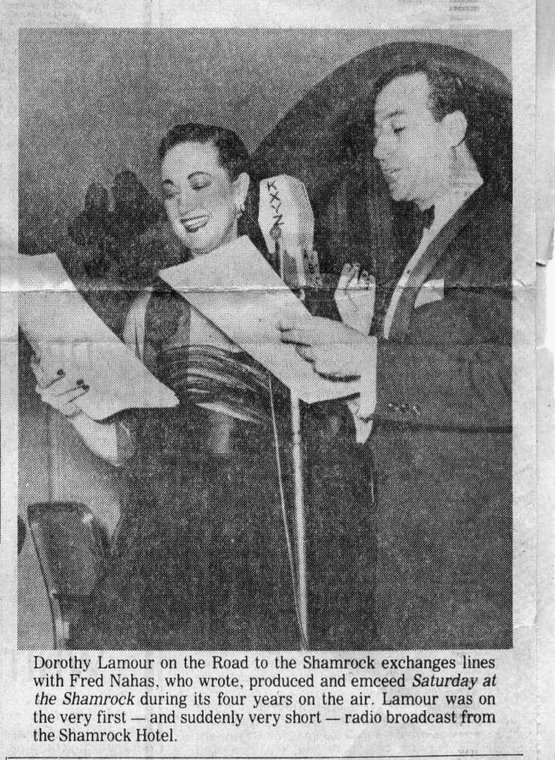
Lee received congratulatory messages from many of his famous and rich friends plus his radio competitors, including Jesse Jones, the Hobbys, Glenn McCarthy and Coke Stephenson. Fred Nahas, who was to become a Houston radio legend in his own right, wrote that he was most impressed that Lee had four ministers pray at the dedication ceremony, a Rabbi, a Catholic priest, a Greek Orthodox priest, and a Methodist minister. Nahas had just launched Houston’s first Muzak-like piped-in music service.

The Chronicle ran a full length column in the Sunday paper on the launch under the headline 'Crowds view KLEE official opening here.' Ray Bright, Commercial Manager of KTRH across the street, had been hired as General Manager. WInthrop 'Bud' Sherman of WOC, Washington, DC, and the Mutual Radio Network had been hired as Program Director. He had also worked at KNOW, WBAP, WACO and KMOX. Paul Huhndorff was picked as the chief engineer; he would go on to put KLEE-TV on the air for Lee in less than a year and stay with the TV station when it was sold to KPRC. The chief announcer was Charles Rashall whom the Chronicle article said 'formerly was heard on coast-to-coast shows originating in the film capital.' Lee's biographer credits Lee with hiring a young Dick Gottlieb out of Texas A&M to do play-by-play of high school football games on Thursday and Friday nights for $25 per game, thus giving Gottlieb and entry into Houston radio. He was to go on to serve as an off-camera announcer on KLEE-TV and stay with the television station when it was sold, becoming known as 'Mr. Television' in Houston for the first decade and a half of Houston TV. However, the claim has also been made that Gottlieb first worked in Houston for Roy Hofheinz' KTHT.

Lee was apparently pretty difficult to work for. He went through 3 program directors in 3 years with Sherman leaving just 3 weeks after the station signed on. Ted Hills, who had been program director of early Houston radio station KFVI in the 1920s and KTHT in the mid 40s was one of the PDs. Without a network affiliation the station had to rely on local advertising sales completely for revenue. According to his biographer Lee attempted to motivate his sales staff but instead drove them away. He was known to fire announcers on the spot for an on-air comment he didn’t like.

Even before KLEE was on the air, Lee had traveled to the East coast, negotiating for talent to appear at the Rodeo, and been exposed to television. He came back to Houston determined to put a television station on the air and filed for a permit on October 8, 1947. The announcement of his intentions appeared in Television Magazine in November, 1947, and that same month in Houston Magazine. Approval by the FCC was to take only 3 months with approval on January 30, 1948, the day before his radio station signed on, although Lee apparently didn’t get the news for a couple of days. Studios were to be in the Milby Hotel with the radio station and the transmitter on South Post Oak near the Pin Oak Horse stables. KLEE-TV was to sign on New Year’s Day, 1949, Houston’s first television station, on Channel 2. There's more on KLEE-TV in the TV section on the sidebar.

The year following Lee’s death, KLEE-AM was sold to Gordon and B.R. McLendon’s Trinity Broadcasting of Dallas who changed the call letters to KLBS and made it a part of his Liberty Broadcasting System. McLendon announced plans to move the headquarters of the network to Houston and use KLBS as the flagship station, according to McLendon’s biographer, but they fell apart when McLendon had to give up the baseball game recreations which formed the backbone of the network programming. According to the History of KLIF website, McLendon owned the station from 1952 to 1954 and repurchased it to flip it to KILT in May, 1957. The studios were still located in the Milby Hotel when the call letters changed, but later moved to 500 Lovett Blvd. in the Montrose area where they stayed for almost 40 years. KILT has been the call on 610 ever since 1957. The station was a Top 40 station for many years and flipped to Country in 1981, then to Sports around 1995.

When I first read of the supposed intentions of moving the headquarters of Liberty to Houston I was skeptical. I have always thought of McLendon as a Dallas broadcaster and it was difficult to even imagine him abandoning Dallas and given his penchant for promotional hype, I thought he was probably just blowing smoke. However it becomes more believable when considering that, according to McLendon's biographer, Ronald Garay, Houstonian Hugh Roy Cullen had invested $1,000,000 in Liberty in August, 1951, to help prop it up. Cullen was considered by some the richest man in Texas at the time and had been expanding his influence politically. He had asked an aid to look into investing in Liberty but canceled the due diligence after just one meeting with Gordon. The two men had similar political ideologies and found they admired each other very much. Cullen extended another loan of $175,000 the next year as the network was collapsing and was one of the major creditors suing for a share of the assets after the collapse (the other was B. R. McLendon).

The Houston Post typically found a way to put it's own radio station on the front page during all the build up to the launch of KLEE. On Thursday, January 29, a front page story pointed out KPRC would be celebrating 20 years of being an NBC affiliate the next Thursday with a special concert at the Music Hall and on Friday, January 30, another front page story advised riders of the Houston Transit Company buses that they would soon be among the first in the nation to hear music as they rode the buses. In an experimental program sponsored by KPRC-FM, special receivers would be installed in buses to allow reception of KPRC-FM’s signal (and presumably no others). The receivers were eventually installed in 250 buses and the ‘experiment’ lasted until 1950.

Wednesday, December 3, 2008

More KILT Memorabilia

Blog reader Charles Fairchild sent me this link to a flyer promoting KILT's Go Texan Hootenanny in 1966 (PDF file) along with an explanation:

"I attended that show when I was 12 because our family was friends with Terri Sharp's family. I looked her up recently living in Kerrville
and we had lunch and she is still writing and has a gold record for a
song Hank WIlliams Jr recorded called Cant Blame the Train. She also
wrote some songs that Don McLean recorded. Anyway while I was looking her up I found that program somebody had put on the internet under a google search of "Terri Sharp, a love that will last" which was her hit in 1966 and I sent her a copy. I think back then, KILT started using the rodeo for musical acts which has become a big event now. But in 1966 all those acts performed two shows in one day I think, each singing two or three songs depending on their ratings.

I got interested in looking up the old deejays listed on the program
which led me to your site. We had a dog named weird beard, all white with a black tuft on his chin (Russ Knight, I think he used to
broadcast from his house if I remember correctly). And I remember
staying awake with a transistor radio under my pillow listening to
Alex Bennett, who is on Sirius radio now according to the link on your
site to his. I guess I was hooked early on to talk radio, and later
was an avid listener of Alvin Van Black, Howard Finch and now there
are lots of them. I pod cast Dennis Miller but don't have time to
listen to all of them. Also a news caster from the 80s at KTRH named
Howard Phillips is in a Barbershop chorus I sing with these days.

Thought you would like it, and glad to help your interesting website,
I sure wish I could go back to Houston in the 50s and 60s for a day.

Charles"

Thanks Charles, I'm sure other blog readers will get a big charge out of this.

UPDATES: James Bond 008 used a fake British accent and became Alex Bennett, talk show host before leaving KILT. Alex Bennett at Wikipedia. Alex Bennett's website.

Bill Young became the long time and very successful program director of KILT-AM/FM and since leaving has run Bill Young Productions.

UPDATE 2: The Coastliners have been identified in a discussion on another forum:...'a group from Baytown/Lynchburg that came very close to hitting the big time and had several regional hits. They opened for many of the top rock acts that visited Houston in the mid-to-late 1960s. They were about the only white group that Don Robey signed for his label.'

Friday, November 21, 2008

KILT Historical Photos


One of the biggest stories in Houston radio in the 1950s was the Top 40 war between KILT and KNUZ. Actually, the war was over pretty fast. Gordon McLendon took over KLBS in May of 1957 and flipped the call letters to KILT on May 14th, launching a whole new air staff and his highly successful Top 40 format from KLIF, Dallas, and KTSA, San Antonio. According to Ronald Garay’s Gordon McLendon, The Maverick of Radio, within one month, by June, 15, 1957, all three rating services - Hooper, Trendex and Pulse - showed KILT had moved from last to first place in the Houston market. Garay says the Top 40 format worked better on KILT than it had on KLIF and Don Keyes once wrote that McLendon basically made no mistakes in his second foray into Houston.

As was typical of McLendon stations there were constant, attention getting promotions. There was the Treasure Hunt which, as it had in Dallas, led to people digging on private property. Houston listeners also heard the ‘Oops, sorry’ apology for some obscenities supposedly aired accidentally on the station during live coverage of a news event.

But apparently the most attention getting promotion, even garnering national news notice, was the flagpole sitter, who was none other than program director and afternoon drive DJ Don Keyes. Keyes was to work for McLendon for years, serving as National Program Director of the McLendon group after graduating from KILT. Soon after taking over KILT, McLendon had ordered Keyes up on a flagpole positioned in the parking lot of the new Gulfgate Mall which also happened to be situated next to the first freeway in Houston, the Gulf Freeway, now I-45 South. Keyes was to stay there until KILT beat KNUZ.

Google is in the process of uploading the photographic archives of Life Magazine, about 10 million photos, and I have discovered a couple of photos of KILT in June, 1957, one of Keyes, clad in a kilt, scaling the tower.

Somewhere I have read Keyes retelling of the story of this promotion but I cannot find it now. Keyes died in 2006 but shortly before he had posted some memoirs on line and I thought that was where I read it but apparently not.

Nevertheless Keyes' memoir is a great read.

Another photo from the Life collection shows new KILT morning DJ Elliot Field in the studio, flanked by a horse. According to the caption, Field had offered a pair of shoe laces in trade for anything of value and the winning offer was that 4 year old mare.


Note the plaid tie and plaid sport coat. I believe those are electrical transcription devices in the background. This photo will be of special interest to KILT alumnae. Unless I’m mistaken, that board was was still in use at the KILT studio at 500 Lovett Blvd, which McLendon built, up until the station moved to Greenway Plaza in 1995. It was in the News Production studio which may have been the original air studio. I wouldn’t be surprised if that Ampex in the background was still in use, too. I don’t know what McLendon’s policies were regarding equipment but LIN Broadcasting, which owned KILT when I went to work for it in 1983, did not believe in spending money for new equipment (or salaries); the KILT engineering staff did an amazing job of keeping ancient equipment working.

The Google Life Magazine Photo Archives

Edited 5/3/2014 to add:  Galvestonian Bill Cherry's feature story that brings up the flagpole sitting incident.

Wednesday, January 23, 2008

Gallery III - Memorabilia

A collection of miscellaneous bumper stickers.


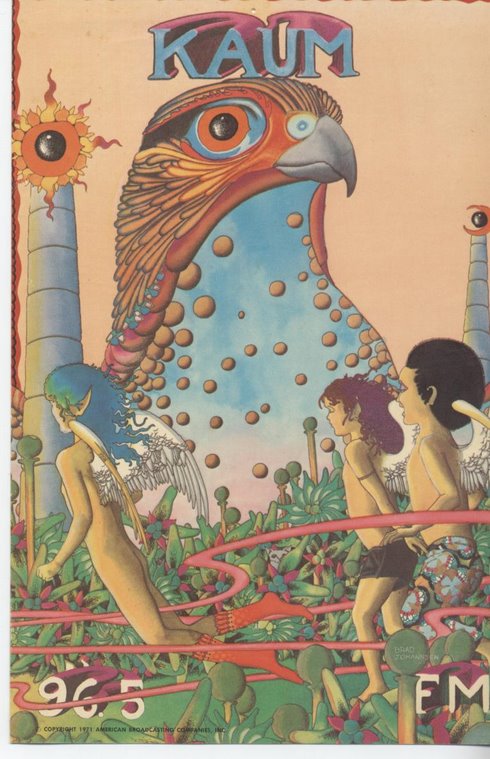
ABC-FM was running Love FM on their 7 FMs, a taped album rock format, but flipped them all to live and local with new calls in September, 1970. In Houston KXYZ-FM flipped to KAUM. The artwork and calls were determined by ABC. Houston got the coolest artwork. The bumper stickers came in about a half dozen different colors.

The Air Corps was a locally conceived, short-lived positioning first used in the fall of 1971. This is actually a billboard card; the bumper stickers were longer and not as tall.


This was when the station was known as Rock 'n Stereo, beginning in 1972. The positioning and design were selected by ABC-FM.


A reverse window sticker for Majic 102, KMJQ-FM


Calls very briefly used on 100.3, KILT-FM


The calls were officially KIKK-FM.

OUT OF TOWN


KMKS-FM, Bay City


KMZK, Fort Worth, ca. 1981, owned by Taft Broadcasting of Houston at the time.

A FEW MISCELLANEOUS RADIO SURVEY SHEETS

A KLBS Survey from February, 1955

A KXYZ survey from May, 1956

A KXYZ survey from November, 1956

A KXYZ survey from January, 1957

A KILT survey from August, 1957

A KTHT Hit Parader survey from May, 1961

More surveys from Houston radio stations (text only) can be found here.

Monday, July 16, 2007

KILT (KLEE, KLBS)

KILT, 610 AM

Original air date: January 31, 1948

Original owner: W. Albert Lee

Original Call letters: KLEE

Additional call letters used: KLBS (1952-1957), KILT (3/14/57)

Current owners: CBS

Website: SportsRadio 610

Photos at the Center for American History, the University of Texas at Austin, relating to KLEE
. Note: the three images supposedly of the KLEE transmitter site on the Dallas Highway are actually of the KLEE-TV site on South Post Rd. The main north/south road is South Post Oak, the main east/west road is what is now called Westpark. In the view looking east, you can see the downtown Houston skyline in the upper left corner; the diagonal street on the right side of that picture is Bissonnet. There is a problem, however, with the date; the photos are dated December 1947 but the FCC didn't even approve the KLEE-TV application until January 30, 1948.

There are photos in the Bob Bailey Collection at the Center for American History, the University of Texas at Austin, relating to KLBS, but they have not been put online yet, apparently.

All posts on this blog labeled KILT (in reverse order as posted).

For additional mentions of these call letters on the blog, use the search feature.

Sunday, May 13, 2007

This Day in History - 1957 - BCMF revealed...

In the first couple of weeks of May, 1957, station KLBS, 610, ran a mail-in contest inviting listeners to guess what the letters BCMF stood for. KLBS had never contested much and there was only a small cash prize.

McLendon Investments had purchased KLBS from Howard Broadcasting earlier in the year for $535,000, the largest cash transaction in Houston radio history up to that point, and final approval was pending. Gordon McLendon was known for making wholesale changes when he took over a station and a new GM, Bill Weaver, was brought in from McLendon’s highly successful KTSA in San Antonio. Arriving on the 5th, Weaver told the Chronicle that changes were coming but there would be no announcement for a week but by Saturday the 11th it was made official: new call letters and a new staff were to be in place by Tuesday May 14th. BCMF meant ‘Big Change May Fourteenth.’

The call letters were flipped to KILT and a new staff installed, although the listings in the paper indicated the new announcers weren’t all in town for the first day. There were only 2 holdovers from the old staff, one a part-timer and swing man.

A full page ad in the papers on the 14th was designed to look like a wanted poster and gave only serial numbers with the pictures of the air staff. It warned Houstonians to be on the lookout for “‘...these men. They are about to steal the Houston radio audience. These men have begun operations on Color Channel 61 today. These colorful characters are highly entertaining. Their deep resonant voices will ‘con’ you into listening to KILT, Houston’s new radio voice, around the clock every day.

REWARD: Twenty four full hours of daily listening pleasure.


To someone who had been listening to KLBS for a couple of years (we couldn’t get KNUZ where I lived) and who would have the privilege of working at KILT during his career, this was a momentous day in Houston radio history.


There will be more on KLBS and KILT in the AM Chronology of the 1950s, in the Station Profiles section and also in a Thanks for the Memories section, which will contain reminiscences from listeners as well as employees of Houston stations.