Showing posts with label KLUF. Show all posts

Saturday, May 3, 2014

Features on Baytown and Galveston Radio

Here are a couple of radio related features from Galveston-born writer Bill Cherry.

The first is about Baytown's DJ of the 1950s, Bill 'Rascal' McKaskill.  This article answers a question posed in a comment here on this blog several years ago about the use of 'Night Train' as a theme, an answer I should have had since I had corresponded with Rascal.

And a story about how George Roy Clough of KLUF invented call-in radio.  There are some problems with the dates in this story - the Moody's station (he's referring to KFUL) was off the air long before 1938 and Clough had also changed calls long before then.  There may be other issues but that's two I noticed.


Wednesday, April 23, 2014

KFUL, Galveston, The Community Station - 1924-1933 - Part 3

For Part 1 of this station history, go here.
For Part 2 of this station history, go here.

The Galveston Daily News began carrying more complete schedules of the programming on KFUL instead of just isolated mentions.  In August a special program was dedicated to the round the world flight of the Graf Zeppelin.  A local concert orchestra led by Felix Stella would play 'appropriate' music and an announcer would give details about each of the countries being traversed by the historic flight.

As 1930 rolled around KFUL broadcast coverage of the Mardi Gras Festival and and started covering baseball games plus live coverage of the opening of Tokio Garden for the season.  In April, the station conducted on-air announcer try-outs.  Aspiring announcers gave a five minute talk on the air and listeners voted, by mail, to determine the winner.  Toward the end of the year, KTSA renewed its request for a full-time assignment on 1290 kilocycles and KFUL also requested a new channel, arguing that if KTSA, which by that time had allied with the Columbia Chain (CBS), received its allocation, KFUL should also get a full time assignment.

Information on the last two and a half years of KFUL is scant, unfortunately.  Issues of the Galveston Daily News are missing (from my source) for all of 1931 and 1932 and up until October, 1933, and the earliest issues of Broadcasting Magazine, which began publication in the second half of 1931, had no mentions of the station. But the Lubbock Avalanche-Journal reported on May 1, 1931, that the Radio Commission had once again denied the application by KTSA for a full time allotment, at the same time authorizing a renewal of KFUL’s license as a share-time station.

On June 4, 1931, the Bryan Eagle reported the station had been taken over by the News Publishing Co, the Galveston Daily News and Tribune parent company.  Louis C. Elbert was Vice President and General Manager of the company.  A similar story appeared in the Valley Morning Star of Harlingen and reference was made to the station formerly being ‘operated by the Buccaneer Hotel.’  The September, 1931, issue of Radex listed the change of ownership among it’s ‘Summer Changes’ column and also reported in it’s last issue of the year that the station slogan was ‘The City of Perpetual Sunshine.’

Despite the lack of better identification of the seller, so far as I know the license for the ‘community station’ had always remained in the name of Thomas Goggan and Brothers up until the sale to the News.

Listings continued in Radex for these years, showing Galveston’s radio stations as KFLX, operating on 1370 kilocycles with 100 watts, and KFUL, operating on 1290 with 500 watts.

The last listing for the station in Radex appeared in the May, 1933, issue.  I have no information about the reason for the sale or the end of operations but perhaps the Great Depression was impacting tourism and straining Galveston’s economy.

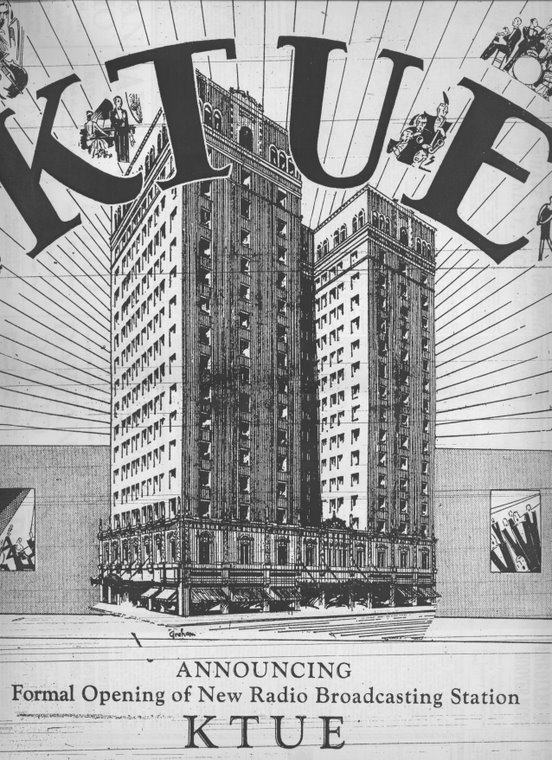
After KFUL ceased operations, George Roy Clough moved his KFLX into the Buccaneer Hotel studios and changed his calls to KLUF, pronounced to rhyme with his last name.  Some accounts of broadcasting history on the island refer to KLUF as a continuation of KFUL and it’s possible some of the established programs of KFUL were picked up by KLUF, but Clough continued to operate on 1370 kc with 100 watts where he had a full-time allotment and the government would consider KLUF a continuation of KFLX, but the history of that station is for another post.

Friday, August 28, 2009

The 1950s Part II - KILT, KILE, Galveston, KRCT,Pasadena

Updated 6/18/11 to add information about the change of ownership of KRCT.

Around the end of February, 1957, the McLendon Investment Corp. completed purchase of KLBS from the Howard Broadcasting Corporation for $535,000, thus repurchasing the station Trinity Investments had owned from 1952-1954. It was said to be the largest cash transaction in Houston radio history. Glenn Douglass, General Manager of KLBS, told the Chronicle there was much speculation on the part of the staff about what was to happen as McLendon was known for making wholesale personnel changes when he took over a station. The line-up included Bob Yongue doing mornings, Bob Gwyn, Dave Chase, Mark Noble and Mike McKay. The station was airing a number of paid religious programs daily including Rev. Lester Roloff at 7am, an Assembly of God program at 9am, Unity Viewpoint at 9:15 and a Dr. Weber from 9:30 to 10am.

On the fifth of May, Jack Harris, GM of KPRC-AM/FM/TV announced the radio stations would begin Houston’s first regular stereo broadcasts that week, from 9:05 to 10pm, five nights a week. Listeners were to tune one station to the AM, another to the FM to get the stereo effect. KPRC-FM PD Ronald Schmitt had secured more than 80 hours of programming that would include music outside the regular Classical fare of the FM station.

The same day, Bill Weaver, a new GM at KLBS, told the Chronicle changes at that station would be coming in a couple of weeks. Weaver had been brought in from KTSA, San Antonio. The big changes were announced just a week later on May 11 and occurred on May 14, a Tuesday, although the new calls, KILT, appeared in the Chronicle the previous afternoon.

The new line-up included Eliot Field from Boston doing mornings, Bob Stephens of Miami on 9a-12N, Art Nelson from Dallas on early afternoons. Don Keyes of San Antonio was the Program Director and did afternoon drive. The newspaper schedules showed Buddy McGregor, 6-9pm, and Bob Adams, 9pm-12M. Other deejays announced included Tom Fallon of Kansas City, Mike Whalen and Bob Horn of Philadelphia and Joe Long of Knoxville as News Director. Mike McKay and Mark Noble were the only holdovers from the old staff; McKay did overnights while Noble was not listed in any slot for several weeks. All the religious programming was dropped.

A full page ad in the Post was designed to look like a Wanted Poster with six pictures bearing only serial numbers and warned Houstonians to be on the lookout for

‘...these men. They are about to steal the Houston radio audience. These men have begun operations on Color Channel 61 Today. These colorful characters are highly entertaining. Their deep resonant voices will ‘con’ you into listening to KILT, Houston’s new radio voice, around the clock every day.

REWARD: Twenty four full hours of daily listening pleasure
.

After Field left for a gig in Los Angeles, Keyes took over as morning man.

The same week of the big flip, Tim Nolan moved from the job as morning host on KXYZ to the same post at KPRC where he soon was to be teamed upwith Bob Byron, a KLBS-ex, to form Houston’s first duo team in morning drive, Tim and Bob; they were to be together for more than a decade.

For more on my memories as a kid of listening to KLBS and KILT, see my ‘Thanks for the Memories’ segment here:

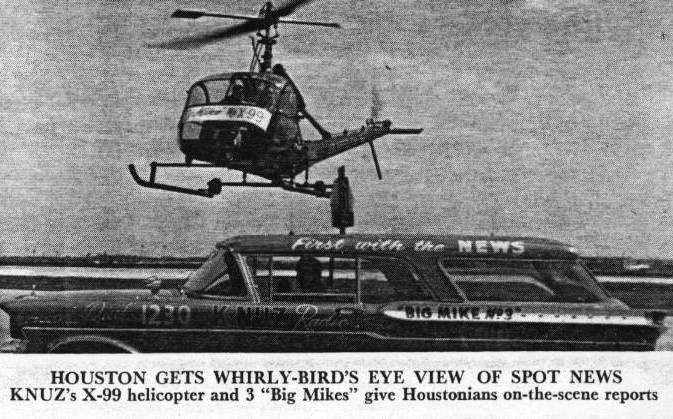
KNUZ, expecting tough competition from the new station, had just purchased a helicopter and ran ads promoting itself as Houston’s only radio station with wings and touting its top ranking. The helicopter had just been put in use when some heavy flooding hit the area and was used in exclusive reports.

Toward the end of the summer a group of Galveston businessmen completed the acquisition of KLUF from it’s founder and owner George Roy Clough and his sons. Clough, whose name was pronounced cluff, hence the call letters, was, even by his own admission, a contentious man who made many enemies and brought a lot of attention to Galveston, not all of it favorable. The son of a telegraph operator and former race car driver, Clough’s knowledge of radio had led him into the field but by this time he was serving as Mayor of Galveston, said to have run initially because he was angered over a city water bill and vowed retribution. He served two terms as Mayor but lost a re-election bid for a third term and a subsequent try for city council. For years he operated a radio and television shop next to his home at 34th and Ave P. He died in November, 1966.


The new call letters for the station were KILE and it debuted on September 2, 1957, at 6am. According to GM Robert. L. McClellan there was all new equipment and programming. Tim Lewis was News Editor and the staff also included Bill Bance, Tom Beck and Warren Anderson. The morning show was called Hit the Deck while an afternoon program was called Teen Tempos. Most old-timers in the Houston/Galveston area will remember KILE as a Top 40 station and it has had many alumni working in Houston radio.

The call letters of this station are now KHCB and it has recently been relicensed to League City.

The first week of October, 1957, KRCT began broadcasting from new studios at 227 East Sterling in Pasadena. The station always ran lots of ads in the Chronicle with the first concerning the changeover appearing on October 2 proclaiming a Grand Opening going on the 3rd thru the 6th with everyone invited to stop by to visit the new facilities. $1000 worth of door prizes were to be given away. The on-air schedule included Hal Harris from 6a-10a, Gabe Tucker, formerly of KATL and KLEE from 10a-1p and Sleepy Bob (Bob Everson) from 1-5pm. Leroy Gloger liked to claim that 650 was Houston’s only ‘clear channel’ station but the clear was assigned to WSM, Nashville, the Houston station was always limited to daytimes only. Over the years the station was also promoted as the ‘Voice of Labor.’ The format was always country.

An application for approval of the sale of the station was announced November 18, from W. D. Christmas to John H. Touchstone and Leroy J. Gloger for $175,000. Touchstone had been a 7 % owner; he and Gloger were to be equal partners under the new ownership. The transfer was approved a month later. In March of 1959 they sought approval of a transfer of the license and CP from Bay Broadcasting to Industrial Broadcasting noting this was a corporate change only, not a change of control. This was granted in mid-May. Touchstone was President, Gloger was Vice President and General Manager.

KRCT was to become KIKK in 1961.

The image above is from the Galveston Daily News
.

Thursday, May 10, 2007

1923 - KFCV, Houston, and KFLX, Galveston, the oldest surviving radio station in the Houston-Galveston area


As mentioned in the post on call letters, up until sometime in January, 1923, radio stations east of a line along the Texas-New Mexico border received call signs beginning with the letter W, stations west of that line received call signs beginning with the letter K. It was apparent there were going to be many more stations in the eastern region than in the west so the Commerce Department moved the dividing line to the Mississippi River. The first station licensed after that change that would have previously received a call sign beginning with W was located in Houston and it was the only new station licensed in Houston in 1923, KFCV. The station was licensed to Fred Mahaffey, Jr. in January.

I have found nothing on KFCV other than that the license was maintained for 3 years (licenses expired every 6 months). However, Christopher Varela in his book Kotton, Port, Rail Center says Mahaffey was a high school student who worked in his father's electric shop, Mahaffey Electric Co., and the station was used to demonstrate radio to potential buyers.

Of the eleven stations that had received licenses up to that point in the area, the Commerce Department official list of June 30, 1923, showed only seven as active. In Houston they were KFCV, WCAK, WEAY, WEV, and WRAA. In Galveston, WHAB and WIAC were still listed.

Late that year a new station was licensed in Galveston and assigned the call letters KFLX. The licensee was George Roy Clough of 1214 40th St. It was authorized to operate on 1250 kc with 10 watts and it was the first station in the Houston-Galveston area to operate on a wave length other than 360 or 485 meters. In 1933 this station changed its call letters to KLUF after another Galveston station using the call letters KFUL went off the air.  As a result of the North American Radio Broadcast Agreement of 1941 it moved to 1400 kilocycles and in 1957, after George Roy Clough sold it, the call letters were changed to KILE. There is still a station on the air on that frequency.  The city of license has been changed to League City and the calls are KHCB-AM and it is the oldest continuously licensed radio facility still on the air in the Houston-Galveston area. Besides that, it can also claim to be the oldest continuously operating radio station on the entire Texas coast.

A claim also has been made that KFLX was originally the station known as WHAB, which would extend its pedigree to 1922. The Broadcasting and Cable Yearbook, a standard industry reference but far from infallible, gives the year of origin of KHCB-AM as 1922, but the Commerce Department records I have examined do not support the claim that WHAB was the precursor of KFLX. Both stations were listed as active stations concurrently for many months in 1923/4. Clough received authorization for KFLX as a new station, not a transfer of ownership or change of call letters, on November 28, 1923, and WHAB was not deleted from the Commerce Department lists until June of the following year.

For his book Texas Signs On, historian Richard Shroeder interviewed Jack McGrew, who had worked for KFDM, Beaumont, in the early years and later spent many years at KPRC, Houston. KFDM was owned by the Magnolia Petroleum Co. Of Beaumont and was very well equipped and funded. It originated the first chain, or network, in Texas, the Magnolene Chain, which consisted of KFDM, KPRC, WFAA, WRR, WBAP, and WJAD. (Magnolene was the name of a lubricant made by Magnolia). McGrew told of visiting Galveston once on for a sports remote for KFDM and learning not all stations were created equal. He went to KFLX where he met Clough who was owner, operator, engineer and staff. It was a Sunday and as the two talked

“...Clough was also playing records over the air. If the record came to an end, without saying anything to the listeners, Clough would pick up the tone arm, turn the record over, put it back down on the revolving turntable, and drop the arm onto the record. All this was done ‘on the air.’ Sometimes he turned the same record back and forth two or three times. This was the only radio station in town and it was pretty loose.

Of course this is what is known in the industry as a tight playlist. Unfortunately the date of the visit was not given. George Roy Clough was later to serve as Mayor of Galveston in the 1950s.

All of the stations on the air in the Houston/Galveston area in 1923 other than KFLX continued to share time on 360 meters, 833 kc.

As mentioned in the post noting the 82nd anniversary of KPRC's sign-on, according to an interview with Alfred P. Daniel that appeared in the Press many years later, sometime during 1923 Ross Sterling, Jr., son of the largest stockholder in the Houston Post Co., Ross Sterling, Sr., took a radio class at the Houston YMCA from Alfred P. Daniel of WCAK. The young man’s interests apparently aroused his father’s curiosity and Sterling, Sr., asked Daniel to meet with him to discuss the possibility of the Post getting into the radio business with its own station. William P. Hobby, President of the Post, had also urged Sterling to get into radio. Sterling had been the first President of Humble Oil and Refining Co. which is now Exxon-Mobil. When he sold his interests to Standard Oil he went on a buying and building spree in Houston. He purchased the Houston Dispatch newspaper in 1924 and combined it with the Post as the Post-Dispatch. Both Sterling and Hobby served as Governors of Texas.

After meeting with Daniel, Sterling was convinced the Post should have its own radio station and ordered a 500 watt transmitter from the Westinghouse Electric and Manufacturing Co., one that had been recommended by Daniel. But by the time the transmitter was delivered Ross, Jr., had died and Ross, Sr., ordered the equipment put in storage without ever being uncrated. The grieving father devoted himself to building a memorial to his beloved son, a campground at Cedar Point on Trinity Bay, below Baytown. On ground that had formerly been a Sterling family residence and
before that, Sam Houston’s summer cabin on the bay, Ravensmore, he built Camp Ross Sterling, Jr., and gave it to the YMCA. The camp was to serve as a youth camp and church camp for decades. (I attended church camp at Camp Ross Sterling, Jr., twice in the 1950s).

A Texas Historical marker on 2354, which runs along Trinity Bay southeast of Baytown, commemorating the first settlers at Cedar Point, mentions Sam Houston's cabin and says the land where it stood (and presumably Camp Ross Sterling, Jr.) is now underwater. This would be due to land subsidence and erosion in the area.

It was more than a year before the Westinghouse transmitter was taken out of storage and put into operation.


The image above is from the archives of the Houston Post at the Houston Public Library.

Note: when KPRC signed on in 1925 the Post-Dispatch identified the transmitter as a Western Electric, not Westinghouse.