A Look At A New Station - Easy Country KKBQ-FM, 1991
From the About Town column, December, 1991, Houston Metropolitan Magazine

From the About Town column, December, 1991, Houston Metropolitan Magazine
A Houston Chronicle slide show of lost FM formats, including some interesting photos and some historical facts, mostly of rather recent stations and not all of which are true.
John Robertson writes:
"My uncle by marriage was T.L. Hinner, he was Chief Engineer at the KTRH Cedar Bayou transmitter facility during this period. I came across your "Houston Radio History" web site and remembered I had these photos.
I remember staying with my aunt and uncle at the transmitter as a young child. My favorite thing was being allowed to switch on the tower lights at dusk.
I remember Bob Sutton, that worked at the transmitter at the ame time as my uncle. He went on to become Chief Engineer for the KTRK TV transmitter facility near DeWalt Texas.
Thanks for your informative web site,
John Robertson"


As I got into researching the history of KFLX, Galveston, I discovered several stories published in the Galveston Daily News in November and December, 1924, purportedly about KFLX that actually were about the brand new station KFUL. It took the News several weeks to straighten out the call letters.
This new information has necessitated a rewrite of the first part of the KFUL station history, moving the first air date back by several weeks.
For Part 1 of this station history, go here.
For Part 2 of this station history, go here.
The Galveston Daily News began carrying more complete schedules of the programming on KFUL instead of just isolated mentions. In August a special program was dedicated to the round the world flight of the Graf Zeppelin. A local concert orchestra led by Felix Stella would play 'appropriate' music and an announcer would give details about each of the countries being traversed by the historic flight.
As 1930 rolled around KFUL broadcast coverage of the Mardi Gras Festival and and started covering baseball games plus live coverage of the opening of Tokio Garden for the season. In April, the station conducted on-air announcer try-outs. Aspiring announcers gave a five minute talk on the air and listeners voted, by mail, to determine the winner. Toward the end of the year, KTSA renewed its request for a full-time assignment on 1290 kilocycles and KFUL also requested a new channel, arguing that if KTSA, which by that time had allied with the Columbia Chain (CBS), received its allocation, KFUL should also get a full time assignment.
Information on the last two and a half years of KFUL is scant, unfortunately. Issues of the Galveston Daily News are missing (from my source) for all of 1931 and 1932 and up until October, 1933, and the earliest issues of Broadcasting Magazine, which began publication in the second half of 1931, had no mentions of the station. But the Lubbock Avalanche-Journal reported on May 1, 1931, that the Radio Commission had once again denied the application by KTSA for a full time allotment, at the same time authorizing a renewal of KFUL’s license as a share-time station.
On June 4, 1931, the Bryan Eagle reported the station had been taken over by the News Publishing Co, the Galveston Daily News and Tribune parent company. Louis C. Elbert was Vice President and General Manager of the company. A similar story appeared in the Valley Morning Star of Harlingen and reference was made to the station formerly being ‘operated by the Buccaneer Hotel.’ The September, 1931, issue of Radex listed the change of ownership among it’s ‘Summer Changes’ column and also reported in it’s last issue of the year that the station slogan was ‘The City of Perpetual Sunshine.’
Despite the lack of better identification of the seller, so far as I know the license for the ‘community station’ had always remained in the name of Thomas Goggan and Brothers up until the sale to the News.
Listings continued in Radex for these years, showing Galveston’s radio stations as KFLX, operating on 1370 kilocycles with 100 watts, and KFUL, operating on 1290 with 500 watts.
The last listing for the station in Radex appeared in the May, 1933, issue. I have no information about the reason for the sale or the end of operations but perhaps the Great Depression was impacting tourism and straining Galveston’s economy.
After KFUL ceased operations, George Roy Clough moved his KFLX into the Buccaneer Hotel studios and changed his calls to KLUF, pronounced to rhyme with his last name. Some accounts of broadcasting history on the island refer to KLUF as a continuation of KFUL and it’s possible some of the established programs of KFUL were picked up by KLUF, but Clough continued to operate on 1370 kc with 100 watts where he had a full-time allotment and the government would consider KLUF a continuation of KFLX, but the history of that station is for another post.
See Part 1 here.
More reports of distant reception continued to be received. On February 10, 1927, the paper reported the station had received a letter from Mission House, Nukulonpa, Panga, in the Friendly Islands, estimated to be as much as 15,000 miles away, where a broadcast by KFUL had been received on January 18th.
On the 19th of February a big squall blew through wrecking planes at the air field, damaging houses and businesses and knocking down the KFUL antenna. The squall affected a wide swath of Texas and Louisiana and reports from as far away as the Valley mentioned the incident. A temporary aerial was put up the next day.
Rev. Raimundo De Ovies of Trinity Episcopal, who had delivered a sermon on the very first broadcast of WHAB, Galveston’s first radio station in 1922, became an announcer at KFUL and the youth group at his church organized a regular Sunday evening program featuring youth groups from churches all over the island. Fred Richardson and his California Syncopators, in town appearing at the Winter Garden, made regular appearances on the station and KFUL station artist ‘Happy’ made an appearance at the opening of a new Star Electric Shop, pawing the ivories and singing ‘the blues’ it was reported. It isn’t clear if ‘Happy’ was a mascot or an actual person but a couple of months later the paper reported on the opening of the Airdome Dance Pavilion, 25th and Boulevard (what we now know as Seawall Boulevard) where KFUL broadcasting star ‘Happy’ Roy Thomas was to be the manager.
‘Radio’s Latest Marvel’ - hypnotism by radio - hit the Galveston airwaves in late March, 1927, when Noah the Great came to town to demonstrate his skills. A booth was set up at Joyland Park where a woman was going to be put under for 48 hours and made to perform several acts before going to sleep. Men were going to be made to ride bicycles and perform tricks and the public was invited to stop by the park to view the demonstrations.
A report in the paper in April claimed bathing crowds at the beach had been breaking all records for so early in the season with a large group from Hamilton, Ontario, Canada and others from Oklahoma and Kansas reported. Efforts of the Beach Association, the Chamber of Commerce, and the power of KFUL were credited.
In May, 1928, new management took over the station. Will H. Ford became the new station manager, Art Johnson of Chicago became announcer and station director, Jack H. Rogers was named as pianist and Roy Cole from Oklahoma City became engineer, apparently replacing George Roy Clough. Goggan’s named a new head of it’s radio department, too, Bernard McComb. An all night program was scheduled for May 29 to launch the ‘new’ station, starting at 8:15 in the evening and running until daylight. Many Galveston performers took part.
The Colorado Joy Boys, who played Hawaiian music, were in town and had a regular daily slot at 12 Noon. They had recently been a big hit on WBAP.
Will Ford was an insurance man and was closely allied with the W.L. Moody, Jr., interests on the island. On the 27th of February, 1929, The News carried a big story about the new Buccaneer Hotel, a project of Moody, getting the final touches at 23rd and Boulevard and revealed KFUL was to have brand new studios on the second floor, which is where the lobby was located.
This postcard on eBay shows the new hotel which has since been demolished. The studios were located on the east end of the building (right side). There were also several meeting rooms on the second floor and my understanding is that there was a picture window into the studio from one of those meeting rooms but not from the lobby itself.
The station was already collecting equipment for the new facility but before the hotel was completed a big fire broke out at Goggans in the second week of March. Traffic was backed up all over the island as fire equipment and onlookers converged on the scene. Damage was said to total $80,000 from the fire which was believed to have started in the Goggan’s workshop on the 3rd floor, next to the radio station. KFUL was practically a complete loss and the Palace Theatre, on the ground floor, suffered extensive water damage. Draperies and other soundproofing in the studio were thought to have accelerated the fire. The transmitter, on the roof, was inaccessible but believed to have been destroyed. Equipment for the new facility had also been lost. It was the 2nd fire in a month at Goggan’s.
Will Ford announced within a few days the station would be back on the air in 60 days from the new facilities in the Buccaneer and would be broadcasting with 1000 watts. It was estimated it would cost $20,000 to get the station back on the air. In the interim, a few regular KFUL programs were picked up by KFLX.
Ten days after the fire, Ford filed for the office of Commissioner of Finance and Revenue for Galveston and the campaign featured charges by his opponent that he and the Moody interests had ‘appropriated’ Galveston’s community radio station and were trying to 'get a stranglehold' on Galveston. In response, Ford claimed the the Rotary Club and Chamber of Commerce, which had been managing KFUL at a loss, had come to him and asked him if he would take over. After consideration he had agreed to take the job and continue to operate the station at a loss. He said he was paying the full cost of the new studios out of his own pocket.
In the meantime in early April the Federal Radio Commission released it’s decision on a petition by KTSA, San Antonio, and KFUL to each be assigned their own frequencies. KTSA had applied to continue on 1280 kilocycles, which the two stations had been sharing since National Radio Allocation Day in November, 1928, and KFUL had applied for 1120 kilocycles (and 1000 watts). The FRC ruled the two stations were to continue to share time on 1280.
By the end of June, 1929, KFUL was once again ready to take to the airwaves. A big gala opening was announced for Monday, June 19, with a 8 hour program that would start at 7:15 pm and the public was invited. Pat H. Wilson, Jr., was the new station announcer and representatives from KTSA, WRR, KPRC and KWKH would be taking part. The broadcast would also include a remote from the Shrine Temple. Six days later another new announcer was introduced. Pvt. C. J. Simmons, with the Third Artillery Group at Fort Crockett, was added to the staff. He had only recently been assigned to Fort Crockett from California and he was said to be known to radio listeners in the West for his sports announcing. He would work evenings at the station using the air name Ace Simmons.
This postcard showing the station orchestra in the studio at the Buccaneer could have been taken anytime after June, 1929.
Continue to Part 3.
This article has been edited 5/3/2014 to reflect new information about the earliest broadcasts of KFUL which were wrongly attributed by the Galveston Daily News to KFLX.
The Radio Service Bulletin published by the Commerce Department on January 2, 1925, listed KFUL, Galveston, as a new station. Licensed to Thomas Goggan and Brothers Music Co., KFUL was authorized on 288 meters, 1160 kilocycles, with 10 watts. Goggans had a big store in the 2100 block of Market Street which housed the station, apparently on the third floor next to a workshop. The firm had been founded in Galveston in the late 1800s and had branches all over the state at one time including a store in downtown Houston. It was considered the largest and oldest musical firm in Texas, supplying sheet music and instruments of all kinds. For more on Goggans, go here.
The earliest mentions of the station's broadcasts in the Galveston Daily News erroneously attributed the broadcasts to George Roy Clough's KFLX but all of the stories mentioned Goggan's and station manager J.R. Davis. The error is emphasized even more by the fact that though KFLX had been licensed a year earlier it had never been mentioned in the paper up until that time and wouldn't be mentioned again by name until 1929.
The first mention on Sunday, November 23, 1924, reported on a concert by St. Mary's Cathedral Choir which was scheduled to start at 9 pm instead of 8 pm which would, it was asserted, eliminate much of the static problems experience on a previous broadcast. And the article reveals that even from its inception the station was seen as a promotional vehicle for the island. The story began ''The air will again be the medium of advertising the 'Treasure Island' Wednesday night..." The paper reported 'many notices of congratulations' were received on the new station from as far east as Cleveland, OH, and stated that concerts would continue on a weekly basis until demand built up. Another story on the 26th reminded readers that another concert was scheduled that evening, mentioned an earlier broadcast on November 19 and reported that more than 300 phones calls had now been received about the previous broadcasts.
One more article with the erroneous calls was published on the 2nd of December and cited letters received from Eugene, OR, Edmonton, Alberta, Canada and Banes, Oriente, Cuba. The last letter reported receiving a broadcast on November 11, with loudspeakers set up so many could listen so the first broadcast of the station was at least that early.


KPRC has added a history to it's website with information taken from this site and some great historical photos.
Here's an article on Zydeco Online on the end of KCOH on 1430 with a little bit of history and lots of great historical photos of the station and staff. This was originally posted back in 2012 when the station was sold and moved from 1430 to 1230.
An application was tendered for filing with the FCC on April 15, 1946, for a new standard broadcast station to operate on 890 kc with 250 watts, daytime, in Brenham, Texas. The applicant was Tom S. Whitehead, owner and publisher of the Brenham Banner Press.
Less than 2 weeks later, the FCC announced it was revamping it’s policies regarding daytime and limited time stations operating on Class 1-A clear channel frequencies and all pending applications were being put on hold. 890 was a Class 1-A frequency and WLS, Chicago, was the protected signal.
On September 30, 1946, Whitehead submitted a modified application, requesting operations on 1280 kc with 1 kilowatt of power and also changing specifications in the proposed antenna and transmitter. The amended application was approved on November 4, one of 46 new stations granted on that day, a record for the FCC up until that time.
When the call letters were applied for and approved has not been discovered nor, for that matter, exactly when the station got on the air. Broadcasting Yearbook cites the date April 15, 1947, but that source is frequently in error. The calls must’ve been taken from the first three letters of the owner’s last name.


See the First Part here.
Broadcasting Magazine took note of a promotion on KIOX in the fall of 1949. 'Cowgirl Sweethearts on Parade' was based on the popularity of disc jockey Charlie Walker, the Singing Cowboy, and his Half Circle W Roundup program on KIOX, All the Long stations were participating and there were said to be 300 entrants. Culmination of the promotion would be at the Bay City Rice Festival that year and a short film would be produced. Billboard Magazine also noted the contest in it’s January 14, 1950, issue, the earliest mention of KIOX in that trade publication. Walker was said to be touring 56 of the Long theatres in Texas with the 15 minute film which also featured some of his show. Other mentions of Walker and KIOX in Billboard included his Texas Ranger Club, in conjunction with a beverage sponsor, which offered premiums to members based on the number of bottle caps collected, and when he sent out an invitation for country artists to stop by his show. In March, 1951, Walker departed KIOX for a gig at KMAC, San Antonio, and mentions of KIOX in the pages of Billboard became much rarer.
Charlie Walker was born in Copeville, Texas, and while with the 8th Army Signal Corps in the Tokyo Occupation forces was credited with being the first dj to play country music for the troops in the Orient. After the war, he and his band, the Texas Ramblers, performed in and around Corpus Christi before he got into radio again. He became a hugely popular country disc jockey in San Antonio, scored a recording contract and a number of hits, moved to Nashville where he became a member of the Grand Ole Opry and eventually was inducted into the Country Radio DJ Hall of Fame. According to the Encyclopedia of Country Music, he opened his show with ‘This is ol’ poke-salad, cotton-picking, boll-pulling, corn shucking, snuff-dipping Charlie Walker.’ Neither his Wikipedia entry nor his entry in the Encyclopedia of Country Music mentions his stint at KIOX, however.
Another famous alumnus of KIOX was Texas and Georgia Radio Hall of Famer Kent Burkhart, who, in the book Turn It Up! American Radio Tales 1946-1996, relates walking into Johnny Long’s office at KIOX when he was not yet 14 and asking him for a 15 minute show to play records for kids.
Though the Bay City Tribune is not available, more insight into the early programming of KIOX comes from the pages of the Freeport Facts (later Freeport Facts and Daily Review when it became a daily). The Brazosport area is only about 35 miles from Bay City and possibly even at that time had a greater population than all Matagorda Co. and was undoubtedly the largest populated area within the range of the KIOX signal that didn’t have its own radio station. KIOX tried to function to some extent as a local station for the Brazosport area, taking advantage of Johnny Long’s Showboat Theater on 2nd Street in downtown Freeport as a stage for many broadcasts.
The earliest mention of KIOX in the Facts occurred on July 24, 1947,when it was reported two representatives of the station (not air personalities) had visited a meeting of the Freeport Kiwanis Club. The station’s coverage of that fall’s Freeport Lions Carnival had to be postponed in August because of a storm and a live broadcast in conjunction with the carnival from the stage of the Showboat failed to make it on the air because of technical difficulties but even by that time the First Baptist Church of Freeport had a program and the station had covered a meeting of the Brazosport Chamber of Commerce.


On March 8, 1946, the FCC granted a Construction Permit for a new standard broadcast station in Bay City, Texas, to operate on 1110 kilocycles with 1000 watts, daytime only. The original application apparently had been filed in February, 1945. Principals of Bay City Broadcasting included John George Long, T. C Dodd, a cattleman, and J.A. Clements, apparently of Angleton, who had formerly been with KPAC, Port Arthur, and at the time was with the Addressograph-Multigraph Corporation in Houston. The estimated cost of construction for the new station was $30, 597.
Long, also known as John G. Long and Johnny Long, was the most important party. Apparently a native and resident of Bay City, he would, through his Long Broadcasting Enterprises, own or operate KVIC, Victoria, KSAM, Huntsville, KNET, Palestine and KTLW, Texas City, in addition to KIOX. Bay City Broadcasting also applied for a 50 kw station in McAllen to operate on 1560 kc. Long was also an owner and operator of as many as 70 theaters across Texas, including the Showboat theater in Texas City, where KTLW would be located.
Information about the early years of KIOX is difficult to find for a number of reasons: the station has been deleted and it’s FCC records are not accessible online, copies of the Bay City Tribune for that era apparentlly are non-existent, and online scans of the fine print notations in Broadcasting Magazine are often illegible. As a result, I do not know when the call letters were applied for and approved, what they stood for, if anything, and when the station actually got on the air, but by July 29, 1946, the station was listed along with 6 others joining the Mutual Broadcasting System as of August 1 so presumably it was on the air by that time. In the meantime, on May 20, 1946, the FCC had accepted for filing an application for modifications to the original CP to change the frequency from 1110 to 1270 kc, change the power from 1000w, daytime, to 1000w, unlimited, and install a new transmitter and antenna. These modifications were not approved by the FCC until January 27, 1947, along with extensions for the dates of commencement and completion of the changes.
Long’s purchase of KSAM, Huntsville was approved in October, 1946, and his purchase of KVIC, Victoria, from Morris Roberts, was approved in December, 1946. In February, 1947, Clements' interest in Bay City Broadcasting was transferred to Harry Reading, Jr., for $8000. Reading had been an IRS Collector and was then employed as accountant by Long. Clements was partner in other broadcast enterprises, either applied for or operating, in Del Rio, San Angelo, and Houston.
Long’s application for KTLW was approved in June, 1947, and then in early October, the move of KIOX to 1270 kc was authorized. In it’s November 17, 1947, issue, Broadcasting ran a story about the formal opening of the new station on November 10. Cost of the facility was estimated at $200,000. There was a list of important officers and staff of Long Broadcasting Enterprises including some of the air talent. As the operator of a small group of stations, Long had been able to attract staffers from far and wide including such major markets as Detroit, Windsor, Ontario, San Antonio and Houston.
A year later, in November, 1948, tendered for filing with the FCC was an assignment of the license of KIOX eliminating Dodd and Reading from the ownership. The consideration was something in the vicinity of $12-13,000 for their two 12.5% shares as best I can make it out. It was mentioned that the station was losing money. Thus did John G. Long become sole owner of KIOX.

For Part 1, go here.
On April 23, 1959, the Brazosport Facts carried a story announcing the FCC had approved the sale of KBRZ. The buyer was Jim Hairgrove doing business as Radio Brazosport, Inc., in partnership with Garfield Kiel and Stanley McKenzie plus Hairgrove’s wife, Sue. The price was $80,000 and the request seeking transfer of ownership had been filed March 30. Various stories over the years indicated Hairgrove had either been manager, owner or ‘had an interest in’ KFRD, Rosenberg. William Schueler, the seller, was moving to Fort Worth where he had an interest in KJIM and he also had an interest in KTOW, Oklahoma City. Ken Ferguson, who had been with KBRZ since 1952, was buying KMOP, Tucson, in a partnership with L.B. Clayton of Oklahoma City.


On April 4, 1952, the Freeport Daily Facts and Review reported that the Federal Communications Commission had approved the call letters for KBRZ, a new AM radio station for the Brazosport area, the first radio station licensed in Brazoria Co. The call letters had been used previously by a station in Bryan operating on 1440 kc that had gone silent in 1949. Kelly Bell of Nacogdoches, President of Brazosport Broadcasting which was putting the new station on the air, told the Facts the call letters stood for Brazosport and Brazoria Co.
The original application had been filed in November, 1950, for a 250 watt station operating unlimited hours on 1490 kc but that had been amended in May, 1951, to 500 watts, daytime only, on 1460 kc. The Construction Permit was granted on March 26, 1952. On May 21, the FCC approved the site for the new station, located on the old Angleton-Velasco road (FM 523) just outside the small settlement of Oyster Creek. The new Texas 332 and the original span over the Intracoastal Waterway to Surfside would not be completed for a couple of years but the location was just north of the intersection of the Angleton-Velasco road and the new highway. Harry Twombley, a construction company man in Brazosport had joined the ownership group. Bell, originally from Midland, was an attorney in Nacogdoches and owner of KOSF there. Another owner was J.C. Stallings of Nacogdoches who was to be General Manager, a post he held at KOSF.
Prior to the launch of KBRZ, KIOX, Bay City, 1270 kc, had served as something of a local station for Brazosport, broadcasting advertiser remotes, a weekly 'This is Freeport' program from the Showboat Theater in Freeport, and covering the opening of the Brazoria Co. Fair in Angleton.
Construction of the facility got underway on June 10 and two days later O. A. Wood told the paper in an interview they hoped to be on the air by August 15 and the station was looking for local personnel to staff the station. Wood, who had worked as Commercial Manager for KOSF, had been named GM of the station and had set up temporary offices on Broad St. in downtown Freeport. Apparently, Stallings was going to stay in Nacogdoches.
As the date approached the sign-on got pushed back a couple of times. On the 15 of August, Wood said they hoped to be on by the 23rd but that date passed. On the 27th, a Wednesday, Wood said the station would begin operations the following Monday but the story also said the station would sign on at Noon that Sunday (possibly this was just for a dedicatory ceremony). Then on Friday August 29 the Daily Facts and Review reported final FCC approval had been received and the station would sign on the next morning and hold an open house at the new station on Sunday, August 31. A special dedication ceremony would be held at the station on Saturday evening involving the local Chamber of Commerce which had petitioned the FCC on behalf of the owners.
KBRZ operated on 1460 kc with 500 watts of power, daytimes only (local sunrise to local sunset). Studios and offices were housed in a building that resembled a big ranch house while the transmitter was located in the rear and the 210' antenna in the salt grass prairie that stretched back to the Intracoastal Waterway.
ETA: A 1964 Historic Aerial image clearly shows the original studio and transmitter site. A direct link to the image is not allowed; go to Historic Aerials and use the search parameters 'FM 523 and FM 332 Velasco Texas.' You can turn on the 'All Roads' overlay to orient yourself. The station is the first structure north of the intersection on the east side of 523 with a driveway to the transmitter out back.
On Monday, September 1st, two small ads appeared in the Daily Facts and Review. One advertised a late fishing report on daily at 5:30 pm with the tag line ‘No, This Didn’t Get Away.’ The other urged listeners to ‘Develop the KBRZ Listening Habit’ by dialing 1460 daily from 7:30 to 7:45 (am) for ‘a program of comfort.’
Several stories over the first several months identified more of the station personnel. In addition to Wood these included Betty Klein, Program Director, Dick Smith, News Director, Jack Howard, Commercial Manager, and Bill Reading on the commercial and announcing staff. Smith had an impressive resume, citing stints as News Director or Editor at WOAI, KTSA, WFAA and the Liberty Broadcasting System. Klein had worked at KTRM, Beaumont, KTXJ, Jasper and the Pams Agency in Dallas. Howard had worked for the Liberty Broadcasting System and also Mutual and the Cactus Network in west Texas while Reading had worked at KNUZ, KULP, the Liberty Broadcasting System and KUHF-FM. In separate stories Danny Kirk was identified as chief announcer and Kenneth Ferguson as Chief Engineer. Kirk had come to KBRZ from WACO.
A story in July, 1953 named Raymond Carlton, aged 17, as working afternoons at KBRZ after summer school and said he planned to make a career in radio. The station started broadcasting football games of the two high schools in the coverage area that autumn, carrying them on tape on Saturdays since the station was off the air Friday evenings. The station at times also carried the games of Lamar Tech in Beaumont. A story in September, 1954 identified Bob Dunnavant as the play-by-play announcer for Brazosport Exporter games with Jim Grant doing the color commentary. Charles Dunaway, Sports Editor of KBRZ, handled play-by-play for the Angleton Wildcats games with Chuck Lay doing commentary. Two months later the paper reported popular DJ Charlie Dunaway was leaving KBRZ for a job as staff announcer at KPRC, Houston, noting Dunaway had been with the station 2 years and married a local girl. Houston native and Texas Radio Hall of Famer Chuck Dunaway chronicled his career in his 2004 book The Way I Remember It, including a chapter devoted to KBRZ. This used to be online but has been taken down and the book is currently out of print. The same month Dunaway departed Jim Grant left for KGBC, Galveston. In April, 1956, Clifford L. Holloway was identified as Commercial Manager for KBRZ when he filed for office as a candidate for Lake Jackson City Council. In June, 1956, a story mentioned ‘former PD’ Bob Dickson was taking a job at KRIS-TV, Corpus Christi, covering sports. Dickson had come to KBRZ in November, 1955, to serve as PD, bring his popular 'Breakfast with Bob' show from KIOX, Bay City.
Within months of signing on, the station conducted the first of what would come to be a long running annual event, a Kiwanis Radio Auction. Kiwanis Club members from both Freeport and Lake Jackson, the two largest towns in Brazosport, collected goods from merchants throughout the area for the auction which was held over the air on a Sunday afternoon in mid-December. A big ad in the paper before the auction listed all the items for sale and for the first year these included a refrigerator, a dishwashing machine, a radio, fishing tackle, a watch and much more. Money raised was to go to underprivileged children and the KRA, as it came to be known, was an annual event on KBRZ for over 20 years.
Another annual event was a Teens Against Polio Radiothon, held as early as 1955 and continuing annually until at least 1969. Several Brazoria Co. residents had been afflicted with polio during the nationwide epidemics of 1952 and 1954 and polio was on everybody’s mind as a terrible disease. Teen groups known as Teens Against Polio were formed all over the country and held fund raising activities, typically in January, including talent shows, dances, and midnight movies. The radiothons on KBRZ involved all the area junior high schools; on a designated Sunday, requests would be taken on the air for dedications in return for a 25 cent donation, which was picked up by one of the volunteers stationed at the various junior highs. I had my first on-air experience as a guest DJ on the radiothon in January, 1960, along with Howard Dupree who was a student like myself but also worked part time at KBRZ. That year we also passed out car litter bags in return for a donation.


The radio community has been buzzing this week over the announced sale of KCOH. The station has been on the market for a couple of years and it looks like the sale will mean the demise of the programming.
J.R. Gonzales of the Chronicle's Bayou City History Blog has dug out a couple dozen pictures from the newspaper files for an article and a great pictorial of the station's history since it became Black-owned and programmed.
(I wish I had access to those archives!).
I have been corresponding with John Hill, CSRTE, an engineer at KILT from 1960 to 1964, who has been filling me in on a lot of facts and data from that era. He lost almost all his family, musical career and radio memorabilia thanks to tropical storm Claudette in 1979 and only a few pieces survive, among them a staff directory. I have organized it by department instead of alphabetically and added a few facts on some of the personalities I have from my own research.
Beverly Bales - Secretary to GM
Sabra Hall - General office
Dino Thompson - Receptionist
Bruno Leonardt - Sales Manager
Paul Fielding, Dickie Rosenfeld, Charlie Trub and Ted Van Brunt - Sales
Sue Reid - Sales Secretary
Sandra Arnold - Traffic
Barbara Van Horn - Continuity
Glenn Cook - Chief Engineer
John Hill - Recording Engineer
Tim Milton Kingston - Transmitter Engineer
Frank J Maher - Transmitter Superintendent
Rob McLeod - Program Director
Chuck Benson - Assistant to the PD
Gene Kelly, Dick Lahm, Bob Presley, Bill Slater, John Trotter - Disc Jockeys
Milton Allen (Graves) - Weekend Disc Jockey
Cecil Tuck - News Director, Program Manager
Thom Beck - News Editor
Dick Dobbin, Rick Eiser, Gary Fuller - Newsmen
Reed Robinson, Larry Thomas - Porters
Missing from the list was Bill Weaver, General Manager.
Also missing were two other transmitter engineers, Bryan Burne and Sam Warren, working at the transmitter on West Rd., west of the Dallas highway (US 75/I-45).
As John remembers it at the time of this list, the air shifts were: Gene Kelly, Midnight to 6 A. M.; Chuck Benson 6-9 AM; Rob McLeod 9-12 Noon; Bob Presley from 12 Noon-3 P. M. (with his KILT Pool & Patio show); Bill Slater 3-6 P. M.; "Honest John" Trotter 6 PM.-Midnight.
I had in my notes from the Chronicle that Trotter had been brought in to do mornings in January, 1961, replacing Joel A. Spivak, I believe, but was demoted to the 6 to Midnight shift as a way of suggesting it was time for him to leave. He did shortly thereafter for KEWB in Oakland, CA. In 1965 he was one of the original group of Western Gentlemen who brought country music radio to WJJD, Chicago and later he worked at KBOX, Dallas. He died in Abilene in 1976 and was inducted into the Country Radio Broadcasters DJ and Radio Hall of Fame in 1996.
Bob Presley went on to a long career in Houston radio at KPRC and KILT.
Bill Weaver left KILT to work for Cap Cities Broadcasting in 1966; he had married his secretary. He touched base with John in Nashville in 1982 at which time he was Executive Vice President at WWCO, a 24 hour station in Waterbury, CT. He died in retirement in San Antonio in February, 2008.
Both Bob Presley and Bill Weaver were inducted into the Texas Radio Hall of Fame in 2003.
Milton Allen (Graves) left for WNOE, New Orleans, one of McLendon's wife's stations; Chuck Benson left for WGR in Buffalo, NY, followed by Bill Slater. John left shortly thereafter, too. After WGR, Bill Slater went to KFWB, Los Angeles (64-65), KRLA (64-67), and KPPC (69-70) according to a Los Angeles radio website. He died in 2002 at age 67 and there were probably some other radio gigs. I have not had any luck finding more information about the other personalities and will appreciate hearing from anyone who can fill in the details of their careers.
See also the Hooper Ratings for the Houston market from this era, courtesy of John. There will be more posts on the blog soon based on the communications I'm having with John.
Updated 7/29/11.
The Ratings are in! KNUZ was still doing quite well vs. KILT with it's 250 watts; second place ain't bad. Note only two FMs showed up.
Thanks to John B. Hill, an engineer at KILT from 1960-1964, for sharing these. John has shared some other memorabilia from that era and filled in some facts and anecdotes about the McLendon operation, both AM and FM. See the KILT Staff Directory from this era here; there more published on this blog in the near future.
- of a Houston radio listener, Friday, June 30, 1961, and Saturday, July 1, 1961, from the Chronicle and Post. The Chronicle was an afternoon paper at that time, hence the day's listings begin at mid-afternoon.


The same page of the Chronicle carried a brief announcement that the next day, Saturday. July 1, KHGM-FM, 99.1, would switch call letters to KODA-FM. President Paul Taft explained it was just the first step in an expansion that would bring a new AM station to Houston in a few weeks, KODA-AM, at 1010 kc.


 By this time the Post was running only abbreviated radio listings. As the decade wore on and TV continued its ascendancy as the primary home entertainment medium, the Chronicle would follow suit. Both papers eventually would offer only very brief mentions of developments in radio, sometimes not for days or weeks after the fact.
This article was edited 10/1/10 to include some new information about the programming of KXYZ-AM/FM in the 1960s.
The decade of the 1960s would prove to be a very active one on the FM dial in Houston with many new stations signing on, but it was not until the end of the decade that FM began to make an impact in the ratings. A year and a half after KHGM-FM moved off the 102.9 frequency to 99.1, Veterans Broadcasting launched an FM in its place. KQUE-FM signed on at 6am, Tuesday, October 1, 1960, to broadcast 18 hours a day, 7 days a week. Webb Hunt was the first Program Director. Teaser ads in the papers ran heavily; ‘Cue – for the best in FM Radio. K-Que. Coming.’
An early program schedule in the newspaper listings had Webb Hunt, 6a-10a, KQ Music Hall, 10a-12N, Felix Martin, 12-2pm, Bob Brock, 2p-4p, Joe Walker, 4p-6p, Felix Martin, 6p-9p, and Bob Brock, 9p-12M.
The second new FM of the decade came on the air just 2 weeks later. KARO-FM took to the airwaves the weekend of the 15th and 16th of October with 8000 watts on 94.5 Megacycles. The studios were on the 11th floor of the American Investors Building at 600 Fannin and the transmitter was atop the building. Robert L. Weeks was the Station Manager and Bert Wiel Assistant Manager. The schedule printed in the papers showed the station was only on the air from noon to midnight originally but by years’ end the broadcast day had been extended to start at 9am. It’s been alleged the call letters were taken from Karo syrup because the programming was sweet, sappy music. The 1962 Houston telephone directory gave Mr. Weeks’ address as San Diego, CA.
KARO lasted just over 4 years before becoming KLEF-FM, a full-time classical music station. However, it’s not clear that KARO was on the air continuously during the 4 years; there were many times when program listings for the station were missing in the papers.
By mid-1961, Gordon McLendon’s FM took to the air waves. KOST-FM first appeared in the radio listings in the Chronicle the weekend of July 15-16; there was no story. The station operated at 100.3 megacycles and simulcast KILT-AM. Broadcasting Yearbook confirms the year 1961 but whether this station had previously been known as KZAP-FM as early as 1959 is not known. Other call letters that have been used on this frequency include KILT-FM and KXAS-FM, ‘Texas 100.’ It has been a country station since the Spring of 1981. (Spring 81 ARB was KILT-FMs first as country).
The Broadcasting Yearbook for 1979 gives 1960 for the first year of KXYZ-FM but it was not until the last quarter of 1961 that the station returned to the air after a hiatus of eight years. In a story about Gerald Chinski’s resignation as Chief Engineer on October 1, Chronicle Radio-TV Editor Howard Stentz noted Chinski would be leaving after 26 years with the station as soon as the FM station was on the air in a few days. KXYZ-FM first appeared in the Chronicle listings on Wednesday, October 4, simulcasting the AM 24 hours a day.
The stations had just changed hands that summer. The sale of the combo from N.A.F.I. Corporation of Los Angeles to Public Radio Corporation of Houston for $1,000,000 was finalized in early June. Public Radio Corporation was Lester and Max Kamin of Houston and Morris Kamin of Victoria; they also had stations in Tulsa and Kansas City. Lester Kamin had been a DJ in Houston in the 1940s and had owned an advertising and public relations firm locally. Sam Bennett, former GM of KTHT came on board as new GM and Milt Willis, former PD of KTHT became the new programming head.
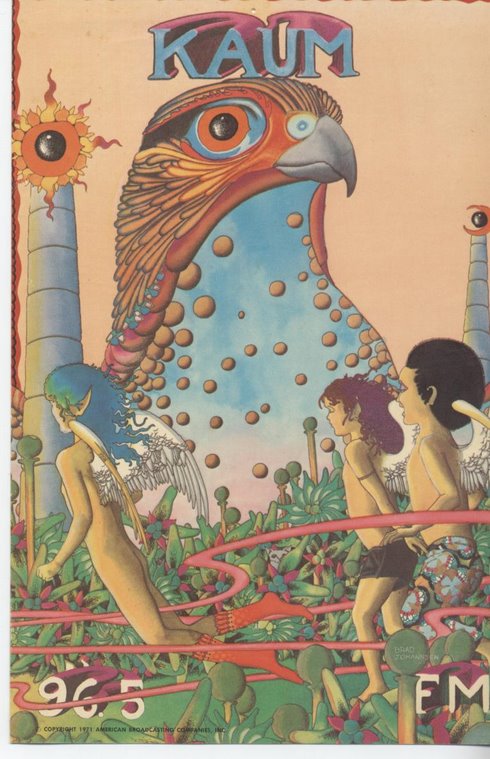
KXYZ-AM and and FM was locally owned and simulcast a heavily proudced beautiful music format until mid-decade when a heavy personality format was installed. In 1968 the stations were purchased by the American Broadcasting Company which returned a produced, matched-flow beautiful music format on the air under the direction of Paul Mitchell. This did well in the ratings until the first matched-flow beautiful music FM came on the air, KYND, the one-time KLVL-FM on 92.9, began to eat away at the numbers. By the spring of 1970, KXYZ-FM was broadcasting the ABC Love format which consisted of syndicated tapes of album-oriented rock programming. KXYZ-FM flipped call letters to KAUM and went live and local with the album rock format the first week of September, 1970. KAUM dropped the album rock format after just a few years and went through several format changes before changing call letters to KSRR in mid-1980. (KAUM last noted in Apr/May 1980 ARB; KSRR shown in Oct/Nov 1980 ARB). The station changed call letters again in the 80s to KKHT and then to KNRJ. (I first have KNRJ in 1989 RnR Ratings Report, Vol II) and by the Spring of 1991 had adopted KHMX-FM. (Spring 1991 ARB). More will be posted on this site on the history of KAUM.
The image above comes from the Houston Press in 1961.
Updated 7/6/2020
 Barry Sheft, a newsman and part-time DJ at KTRH; courtesy of Texas Radio Hall of Famer Bud Buschardt.
Chad Lassiter, first all-night talk host on KTRH, courtesy of Sam Lester.
The following photos are courtesy of Charlie Pena. Because of the size of the post and because I may add to it over time, I've experimented in this post with including smaller images in the post; it is still possible to see larger images by clicking on them.

A fascinating document, believed to be in Jesse Jones' own hand. It's dated a month before the sale of KUT to Jones was okayed by the FRC and on Texas State Hotel stationery rather than Rice Hotel stationery. Because of the mention of the Columbia Chain this must've been a projected budget for KTRH. And are the figures monthly or yearly? $175 a month for an announcer sounds like a princely sum.


Shots of the KTRH facility on the La Porte Highway, today's 225, probably taken in early 1930 after the move had been approved by the Federal Radio Commission but before operations began in Houston. I have always assumed the building faced the present day highway as later buildings on the site have done (KXYZ occupies the site today), but is the roadway pictured in front of the building the highway or just a driveway? Just a few years earlier, in the mid-1920s, there was no paved highway to Austin and no bridges over some streams that had to be crossed but this would have been a heavily traveled route on weekends as Houstonians made their way down to La Porte to Sylvan Beach Park and Bayshore Park. Perhaps the buildings faced in an easterly or westerly direction.

In the twenties and thirties and beyond, communities and broadcasters were proud of their broadcasting facilities and picture postcards were produced showing off buildings, often with the antenna in the background. I've searched for such postcards for the Houston stations and this is the closest I've seen. It at least identifies the Rice as the home of KTRH.

An unknown technician and what appears to be an electrical transcription machine and a portable one at that. Before the advent or wire recorders and, thankfully, tape recorders, this is how recordings were made by radio stations for rebroadcast or time-delayed broadcast. A large, long playing disc was produced which could be played back immediately.

KTRH owner Jesse Jones.

The group includes station owner Jesse Jones and comedian Jack Benny. I'm guessing the man on the left is a station announcer and the woman is a listener. It was a lot easier for network radio programs to go on the road than it is for TV shows and many shows, if not most, traveled, especially quiz shows and comedy shows. Benny may have been in town originating his show from KTRH or may have been in town for some other occasion. The show probably would have been performed live on the stage of the Music Hall or one of the big downtown movie houses rather than the KTRH studios so a large live audience could be accommodated.


A country music band, probably referred to as a hillbilly band at the time. Correspondent Andrew Brown has identified the fiddler as Dickie Jones and the group as Dickie Jones and his Rhythm Riders. Jones had several bands and performed in the Houston area a lot; this group was active ca. 1948-1950. The female may be Helen Smith. In the 1940s and early 1950s all the stations in town except KCOH aired at least some hillbilly music.

Unknown group although the person second from the right appears to be W. Albert Lee, owner of KLEE and KLEE-TV. He was associated with the Houston Fat Stock Show and Rodeo for years and because of the cowboy hats this may have something to do with that event. It's been suggested that's film star Tom Mix beside the microphone but it doesn't look like him to me and that's not his trademark style of hat, plus IMDB says Mix was 6 feet tall which would make 3 other men in that photo around 6'4". The gentleman on the right looks familiar and may have been a Harris County Sheriff.
Pictures like this make it evident how 'mic flags' got their name.

An unknown keyboard performer, possibly a station employee or a visiting artist.

This appears to be a man-in-the-street program, possibly on the sidewalk along Texas Avenue outside the Rice Hotel. Judging by the vehicles visible in the background and in the reflection and by the military uniforms, I'm guessing this was in the 1940s and after the end of World War II. This was long after Vox Pop had gone to the network but there would have been may occasions for a man-in-the-street program.
 Dr. Ben Oldag, on the left, and Bill Zak (corrected). This is the most recent photo in the collection and probably dates from the 1970s.