Showing posts with label KBRZ. Show all posts

Monday, February 17, 2014

KBRZ, Freeport, 1460 - Part 2

For Part 1, go here.

On April 23, 1959, the Brazosport Facts carried a story announcing the FCC had approved the sale of KBRZ.  The buyer was Jim Hairgrove doing business as Radio Brazosport, Inc., in partnership with Garfield Kiel and Stanley McKenzie plus Hairgrove’s wife, Sue.  The price was $80,000 and the request seeking transfer of ownership had been filed March 30.  Various stories over the years indicated Hairgrove had either been manager, owner or ‘had an interest in’ KFRD, Rosenberg.  William Schueler, the seller, was moving to Fort Worth where he had an interest in KJIM and he also had an interest in KTOW, Oklahoma City.  Ken Ferguson, who had been with KBRZ since 1952, was buying KMOP, Tucson, in a partnership with L.B. Clayton of Oklahoma City.

On the 26th, Radio Brazosport took out an ad in the Facts introducing itself to the community and on the 29th a story reported that Hairgrove, identified as owner/manager of KBRZ, was going to be one of the judges at that year’s Sun Fest Time at Surfside Beach.  Incidentally this ad is interesting to me; the Hairgrove family went to the same church as my family and I knew him, though not well.  I remember being told at some point that he did not like his radio station referred to as Kay-Breeze.

During the years that Hairgrove was owner the station was more involved in the community and received more mentions in the paper than it had under Scheuler with Hairgrove frequently serving as the identifiable station personality.  He became active in several civic and business organizations and there were fewer mentions in the paper of other personalities at the station.

On August 15, 1960, the FCC granted a pemit to KBRZ to install a new transmitter, change the studio location and permit remote operation of the transmitter.  Brazosport Savings and Loan was building a new center where North 11th and Avenue F intersect Texas 288 (Brazosport Boulevard) and it was announced KBRZ would be the first tenant.


Broadcasting Magazine reported on February 13, 1961, that the station had occupied its new facilites, installing a new Gates transmitter and Ampex PR 10 recording equipment.   The building originally was a light, bluish-gray color with royal blue trim.  Very large KBRZ letters, in royal blue, adorned  the second floor face of the building and couldn’t be missed coming into Freeport on 288.  A Pickwick Cafeteria occupied the ground floor of the two story section of the center while the station’s studios and offices were on the second floor.  The transmitter remained at the original site on FM 523.  Today the center is mostly vacant.

Meanwhile, in October, 1960, KBRZ had filed another application with the FCC requesting permission to up power to 1000 watts.  The story in the Facts also noted Hairgrove had just been elected President of the Texas Association of Broadcasters after having served as Vice President. He was also to serve 9 years as a Director of the TAB. The application for 1000 watts was dismissed in November, 1961, at the request of the station.

In 1962, a new company, Texas Audio Electronics, was formed by the same group of investors to seek a license for an FM staton.  More information about the launch and early years of KLJT-FM can be found in this updated FM Chronology post.

I found this ad in the Sunday, January 6, 1963, edition of the Facts but there was no story offering an explanation.  There were also ads appearing from time to time over the years for Secret Shopper contests, a Strike it Rich contest and others, but it was necessary to listen to get the details.  In November, 1963, the station published a 'survey' form in the paper, asking listeners to clip it, fill it in and return it.  The questions asked listener preferences about a number of programming categories and was perhaps a sort of market research to be used in programming the forthcoming FM station.

The 59th Session of the Texas Legislature created a new legislative district, 20-F, serving Brazoria and Ft. Bend counties and Jim Hairgrove announced his candidacy for the seat in January, 1966, citing as one of his main goals the reuniting of Brazoria Co. in one district.  He won handily over his only opponent in the May Democratic Primary, in those days tantamount to the general election, and took his seat in early January, 1967.  His legislative career was short-lived, however.  On April 12, he was found dead in his hotel room in Austin of an apparent heart attack.  His passing was banner headline news in the Facts and his funeral service also received extensive front page coverage.  After his passing, several civic organizations and governmental bodies in Brazosport issued proclamations praising his service to the community.  His widow took over running the radio stations (she had always been involved in daily activities) but by the end of the month, announced she would run to succeed her husband in a special election called for May and turned operations of the properties over to James V. Fridle as General Manager and Randy Griffin as Commercial Manager.  Fridle had come to KBRZ in 1963 from WRAC, Racine Wisconsin, to be News Director and been named Operations Manager in June, 1965.  Griffin had been with KBRZ since 1961.

Sue Hairgrove won out over a field of five in the special election and served the rest of what would have been her husband’s term but declined to run for re-election, saying she felt she had fulfilled his mission.  In October, 1968, Fridle resigned to take a job with the Curtis Broadcast group in the southeastern US and Sue Hairgrove resumed managing the properties, retaining Griffin as assistant.  Then in February, 1969, the sale of the two radio stations and background music service was announced to Wayne Marcy and George Mayoral, operating as Summit Broadcasting.  Marcy was a sales rep for radio equipment and Mayoral had radio and television interests in New Orleans and Puerto Rico.  The FCC approved the sale in July and transfer of ownership took effect on Saturday, July 19.  Sue Hairgrove announced her intention to remain in the Brazosport area but so far as I know was never involved in broadcasting again.

To be continued.

A link to the KBRZ Classic website, a tribute and streaming website.

Ad images above from the archives of The Facts on newspapers.com.

Monday, January 27, 2014

KBRZ, 1460, Freeport - Part 1

On April 4, 1952, the Freeport Daily Facts and Review reported that the Federal Communications Commission had approved the call letters for KBRZ, a new AM radio station for the Brazosport area, the first radio station licensed in Brazoria Co.  The call letters had been used previously by a station in Bryan operating on 1440 kc that had gone silent in 1949.  Kelly Bell of Nacogdoches, President of Brazosport Broadcasting which was putting the new station on the air, told the Facts the call letters stood for Brazosport and Brazoria Co.

The original application had been filed in November, 1950, for a 250 watt station operating unlimited hours on 1490 kc but that had been amended in May, 1951, to 500 watts, daytime only, on 1460 kc.  The Construction Permit was granted on March 26, 1952.  On May 21, the FCC approved the site for the new station, located on the old Angleton-Velasco road (FM 523) just outside the small settlement of Oyster Creek.  The new Texas 332 and the original span over the Intracoastal Waterway to Surfside would not be completed for a couple of years but the location was just north of the intersection of the Angleton-Velasco road and the new highway.   Harry Twombley, a construction company man in Brazosport had joined the ownership group.  Bell, originally from Midland, was an attorney in Nacogdoches and owner of KOSF there.  Another owner was J.C. Stallings of Nacogdoches who was to be General Manager, a post he held at KOSF

Prior to the launch of KBRZ, KIOX, Bay City, 1270 kc, had served as something of a local station for Brazosport, broadcasting advertiser remotes, a weekly 'This is Freeport' program from the Showboat Theater in Freeport, and covering the opening of the Brazoria Co. Fair in Angleton.

Construction of the facility got underway on June 10 and two days later O. A. Wood told the paper in an interview they hoped to be on the air by August 15 and the station was looking for local personnel to staff the station.  Wood, who had worked as Commercial Manager for KOSF, had been named GM of the station and had set up temporary offices on Broad St. in downtown Freeport.  Apparently, Stallings was going to stay in Nacogdoches.

As the date approached the sign-on got pushed back a couple of times.  On the 15 of August, Wood said they hoped to be on by the 23rd but that date passed.  On the 27th, a Wednesday, Wood said the station would begin operations the following Monday but the story also said the station would sign on at Noon that Sunday (possibly this was just for a dedicatory ceremony).  Then on Friday August 29 the Daily Facts and Review reported final FCC approval had been received and the station would sign on the next morning and hold an open house at the new station on Sunday, August 31.  A special dedication ceremony would be held at the station on Saturday evening involving the local Chamber of Commerce which had petitioned the FCC on behalf of the owners. 

KBRZ operated on 1460 kc with 500 watts of power, daytimes only (local sunrise to local sunset).  Studios and offices were housed in a building that resembled a big ranch house while the transmitter was located in the rear and the 210' antenna in the salt grass prairie that stretched back to the Intracoastal Waterway.

ETA:  A 1964 Historic Aerial image clearly shows the original studio and transmitter site.  A direct link to the image is not allowed; go to Historic Aerials and use the search parameters 'FM 523 and FM 332 Velasco Texas.'  You can turn on the 'All Roads' overlay to orient yourself.  The station is the first structure north of the intersection on the east side of 523 with a driveway to the transmitter out back.

On Monday, September 1st, two small ads appeared in the Daily Facts and Review.  One advertised a late fishing report on daily at 5:30 pm with the tag line ‘No, This Didn’t Get Away.’  The other urged listeners to ‘Develop the KBRZ Listening Habit’ by dialing 1460 daily from 7:30 to 7:45 (am) for ‘a program of comfort.’ 

Several stories over the first several months identified more of the station personnel.  In addition to Wood these included Betty Klein, Program Director, Dick Smith, News Director, Jack Howard, Commercial Manager, and Bill Reading on the commercial and announcing staff.  Smith had an impressive resume, citing stints as News Director or Editor at WOAI, KTSA, WFAA and the Liberty Broadcasting System.  Klein had worked at KTRM, Beaumont, KTXJ, Jasper and the Pams Agency in Dallas.  Howard had worked for the Liberty Broadcasting System and also Mutual and the Cactus Network in west Texas while Reading had worked at KNUZ, KULP, the Liberty Broadcasting System and KUHF-FM.  In separate stories Danny Kirk was identified as chief announcer and Kenneth Ferguson as Chief Engineer.  Kirk had come to KBRZ from WACO.

A story in July, 1953 named Raymond Carlton, aged 17, as working afternoons at KBRZ after summer school and said he planned to make a career in radio.  The station started broadcasting football games of the two high schools in the coverage area that autumn, carrying them on tape on Saturdays since the station was off the air Friday evenings. The station at times also carried the games of Lamar Tech in Beaumont.  A story in September, 1954 identified Bob Dunnavant as the play-by-play announcer for Brazosport Exporter games with Jim Grant doing the color commentary.  Charles Dunaway, Sports Editor of KBRZ, handled play-by-play for the Angleton Wildcats games with Chuck Lay doing commentary.  Two months later the paper reported popular DJ Charlie Dunaway was leaving KBRZ for a job as staff announcer at KPRC, Houston, noting Dunaway had been with the station 2 years and married a local girl.  Houston native and Texas Radio Hall of Famer Chuck Dunaway chronicled his career in his 2004 book The Way I Remember It, including a chapter devoted to KBRZ.  This used to be online but has been taken down and the book is currently out of print.  The same month Dunaway departed Jim Grant left for KGBC, Galveston. In April, 1956, Clifford L. Holloway was identified as Commercial Manager for KBRZ when he filed for office as a candidate for Lake Jackson City Council.  In June, 1956, a story mentioned ‘former PD’ Bob Dickson was taking a job at KRIS-TV, Corpus Christi, covering sports.  Dickson had come to KBRZ in November, 1955, to serve as PD, bring his popular 'Breakfast with Bob' show from KIOX, Bay City.

Within months of signing on, the station conducted the first of what would come to be a long running annual event, a Kiwanis Radio Auction.  Kiwanis Club members from both Freeport and Lake Jackson, the two largest towns in Brazosport, collected goods from merchants throughout the area for the auction which was held over the air on a Sunday afternoon in mid-December.  A big ad in the paper before the auction listed all the items for sale and for the first year these included a refrigerator, a dishwashing machine, a radio, fishing tackle, a watch and much more.  Money raised was to go to underprivileged children and the KRA, as it came to be known, was an annual event on KBRZ for over 20 years.

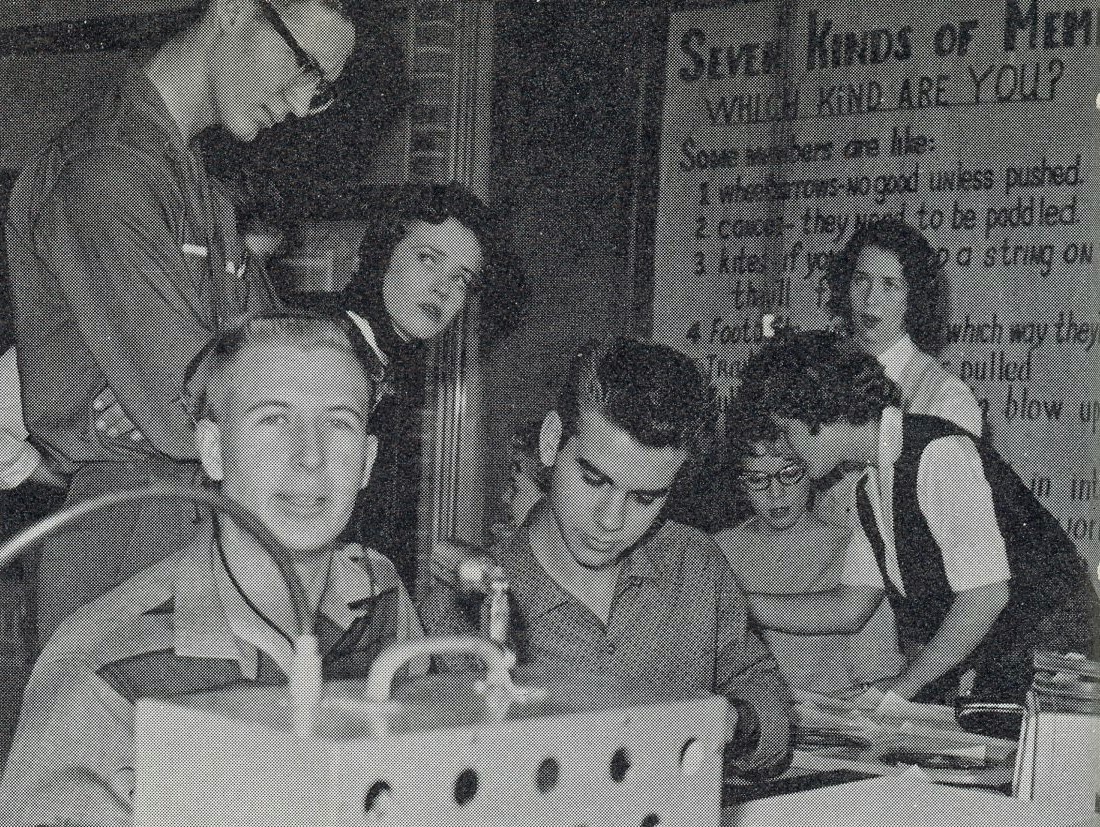
Another annual event was a Teens Against Polio Radiothon, held as early as 1955 and continuing annually until at least 1969.  Several Brazoria Co. residents had been afflicted with polio during the nationwide epidemics of 1952 and 1954 and polio was on everybody’s mind as a terrible disease.  Teen groups known as Teens Against Polio were formed all over the country and held fund raising activities, typically in January, including talent shows, dances, and midnight movies.  The radiothons on KBRZ involved all the area junior high schools; on a designated Sunday, requests would be taken on the air for dedications in return for a 25 cent donation, which was picked up by one of the volunteers stationed at the various junior highs.  I had my first on-air experience as a guest DJ on the radiothon in January, 1960, along with Howard Dupree who was a student like myself but also worked part time at KBRZ.  That year we also passed out car litter bags in return for a donation.

This photo shows Dupree at the microphone for the Radiothon, January 30, 1960, in the lobby of Brazosport Senior High, and was published in the Exporter, the school yearbook, for that year along with other photos of TAP activities.

One of the most memorable personalities on KBRZ in the early years was the guy who delivered the weather forecast every morning from Coast Guard Station Freeport.  It had been a huge boost to civic pride when the Coast Guard opted to station the 165' cutter Dionne at Freeport instead of Galveston in 1952 but even before the cutter arrived the Coast Guard station, on Freeport Harbor, the old Brazos River, just inland of the Intracoastal Waterway and below Dow Chemical Plant A, had been well known.  It was a frequent destination for school field trips and you passed right by it on the old road to the swing bridge leading to Surfside.  The weather report was probably the most complete weather feature you could ever want to hear on the radio delivered live by a specialist at the station and focused on conditions in southern Brazoria Co. but what made it so memorable was the accent of the Coast Guardsman who delivered it.  In his pronunciation the word hour became almost a 3 syllable word - ouwuh, as in 8 miles puh ouwuh - and it produced chuckles and comments among people throughout the area.

In December, 1955, Brazosport Broadcasting and KBRZ changed hands.  The buyer was William D. Schueler of Baltimore, MD, who had been in broadcasting since 1940.  Schueler planned to move to Brazosport with his family and told the local paper he contemplated no personnel or programming changes.  At the time, Kenneth W. Ferguson was identified as General Manager, having moved up from Chief Engineer.

In January, 1958, Ferguson announced the launch of ‘146 Full Dimensional Fidelity,’ a technological innovation which promised to bring ‘full hi-fi tones’ to the radio listening experience.  FDF as it was referred to for short was said to be the equivalent of hi-fi in recording.


Schedules for the broadcast day on KBRZ were published regularly in the Daily Facts and Review and it's successor, The Brazosport Facts, in the first several years.  These three, published Friday afternoon, October 10, 1952, for Saturday the 11th, Sunday the 12th and Monday the 13th were among the first.  The Facts was only 5 or 6 issues per week at that time, hence the schedule for the whole weekend; the last few hours of the schedule for Monday were perhaps omitted for lack of space.

Ad published in the Freeport Daily Facts and Review on September 9, 1955.

Images taken from newspapers.com.

For Part 2, go here.

Friday, July 24, 2009

The 1950s - Part I - KLVL, KMCO, KLBS, KBRZ, KCOH, KYOK

EDITED (BELOW) 9/8/2023

The number of stations on the AM dial in the Houston/Galveston area continued to grow throughout the 1950s but at a much slower pace than in the 1940s. By the end of the decade, FM began to come into it’s own.

As mentioned previously, KLVL signed on May 5, 1950, at 1480 kc, licensed to Pasadena. (Posts including mentions).

On April 16, 1951, KMCO signed on in Conroe at 900 kc. In 1979, the call letters of the Conroe station were KIKR; presently, KREH, licensed to Pecan Grove and a Vietnamese language station known as Radio Saigon, operates on the 900 frequency.

After the death of W. Albert Lee in November, 1951, Trinity Broadcasting Corporation purchased KLEE from his estate for $300,000. Trinity was made up of B.R. and Gordon McLendon of Dallas and oilman Hugh Roy Cullen of Houston. They owned KLIF, Dallas, KELP, El Paso, and the Liberty Broadcasting System. The station’s new calls were to be KLBS and the change took place on April 25, 1952, probably at midnight since both stations operated 24 hours a day. Ray A. Lewis was general manager of Trinity; Tom Cavanaugh was to be the General Manager of KLBS.

Gordon McLendon also said plans were being made to move the Liberty network’s headquarters to Houston from Dallas by sometime early in 1953 with about 150 jobs accompanying the move. KLBS would be the key station of the Liberty Broadcasting System and there would be a 100% change in the programming of the station. “Our goal is to salute Houston daily with top local and national entertainment, public interest and sports features,’ McLendon told the Houston Chronicle. The proposed move never took place as the network fell apart. McLendon was to sell KLBS in less than 2 years, only to repurchase it in 1957 and flip the call letters to KILT.

The Liberty network’s re-creations of baseball games had been a huge success and are what the network is mostly remembered for but there was a full range of programming offered including soap operas and newscasts originating from Washington, D.C., with such noted journalists of the day as William L. Shirer, Raymond Gram Swing, Joseph C. Harsh and John C. Vandercook. By the end of 1950, Liberty was supplying programming 16 hours a day and by August, 1951, had 431 affiliates, second only to the Mutual Broadcasting System. In Houston, LBS programs were heard on KATL. Less than a year later, 100 of the affiliates had pulled their affiliations, the broadcast day had been cut to 8 hours and the network was unraveling. Finanical problems were at the fore, with the loss of a $1,000,000 advertising contract with Falstaff beer the biggest single blow. This is what had led Hugh Roy Cullen to buy a stake in the network. Cullen, probably the richest Texan of the period, was impressed with McLendon and put $1,000,000 into the company without ever looking at the books. The network continued to lose money, however, and a second major blow was the refusal of Western Union to provide the wire service accounts that were necessary to the re-creation of ball games, a refusal that was upheld by a Federal judge in Chicago on April 14, 1952, one day before the start of the ‘52 baseball season.

For a first hand account of a McLendon sports recreation, see Don Keyes' account of working with McLendon, posted online a few years ago. Keyes was to be the National Program Director of the McLendon station group in later years, after the demise of LBS, and did mornings on KILT in Houston in the late 50s, being most famous for a flag-pole sitting stunt at Gulfgate Mall in 1957 (story here).

For a history of Gordon McLendon and his Liberty Broadcasting System and his ‘home’ station KLIF, see this excellent, comprehensive site maintained by Steve Eberhart. Also see the biography Gordon McLendon: The Maverick of Radio by Ronald Garay.

KBRZ, Freeport, came on the air at 1460 kc at the end of August, 1952.  A detailed account of the sign-on and early years of the station has been posted here.


The first week of August, 1953, a group of investors headed by Robert C. Meeker acquired the license to KCOH and announced plans to change the programming over to serve Houston’s Black community. The office, technical and sales staff were to be retained but an all new air staff would be brought in. Vernon Chambers, who for three straight years had been voted one of the nation’s best Black disk jockeys, was named program director. Walter Rubens was the commercial manager. KCOH was the first Black-owned radio station in Texas according to the Handbook of Texas and only the second programmed for a Black audience in the state.

The official switch over of programming was supposed to be on August 21, 1953, but a look at the daily listings indicates the changes may have been made gradually or the station might have already been programming some toward the Black audience before the change of ownership. Programs included Harlem Breakfast and Harlem Nights, Tuxedo Junction and Cool and Easy. It is, of course, impossible to know what the musical content of those programs was just from the names. On the 21st, the newspaper schedule showed Chambers Corner, King Bee and Hattie Holmes, Sweet and Solid, Jammin’ Jamboree, Swing Low, the Rhythm Parade and the PM Ramble on the schedule.

A similar switch seemed to be taking place on KATL in the same time period. Program listings included Dixie Downbeat, RFD 1590, and the Chuck Wagon Call that had been the station’s morning show for years, but also Trummie Cain and Ramblin’ Round, both of which were later seen on KCOH schedules. In early 1954 King Robinson, General Manager and part-owner, announced that he and William H. ‘Little Eva’ Talbot, majority owner, had received an inquiry from a couple of Louisiana businessmen interested in buying the station. An announcement was expected soon and it came on the 15th of January. Jules Paglin and Stanley Ray, who owned stations in New Orleans, Baton Rouge and Lake Charles, bought KATL for $200,000. Their group was known as the ‘OK’ chain and they were considering KYOK as new calls on 1590. No changes in programming were planned, it was stated.

KYOK was to become Houston’s second Black radio station; program changes apparently were brought into place gradually. Like most stations, KATL/KYOK was block programmed. Paglin and Ray eventually were to own a chain of black radio stations, including WBOK, New Orleans, WGOK, Mobile, WLOK, Memphis and WXOK, Baton Rouge. The new calls first appeared in the listings in the Chronicle on March 10 but not until March 18 in the Post.

In the summer of 1954 KYOK program listings still included Chuck Wagon Call, Let’s Polka, Gabe Tucker, Serenade in Blue, Kosher Kitchen and Hillbilly Hits, along with Sweet Chariot, Hotsy Totsy, Spiritual Sunbeams, and Little Betty. Hotsy-Totsy was to be a name of a KYOK jock for years. Tucker, a country dj, had worked on KATL, KLEE, and was to be on KRCT and KIKK for years.


Other stations, including KREL, also played rhythm and blues but KCOH took note of the new competition running ads touting itself as ‘Houston’s First and Only Negro Radio Station.’ The line-up on 1430 by this time included Chamber’s Corners, King Bee, Hattie Holmes, the Great Montague and Ramblin’ Around. A real estate program had been added on Sunday afternoons, patterned after a successful show on KXYZ, presented by a Black realtors association and aimed at Black homebuyers. It has also joined a new network, the 45 station strong National Negro Network, and started airing the first network program, a soap opera called Ruby Valentine, daily at 11am. There were plans for 3 more soaps and a dramatic series; network programs were distributed on tape.

EDIT TO ADD:  King Bee, on KCOH, real name was Clifton Smith.  He had an airshift on KNUZ in 1950 and is pictured in the montage at the top of the blog.  He (and Gladys 'GiGi' Hill were nominated for the Texas Radio Hall of Fame this year (2023) but did not receive enough votes to get in.