Showing posts with label KLBS. Show all posts

Wednesday, January 4, 2012

A Tim and Bob Gallery

Often referred to as Houston's first morning duo, Tim and Bob were together on KPRC for over a decade. For more on the duo on this blog, click on the label at the end of this post; for other mentions of either individual enter the words 'Byron' or 'Nolan' in the search box.

The St. Patrick's Day Parade was one of their biggest promotions. According to a history on the St. Patrick's Parade Commission website, Tim and Bob resurrected the long-dormant Houston St. Patrick's Day parade in 1960 but I don't have dates for these pictures.

Bob Byron, left, and Tim Nolan. Judging by the decorations on the cake, this had something to do with St. Patrick's Day, too.

KPRC carried the syndicated 1960s comedy feature Chickenman and the Fearless Feathered Fighter came to town to promote the series.

And now for something a little different:


Judy Bonham, Byron's oldest daughter, to whom I am indebted for these pictures, notes the guys seem to be enjoying themselves.

Miscellaneous clippings and shots:

This clipping was from the Houston Post on a Friday in August but unfortunately the date and year is cut. It appeared top left, right under the masthead and above a story about heart surgery for a Cuban boy.

And a couple of personal mementos from Byron:

My thanks to Judy Bonham for providing all these shots and my apologies for taking so long to get them online. My thanks also to all the children of Tim and Bob I have corresponded with over the last year or so for their help.

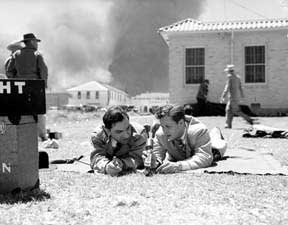
One of the reasons I delayed publishing these pics was to try and identify the football player in the third from the last picture. I wasn't in Houston during most of the 60s and have no idea who it is, but have a suspicion that he was rather famous for some reason. I will appreciate it if anyone can identify him or add any information about any of these photos such as dates or names. For instance, if anyone can hazard a guess about the name of the movie on the marquee in picture # 1, we can probably date that picture but since Glenn McCarthy appears in two different shots in two different vehicles, the pictures probably do not all date from the same year.

Friday, August 28, 2009

The 1950s Part II - KILT, KILE, Galveston, KRCT,Pasadena

Updated 6/18/11 to add information about the change of ownership of KRCT.

Around the end of February, 1957, the McLendon Investment Corp. completed purchase of KLBS from the Howard Broadcasting Corporation for $535,000, thus repurchasing the station Trinity Investments had owned from 1952-1954. It was said to be the largest cash transaction in Houston radio history. Glenn Douglass, General Manager of KLBS, told the Chronicle there was much speculation on the part of the staff about what was to happen as McLendon was known for making wholesale personnel changes when he took over a station. The line-up included Bob Yongue doing mornings, Bob Gwyn, Dave Chase, Mark Noble and Mike McKay. The station was airing a number of paid religious programs daily including Rev. Lester Roloff at 7am, an Assembly of God program at 9am, Unity Viewpoint at 9:15 and a Dr. Weber from 9:30 to 10am.

On the fifth of May, Jack Harris, GM of KPRC-AM/FM/TV announced the radio stations would begin Houston’s first regular stereo broadcasts that week, from 9:05 to 10pm, five nights a week. Listeners were to tune one station to the AM, another to the FM to get the stereo effect. KPRC-FM PD Ronald Schmitt had secured more than 80 hours of programming that would include music outside the regular Classical fare of the FM station.

The same day, Bill Weaver, a new GM at KLBS, told the Chronicle changes at that station would be coming in a couple of weeks. Weaver had been brought in from KTSA, San Antonio. The big changes were announced just a week later on May 11 and occurred on May 14, a Tuesday, although the new calls, KILT, appeared in the Chronicle the previous afternoon.

The new line-up included Eliot Field from Boston doing mornings, Bob Stephens of Miami on 9a-12N, Art Nelson from Dallas on early afternoons. Don Keyes of San Antonio was the Program Director and did afternoon drive. The newspaper schedules showed Buddy McGregor, 6-9pm, and Bob Adams, 9pm-12M. Other deejays announced included Tom Fallon of Kansas City, Mike Whalen and Bob Horn of Philadelphia and Joe Long of Knoxville as News Director. Mike McKay and Mark Noble were the only holdovers from the old staff; McKay did overnights while Noble was not listed in any slot for several weeks. All the religious programming was dropped.

A full page ad in the Post was designed to look like a Wanted Poster with six pictures bearing only serial numbers and warned Houstonians to be on the lookout for

‘...these men. They are about to steal the Houston radio audience. These men have begun operations on Color Channel 61 Today. These colorful characters are highly entertaining. Their deep resonant voices will ‘con’ you into listening to KILT, Houston’s new radio voice, around the clock every day.

REWARD: Twenty four full hours of daily listening pleasure
.

After Field left for a gig in Los Angeles, Keyes took over as morning man.

The same week of the big flip, Tim Nolan moved from the job as morning host on KXYZ to the same post at KPRC where he soon was to be teamed upwith Bob Byron, a KLBS-ex, to form Houston’s first duo team in morning drive, Tim and Bob; they were to be together for more than a decade.

For more on my memories as a kid of listening to KLBS and KILT, see my ‘Thanks for the Memories’ segment here:

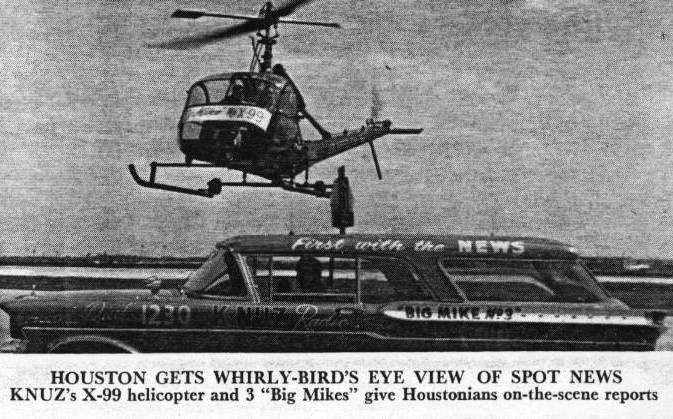
KNUZ, expecting tough competition from the new station, had just purchased a helicopter and ran ads promoting itself as Houston’s only radio station with wings and touting its top ranking. The helicopter had just been put in use when some heavy flooding hit the area and was used in exclusive reports.

Toward the end of the summer a group of Galveston businessmen completed the acquisition of KLUF from it’s founder and owner George Roy Clough and his sons. Clough, whose name was pronounced cluff, hence the call letters, was, even by his own admission, a contentious man who made many enemies and brought a lot of attention to Galveston, not all of it favorable. The son of a telegraph operator and former race car driver, Clough’s knowledge of radio had led him into the field but by this time he was serving as Mayor of Galveston, said to have run initially because he was angered over a city water bill and vowed retribution. He served two terms as Mayor but lost a re-election bid for a third term and a subsequent try for city council. For years he operated a radio and television shop next to his home at 34th and Ave P. He died in November, 1966.


The new call letters for the station were KILE and it debuted on September 2, 1957, at 6am. According to GM Robert. L. McClellan there was all new equipment and programming. Tim Lewis was News Editor and the staff also included Bill Bance, Tom Beck and Warren Anderson. The morning show was called Hit the Deck while an afternoon program was called Teen Tempos. Most old-timers in the Houston/Galveston area will remember KILE as a Top 40 station and it has had many alumni working in Houston radio.

The call letters of this station are now KHCB and it has recently been relicensed to League City.

The first week of October, 1957, KRCT began broadcasting from new studios at 227 East Sterling in Pasadena. The station always ran lots of ads in the Chronicle with the first concerning the changeover appearing on October 2 proclaiming a Grand Opening going on the 3rd thru the 6th with everyone invited to stop by to visit the new facilities. $1000 worth of door prizes were to be given away. The on-air schedule included Hal Harris from 6a-10a, Gabe Tucker, formerly of KATL and KLEE from 10a-1p and Sleepy Bob (Bob Everson) from 1-5pm. Leroy Gloger liked to claim that 650 was Houston’s only ‘clear channel’ station but the clear was assigned to WSM, Nashville, the Houston station was always limited to daytimes only. Over the years the station was also promoted as the ‘Voice of Labor.’ The format was always country.

An application for approval of the sale of the station was announced November 18, from W. D. Christmas to John H. Touchstone and Leroy J. Gloger for $175,000. Touchstone had been a 7 % owner; he and Gloger were to be equal partners under the new ownership. The transfer was approved a month later. In March of 1959 they sought approval of a transfer of the license and CP from Bay Broadcasting to Industrial Broadcasting noting this was a corporate change only, not a change of control. This was granted in mid-May. Touchstone was President, Gloger was Vice President and General Manager.

KRCT was to become KIKK in 1961.

The image above is from the Galveston Daily News
.

Friday, July 24, 2009

The 1950s - Part I - KLVL, KMCO, KLBS, KBRZ, KCOH, KYOK

EDITED (BELOW) 9/8/2023

The number of stations on the AM dial in the Houston/Galveston area continued to grow throughout the 1950s but at a much slower pace than in the 1940s. By the end of the decade, FM began to come into it’s own.

As mentioned previously, KLVL signed on May 5, 1950, at 1480 kc, licensed to Pasadena. (Posts including mentions).

On April 16, 1951, KMCO signed on in Conroe at 900 kc. In 1979, the call letters of the Conroe station were KIKR; presently, KREH, licensed to Pecan Grove and a Vietnamese language station known as Radio Saigon, operates on the 900 frequency.

After the death of W. Albert Lee in November, 1951, Trinity Broadcasting Corporation purchased KLEE from his estate for $300,000. Trinity was made up of B.R. and Gordon McLendon of Dallas and oilman Hugh Roy Cullen of Houston. They owned KLIF, Dallas, KELP, El Paso, and the Liberty Broadcasting System. The station’s new calls were to be KLBS and the change took place on April 25, 1952, probably at midnight since both stations operated 24 hours a day. Ray A. Lewis was general manager of Trinity; Tom Cavanaugh was to be the General Manager of KLBS.

Gordon McLendon also said plans were being made to move the Liberty network’s headquarters to Houston from Dallas by sometime early in 1953 with about 150 jobs accompanying the move. KLBS would be the key station of the Liberty Broadcasting System and there would be a 100% change in the programming of the station. “Our goal is to salute Houston daily with top local and national entertainment, public interest and sports features,’ McLendon told the Houston Chronicle. The proposed move never took place as the network fell apart. McLendon was to sell KLBS in less than 2 years, only to repurchase it in 1957 and flip the call letters to KILT.

The Liberty network’s re-creations of baseball games had been a huge success and are what the network is mostly remembered for but there was a full range of programming offered including soap operas and newscasts originating from Washington, D.C., with such noted journalists of the day as William L. Shirer, Raymond Gram Swing, Joseph C. Harsh and John C. Vandercook. By the end of 1950, Liberty was supplying programming 16 hours a day and by August, 1951, had 431 affiliates, second only to the Mutual Broadcasting System. In Houston, LBS programs were heard on KATL. Less than a year later, 100 of the affiliates had pulled their affiliations, the broadcast day had been cut to 8 hours and the network was unraveling. Finanical problems were at the fore, with the loss of a $1,000,000 advertising contract with Falstaff beer the biggest single blow. This is what had led Hugh Roy Cullen to buy a stake in the network. Cullen, probably the richest Texan of the period, was impressed with McLendon and put $1,000,000 into the company without ever looking at the books. The network continued to lose money, however, and a second major blow was the refusal of Western Union to provide the wire service accounts that were necessary to the re-creation of ball games, a refusal that was upheld by a Federal judge in Chicago on April 14, 1952, one day before the start of the ‘52 baseball season.

For a first hand account of a McLendon sports recreation, see Don Keyes' account of working with McLendon, posted online a few years ago. Keyes was to be the National Program Director of the McLendon station group in later years, after the demise of LBS, and did mornings on KILT in Houston in the late 50s, being most famous for a flag-pole sitting stunt at Gulfgate Mall in 1957 (story here).

For a history of Gordon McLendon and his Liberty Broadcasting System and his ‘home’ station KLIF, see this excellent, comprehensive site maintained by Steve Eberhart. Also see the biography Gordon McLendon: The Maverick of Radio by Ronald Garay.

KBRZ, Freeport, came on the air at 1460 kc at the end of August, 1952.  A detailed account of the sign-on and early years of the station has been posted here.


The first week of August, 1953, a group of investors headed by Robert C. Meeker acquired the license to KCOH and announced plans to change the programming over to serve Houston’s Black community. The office, technical and sales staff were to be retained but an all new air staff would be brought in. Vernon Chambers, who for three straight years had been voted one of the nation’s best Black disk jockeys, was named program director. Walter Rubens was the commercial manager. KCOH was the first Black-owned radio station in Texas according to the Handbook of Texas and only the second programmed for a Black audience in the state.

The official switch over of programming was supposed to be on August 21, 1953, but a look at the daily listings indicates the changes may have been made gradually or the station might have already been programming some toward the Black audience before the change of ownership. Programs included Harlem Breakfast and Harlem Nights, Tuxedo Junction and Cool and Easy. It is, of course, impossible to know what the musical content of those programs was just from the names. On the 21st, the newspaper schedule showed Chambers Corner, King Bee and Hattie Holmes, Sweet and Solid, Jammin’ Jamboree, Swing Low, the Rhythm Parade and the PM Ramble on the schedule.

A similar switch seemed to be taking place on KATL in the same time period. Program listings included Dixie Downbeat, RFD 1590, and the Chuck Wagon Call that had been the station’s morning show for years, but also Trummie Cain and Ramblin’ Round, both of which were later seen on KCOH schedules. In early 1954 King Robinson, General Manager and part-owner, announced that he and William H. ‘Little Eva’ Talbot, majority owner, had received an inquiry from a couple of Louisiana businessmen interested in buying the station. An announcement was expected soon and it came on the 15th of January. Jules Paglin and Stanley Ray, who owned stations in New Orleans, Baton Rouge and Lake Charles, bought KATL for $200,000. Their group was known as the ‘OK’ chain and they were considering KYOK as new calls on 1590. No changes in programming were planned, it was stated.

KYOK was to become Houston’s second Black radio station; program changes apparently were brought into place gradually. Like most stations, KATL/KYOK was block programmed. Paglin and Ray eventually were to own a chain of black radio stations, including WBOK, New Orleans, WGOK, Mobile, WLOK, Memphis and WXOK, Baton Rouge. The new calls first appeared in the listings in the Chronicle on March 10 but not until March 18 in the Post.

In the summer of 1954 KYOK program listings still included Chuck Wagon Call, Let’s Polka, Gabe Tucker, Serenade in Blue, Kosher Kitchen and Hillbilly Hits, along with Sweet Chariot, Hotsy Totsy, Spiritual Sunbeams, and Little Betty. Hotsy-Totsy was to be a name of a KYOK jock for years. Tucker, a country dj, had worked on KATL, KLEE, and was to be on KRCT and KIKK for years.


Other stations, including KREL, also played rhythm and blues but KCOH took note of the new competition running ads touting itself as ‘Houston’s First and Only Negro Radio Station.’ The line-up on 1430 by this time included Chamber’s Corners, King Bee, Hattie Holmes, the Great Montague and Ramblin’ Around. A real estate program had been added on Sunday afternoons, patterned after a successful show on KXYZ, presented by a Black realtors association and aimed at Black homebuyers. It has also joined a new network, the 45 station strong National Negro Network, and started airing the first network program, a soap opera called Ruby Valentine, daily at 11am. There were plans for 3 more soaps and a dramatic series; network programs were distributed on tape.

EDIT TO ADD:  King Bee, on KCOH, real name was Clifton Smith.  He had an airshift on KNUZ in 1950 and is pictured in the montage at the top of the blog.  He (and Gladys 'GiGi' Hill were nominated for the Texas Radio Hall of Fame this year (2023) but did not receive enough votes to get in.

Tuesday, February 24, 2009

Gallery IV - Miscellaneous Ads


Published in November, 1922. Bering-Cortes was one of the forerunners of today's Bering Hardware.


Once upon a time, everything in radio was battery-powered, not just receivers but studio and transmitting equipment, too. And we're not talking a couple of AAs, either. Batteries had to be charged up, of course. Automobiles did not have generators or alternators so garages were set up to service, i.e., charge, batteries and they serviced home batteries, too. One such business in Houston was the Hurlburtt Still Electric Co. who also obtained the first broadcasting license in Houston, for WEV, and whose garage on McKinney at San Jacinto served as the station's studios.


These ads were published in the Scripps-Howard Houston Press in the fall of 1950 when the newspaper and radio station were sharing news coverage and reporting. Gordon McLendon's Liberty Broadcasting System was heard over several radio stations over the years. KATL was the first Houston affiliate.


Published July 23, 1960.


The ads for KFMK, KHUL, KODA, KRBE and KTLW all appeared in the Houston Now section of the Houston Post for August 4, 1961, which was shortly after KODA first signed on. I have misplaced my original for the Lone Ranger on KODA ad and do not know the date.

A full page ad for KULF, 790, formerly KTHT, in Houston Home and Garden Magazine, June, 1978.

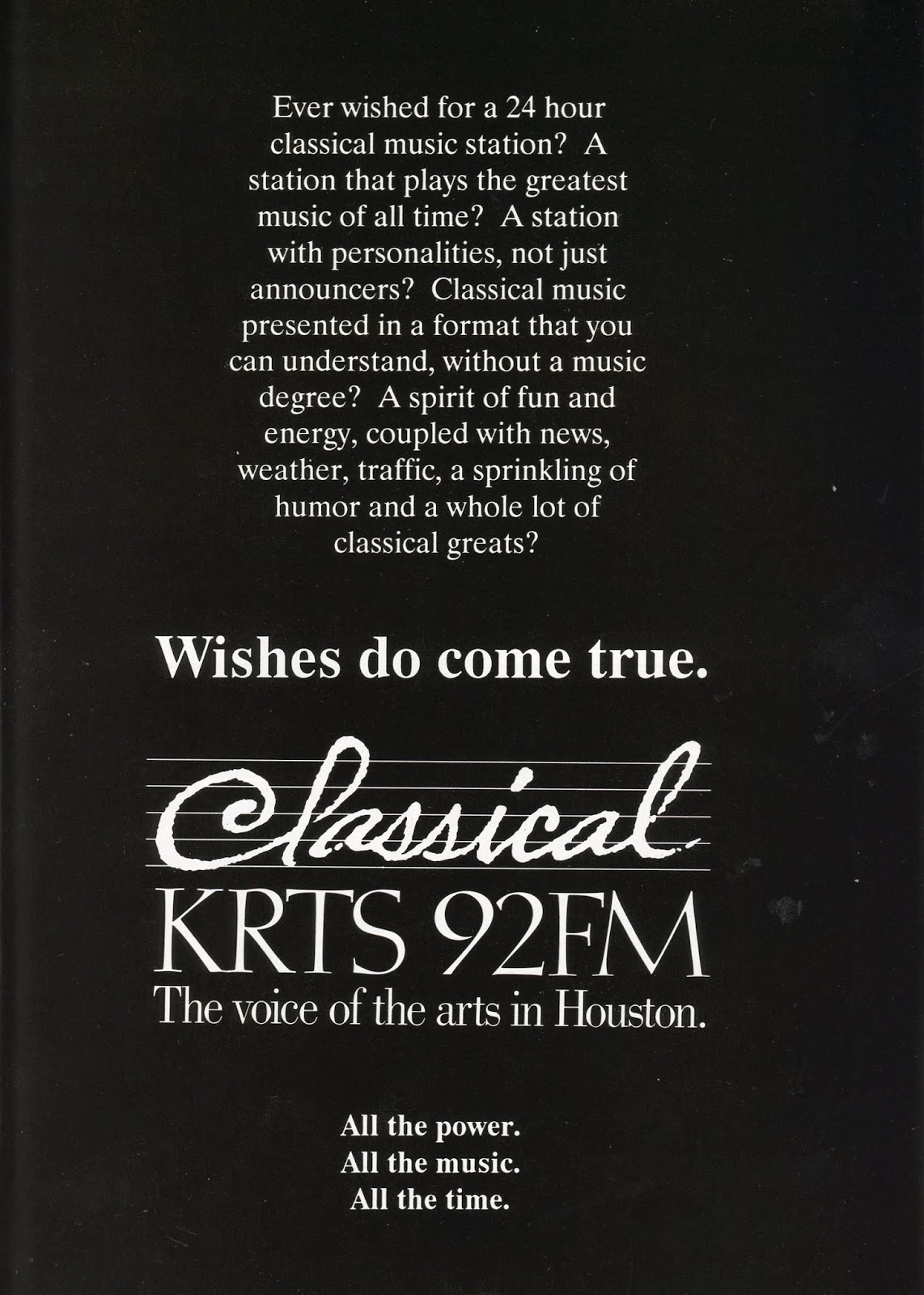
A full page ad for KRTS-FM, 92.1, in Houston Metropolitan Magazine, May, 1992.


KODA-FM Outdoor, ca. 1978-9, after purchase by Group W, Westinghouse

An ad from Broadcasting Yearbook, 1964.

Following are some ads from the broadcasting trade papers sent to me by Chris Huff of the DFW Radio Archives.


KLBS, 1957


An ad for the Veterans Broadcasting group of stations; date unknown but has to be later than late 1961.


KTHT, 1956


KYOK, 1956


A business card for Utah Carl, a Galveston performer on KLUF (1400),KGUL-TV and KTRK-TV, sent to me by Dave Westheimer.

My apologies for the quality of some off the images, the result of over-inked newspapers and the impossibility of getting a decent print off of a microfilm printer sometimes.

Saturday, December 13, 2008

The 1940s - Part 7 - KLEE


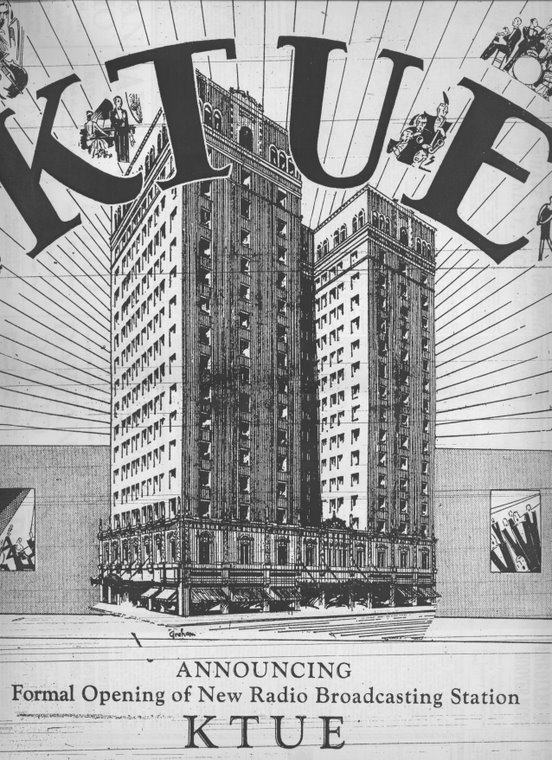
If KATL had been a something of a stealth entry onto the Houston radio scene the next new AM station in town was to make quite a splash. In early 1946, Houston businessman W. Albert Lee had decided to make a foray into broadcasting. He received a permit in May 1947 and got his station on the air Saturday, January 31, 1948, timed to coincide with the opening of the Fat Stock show that year. Studios were to be in the San Jacinto Hotel, which was being remodeled, but work went faster on a similar project at the Milby at Travis and Texas and the studios wound up there. Lee put a 62 foot Translux animated sign on the exterior of the hotel, the first of its kind in Houston, a smaller version of the famous one in Times Square in Manhattan. As he had done with 2 of his hotels and was to do with his television station less than a year later, Lee used his name for the call letters. KLEE operated at 610 kc with 5000 watts from a 4 tower array. Hilton Waldo Hearn, Jr.'s 1971 Masters Thesis on Lee placed the transmitter on Airline Drive but a Chronicle story placed it on the Dallas Highway. John B. Hill, an engineer at KILT from 1960-1964 who started as an engineer at the transmitter says it was on West Rd., just west of I-45, across 45 from Aldine High, which sits near the intersection of Airline at West. Lee still owned the station at the time of his death in late November, 1951.

As part of the build-up to the launch of the station, Lee turned on the Translux sign two weeks before broadcasting began, staging a big ceremony. The sign was on the Texas Avenue side of the Hotel, facing Jesse Jones’ Rice Hotel but was to be turned off at 10:30 every night. There were big stories in the newspapers almost every day in the week leading up to the launch.

KLEE received front page coverage in the Saturday morning Houston Post on the day the station signed on and the station placed a full page ad concerning the opening ceremonies scheduled for 5pm. The ad included pictures of station personnel and facilities, but has been difficult to reproduce from the microfilms or I would post it here. Gene Autry and his entire troupe were to be on hand, as well as actor Michael O’Shea, Virginia Mayo, Wild Bill Elliot, Albino Torres and his Orchestra and others. There was to be a special live, remote broadcast from the Fat Stock show, and, in the midst of all that, coverage of that day’s election returns on a vote on the subject of zoning for the city of Houston (the zoning proposal lost - duh).

Lee had purchased an 8000 disc library and subscribed to a music transcription service but the first song aired on the new station was performed live: Gene Autry's Cass County Boys played 'The Eyes of Texas,' punctuated by pistol shots and cries of 'Yippee,' to open the ceremony and Autry later sang his signature song ‘I’m Back in the Saddle Again,’ the first song sung on 610. All the show business people stuck around for more appearances on the station for a couple of days, with live broadcasts in one of the big studios starting at 6:10pm, open to the public.


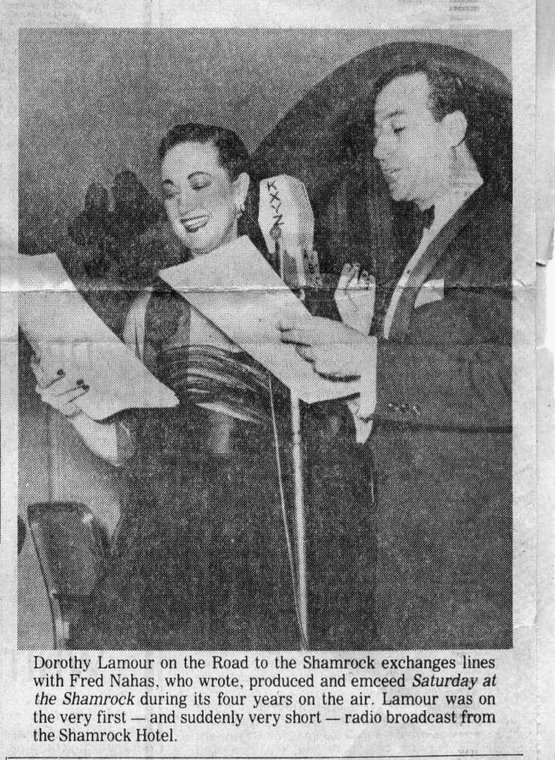
Lee received congratulatory messages from many of his famous and rich friends plus his radio competitors, including Jesse Jones, the Hobbys, Glenn McCarthy and Coke Stephenson. Fred Nahas, who was to become a Houston radio legend in his own right, wrote that he was most impressed that Lee had four ministers pray at the dedication ceremony, a Rabbi, a Catholic priest, a Greek Orthodox priest, and a Methodist minister. Nahas had just launched Houston’s first Muzak-like piped-in music service.

The Chronicle ran a full length column in the Sunday paper on the launch under the headline 'Crowds view KLEE official opening here.' Ray Bright, Commercial Manager of KTRH across the street, had been hired as General Manager. WInthrop 'Bud' Sherman of WOC, Washington, DC, and the Mutual Radio Network had been hired as Program Director. He had also worked at KNOW, WBAP, WACO and KMOX. Paul Huhndorff was picked as the chief engineer; he would go on to put KLEE-TV on the air for Lee in less than a year and stay with the TV station when it was sold to KPRC. The chief announcer was Charles Rashall whom the Chronicle article said 'formerly was heard on coast-to-coast shows originating in the film capital.' Lee's biographer credits Lee with hiring a young Dick Gottlieb out of Texas A&M to do play-by-play of high school football games on Thursday and Friday nights for $25 per game, thus giving Gottlieb and entry into Houston radio. He was to go on to serve as an off-camera announcer on KLEE-TV and stay with the television station when it was sold, becoming known as 'Mr. Television' in Houston for the first decade and a half of Houston TV. However, the claim has also been made that Gottlieb first worked in Houston for Roy Hofheinz' KTHT.

Lee was apparently pretty difficult to work for. He went through 3 program directors in 3 years with Sherman leaving just 3 weeks after the station signed on. Ted Hills, who had been program director of early Houston radio station KFVI in the 1920s and KTHT in the mid 40s was one of the PDs. Without a network affiliation the station had to rely on local advertising sales completely for revenue. According to his biographer Lee attempted to motivate his sales staff but instead drove them away. He was known to fire announcers on the spot for an on-air comment he didn’t like.

Even before KLEE was on the air, Lee had traveled to the East coast, negotiating for talent to appear at the Rodeo, and been exposed to television. He came back to Houston determined to put a television station on the air and filed for a permit on October 8, 1947. The announcement of his intentions appeared in Television Magazine in November, 1947, and that same month in Houston Magazine. Approval by the FCC was to take only 3 months with approval on January 30, 1948, the day before his radio station signed on, although Lee apparently didn’t get the news for a couple of days. Studios were to be in the Milby Hotel with the radio station and the transmitter on South Post Oak near the Pin Oak Horse stables. KLEE-TV was to sign on New Year’s Day, 1949, Houston’s first television station, on Channel 2. There's more on KLEE-TV in the TV section on the sidebar.

The year following Lee’s death, KLEE-AM was sold to Gordon and B.R. McLendon’s Trinity Broadcasting of Dallas who changed the call letters to KLBS and made it a part of his Liberty Broadcasting System. McLendon announced plans to move the headquarters of the network to Houston and use KLBS as the flagship station, according to McLendon’s biographer, but they fell apart when McLendon had to give up the baseball game recreations which formed the backbone of the network programming. According to the History of KLIF website, McLendon owned the station from 1952 to 1954 and repurchased it to flip it to KILT in May, 1957. The studios were still located in the Milby Hotel when the call letters changed, but later moved to 500 Lovett Blvd. in the Montrose area where they stayed for almost 40 years. KILT has been the call on 610 ever since 1957. The station was a Top 40 station for many years and flipped to Country in 1981, then to Sports around 1995.

When I first read of the supposed intentions of moving the headquarters of Liberty to Houston I was skeptical. I have always thought of McLendon as a Dallas broadcaster and it was difficult to even imagine him abandoning Dallas and given his penchant for promotional hype, I thought he was probably just blowing smoke. However it becomes more believable when considering that, according to McLendon's biographer, Ronald Garay, Houstonian Hugh Roy Cullen had invested $1,000,000 in Liberty in August, 1951, to help prop it up. Cullen was considered by some the richest man in Texas at the time and had been expanding his influence politically. He had asked an aid to look into investing in Liberty but canceled the due diligence after just one meeting with Gordon. The two men had similar political ideologies and found they admired each other very much. Cullen extended another loan of $175,000 the next year as the network was collapsing and was one of the major creditors suing for a share of the assets after the collapse (the other was B. R. McLendon).

The Houston Post typically found a way to put it's own radio station on the front page during all the build up to the launch of KLEE. On Thursday, January 29, a front page story pointed out KPRC would be celebrating 20 years of being an NBC affiliate the next Thursday with a special concert at the Music Hall and on Friday, January 30, another front page story advised riders of the Houston Transit Company buses that they would soon be among the first in the nation to hear music as they rode the buses. In an experimental program sponsored by KPRC-FM, special receivers would be installed in buses to allow reception of KPRC-FM’s signal (and presumably no others). The receivers were eventually installed in 250 buses and the ‘experiment’ lasted until 1950.

Wednesday, January 23, 2008

Gallery III - Memorabilia

A collection of miscellaneous bumper stickers.


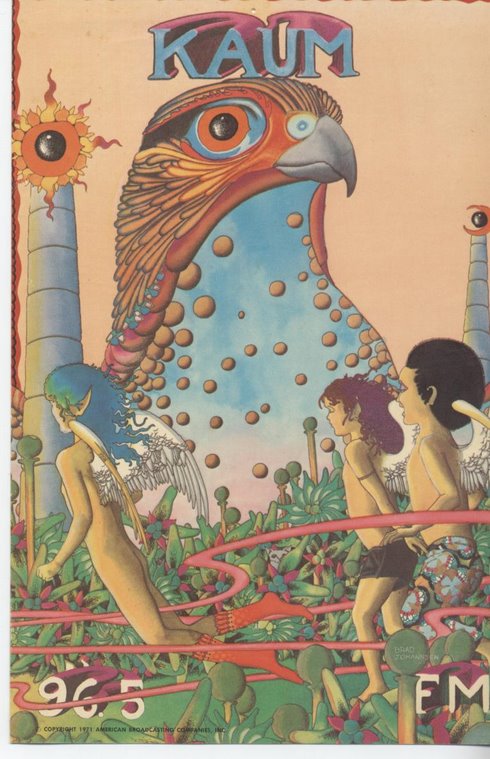
ABC-FM was running Love FM on their 7 FMs, a taped album rock format, but flipped them all to live and local with new calls in September, 1970. In Houston KXYZ-FM flipped to KAUM. The artwork and calls were determined by ABC. Houston got the coolest artwork. The bumper stickers came in about a half dozen different colors.


The Air Corps was a locally conceived, short-lived positioning first used in the fall of 1971. This is actually a billboard card; the bumper stickers were longer and not as tall.


This was when the station was known as Rock 'n Stereo, beginning in 1972. The positioning and design were selected by ABC-FM.


A reverse window sticker for Majic 102, KMJQ-FM


Calls very briefly used on 100.3, KILT-FM


The calls were officially KIKK-FM.

OUT OF TOWN


KMKS-FM, Bay City


KMZK, Fort Worth, ca. 1981, owned by Taft Broadcasting of Houston at the time.

A FEW MISCELLANEOUS RADIO SURVEY SHEETS

A KLBS Survey from February, 1955

A KXYZ survey from May, 1956

A KXYZ survey from November, 1956

A KXYZ survey from January, 1957

A KILT survey from August, 1957

A KTHT Hit Parader survey from May, 1961

More surveys from Houston radio stations (text only) can be found here.