Showing posts with label KATL. Show all posts

Monday, April 28, 2014

A Feature on Early Black DJs in Houston

...and the origin of the term rock and roll, from Wired For Sound, an excellent blog (link on the sidebar) with pictures, names and history.

Would I ever love to hear some air checks.

There are scattered pictures and history of Houston radio of years past throughout the blog.  For instance, way down at the bottom of this post is a picture of Dickie Jones and the Skyliners in the KATL studio in 1947.  As the legend notes, the man at the microphone is Johnny Edwards, morning man on KATL.

Thursday, November 19, 2009

More on the Marvin Zindler tapes

The Bayou City History Blogger, J.R. Gonzales, has continued to post excerpts from the Marvin Zindler tapes but not all of them have been in The Roving Mike series. Recently J.R. posted what I guessed were excerpts from the production music library at KATL and just yesterday revealed excerpts from a live country music show that ran on KTRH with Western Swing musician Bennie Lueders, whom Gonzales tracked down and interviewed in Bastrop.

J.R. is hoping to be able to make more of the Lueders recordings available; if anyone can advise or help him, please contact him on his blog, by making a comment or emailing him from the link on the sidebar.

Thanks once again to J.R. for publishing these excerpts and stories and giving us a fascinating glimpse into what radio sounded like in Houston in the early 1950s.

There were probably live country music shows on every station in town in those days and besides that, on local television in the early days. One of these days, I'm planning a piece on my memories of Houston television's country music shows like Utah Carl and Curly Fox and Miss Texas Ruby and others.

Wednesday, September 2, 2009

Marvin Zindler on KATL

JR Gonzales of the Bayou City History blog in the Chronicle has notified me he's come across some audio tapes of an old Marvin Zindler crime reporting series on KATL in the early 1950s called The Roving Mike. There will be several installments throughout the month. Here's a link that will take you to a file with all the posts.

Check it out. It's going to be a fun month!

Friday, July 24, 2009

The 1950s - Part I - KLVL, KMCO, KLBS, KBRZ, KCOH, KYOK

EDITED (BELOW) 9/8/2023

The number of stations on the AM dial in the Houston/Galveston area continued to grow throughout the 1950s but at a much slower pace than in the 1940s. By the end of the decade, FM began to come into it’s own.

As mentioned previously, KLVL signed on May 5, 1950, at 1480 kc, licensed to Pasadena. (Posts including mentions).

On April 16, 1951, KMCO signed on in Conroe at 900 kc. In 1979, the call letters of the Conroe station were KIKR; presently, KREH, licensed to Pecan Grove and a Vietnamese language station known as Radio Saigon, operates on the 900 frequency.

After the death of W. Albert Lee in November, 1951, Trinity Broadcasting Corporation purchased KLEE from his estate for $300,000. Trinity was made up of B.R. and Gordon McLendon of Dallas and oilman Hugh Roy Cullen of Houston. They owned KLIF, Dallas, KELP, El Paso, and the Liberty Broadcasting System. The station’s new calls were to be KLBS and the change took place on April 25, 1952, probably at midnight since both stations operated 24 hours a day. Ray A. Lewis was general manager of Trinity; Tom Cavanaugh was to be the General Manager of KLBS.

Gordon McLendon also said plans were being made to move the Liberty network’s headquarters to Houston from Dallas by sometime early in 1953 with about 150 jobs accompanying the move. KLBS would be the key station of the Liberty Broadcasting System and there would be a 100% change in the programming of the station. “Our goal is to salute Houston daily with top local and national entertainment, public interest and sports features,’ McLendon told the Houston Chronicle. The proposed move never took place as the network fell apart. McLendon was to sell KLBS in less than 2 years, only to repurchase it in 1957 and flip the call letters to KILT.

The Liberty network’s re-creations of baseball games had been a huge success and are what the network is mostly remembered for but there was a full range of programming offered including soap operas and newscasts originating from Washington, D.C., with such noted journalists of the day as William L. Shirer, Raymond Gram Swing, Joseph C. Harsh and John C. Vandercook. By the end of 1950, Liberty was supplying programming 16 hours a day and by August, 1951, had 431 affiliates, second only to the Mutual Broadcasting System. In Houston, LBS programs were heard on KATL. Less than a year later, 100 of the affiliates had pulled their affiliations, the broadcast day had been cut to 8 hours and the network was unraveling. Finanical problems were at the fore, with the loss of a $1,000,000 advertising contract with Falstaff beer the biggest single blow. This is what had led Hugh Roy Cullen to buy a stake in the network. Cullen, probably the richest Texan of the period, was impressed with McLendon and put $1,000,000 into the company without ever looking at the books. The network continued to lose money, however, and a second major blow was the refusal of Western Union to provide the wire service accounts that were necessary to the re-creation of ball games, a refusal that was upheld by a Federal judge in Chicago on April 14, 1952, one day before the start of the ‘52 baseball season.

For a first hand account of a McLendon sports recreation, see Don Keyes' account of working with McLendon, posted online a few years ago. Keyes was to be the National Program Director of the McLendon station group in later years, after the demise of LBS, and did mornings on KILT in Houston in the late 50s, being most famous for a flag-pole sitting stunt at Gulfgate Mall in 1957 (story here).

For a history of Gordon McLendon and his Liberty Broadcasting System and his ‘home’ station KLIF, see this excellent, comprehensive site maintained by Steve Eberhart. Also see the biography Gordon McLendon: The Maverick of Radio by Ronald Garay.

KBRZ, Freeport, came on the air at 1460 kc at the end of August, 1952.  A detailed account of the sign-on and early years of the station has been posted here.


The first week of August, 1953, a group of investors headed by Robert C. Meeker acquired the license to KCOH and announced plans to change the programming over to serve Houston’s Black community. The office, technical and sales staff were to be retained but an all new air staff would be brought in. Vernon Chambers, who for three straight years had been voted one of the nation’s best Black disk jockeys, was named program director. Walter Rubens was the commercial manager. KCOH was the first Black-owned radio station in Texas according to the Handbook of Texas and only the second programmed for a Black audience in the state.

The official switch over of programming was supposed to be on August 21, 1953, but a look at the daily listings indicates the changes may have been made gradually or the station might have already been programming some toward the Black audience before the change of ownership. Programs included Harlem Breakfast and Harlem Nights, Tuxedo Junction and Cool and Easy. It is, of course, impossible to know what the musical content of those programs was just from the names. On the 21st, the newspaper schedule showed Chambers Corner, King Bee and Hattie Holmes, Sweet and Solid, Jammin’ Jamboree, Swing Low, the Rhythm Parade and the PM Ramble on the schedule.

A similar switch seemed to be taking place on KATL in the same time period. Program listings included Dixie Downbeat, RFD 1590, and the Chuck Wagon Call that had been the station’s morning show for years, but also Trummie Cain and Ramblin’ Round, both of which were later seen on KCOH schedules. In early 1954 King Robinson, General Manager and part-owner, announced that he and William H. ‘Little Eva’ Talbot, majority owner, had received an inquiry from a couple of Louisiana businessmen interested in buying the station. An announcement was expected soon and it came on the 15th of January. Jules Paglin and Stanley Ray, who owned stations in New Orleans, Baton Rouge and Lake Charles, bought KATL for $200,000. Their group was known as the ‘OK’ chain and they were considering KYOK as new calls on 1590. No changes in programming were planned, it was stated.

KYOK was to become Houston’s second Black radio station; program changes apparently were brought into place gradually. Like most stations, KATL/KYOK was block programmed. Paglin and Ray eventually were to own a chain of black radio stations, including WBOK, New Orleans, WGOK, Mobile, WLOK, Memphis and WXOK, Baton Rouge. The new calls first appeared in the listings in the Chronicle on March 10 but not until March 18 in the Post.

In the summer of 1954 KYOK program listings still included Chuck Wagon Call, Let’s Polka, Gabe Tucker, Serenade in Blue, Kosher Kitchen and Hillbilly Hits, along with Sweet Chariot, Hotsy Totsy, Spiritual Sunbeams, and Little Betty. Hotsy-Totsy was to be a name of a KYOK jock for years. Tucker, a country dj, had worked on KATL, KLEE, and was to be on KRCT and KIKK for years.


Other stations, including KREL, also played rhythm and blues but KCOH took note of the new competition running ads touting itself as ‘Houston’s First and Only Negro Radio Station.’ The line-up on 1430 by this time included Chamber’s Corners, King Bee, Hattie Holmes, the Great Montague and Ramblin’ Around. A real estate program had been added on Sunday afternoons, patterned after a successful show on KXYZ, presented by a Black realtors association and aimed at Black homebuyers. It has also joined a new network, the 45 station strong National Negro Network, and started airing the first network program, a soap opera called Ruby Valentine, daily at 11am. There were plans for 3 more soaps and a dramatic series; network programs were distributed on tape.

EDIT TO ADD:  King Bee, on KCOH, real name was Clifton Smith.  He had an airshift on KNUZ in 1950 and is pictured in the montage at the top of the blog.  He (and Gladys 'GiGi' Hill were nominated for the Texas Radio Hall of Fame this year (2023) but did not receive enough votes to get in.

Monday, April 20, 2009

A Day in the Life -

...of a Houston radio listener. From the Houston Post, Wednesday, February 18, 1948, the first day of broadcast of KNUZ, 1230.


Tuesday, February 24, 2009

Gallery IV - Miscellaneous Ads


Published in November, 1922. Bering-Cortes was one of the forerunners of today's Bering Hardware.


Once upon a time, everything in radio was battery-powered, not just receivers but studio and transmitting equipment, too. And we're not talking a couple of AAs, either. Batteries had to be charged up, of course. Automobiles did not have generators or alternators so garages were set up to service, i.e., charge, batteries and they serviced home batteries, too. One such business in Houston was the Hurlburtt Still Electric Co. who also obtained the first broadcasting license in Houston, for WEV, and whose garage on McKinney at San Jacinto served as the station's studios.


These ads were published in the Scripps-Howard Houston Press in the fall of 1950 when the newspaper and radio station were sharing news coverage and reporting. Gordon McLendon's Liberty Broadcasting System was heard over several radio stations over the years. KATL was the first Houston affiliate.


Published July 23, 1960.


The ads for KFMK, KHUL, KODA, KRBE and KTLW all appeared in the Houston Now section of the Houston Post for August 4, 1961, which was shortly after KODA first signed on. I have misplaced my original for the Lone Ranger on KODA ad and do not know the date.

A full page ad for KULF, 790, formerly KTHT, in Houston Home and Garden Magazine, June, 1978.

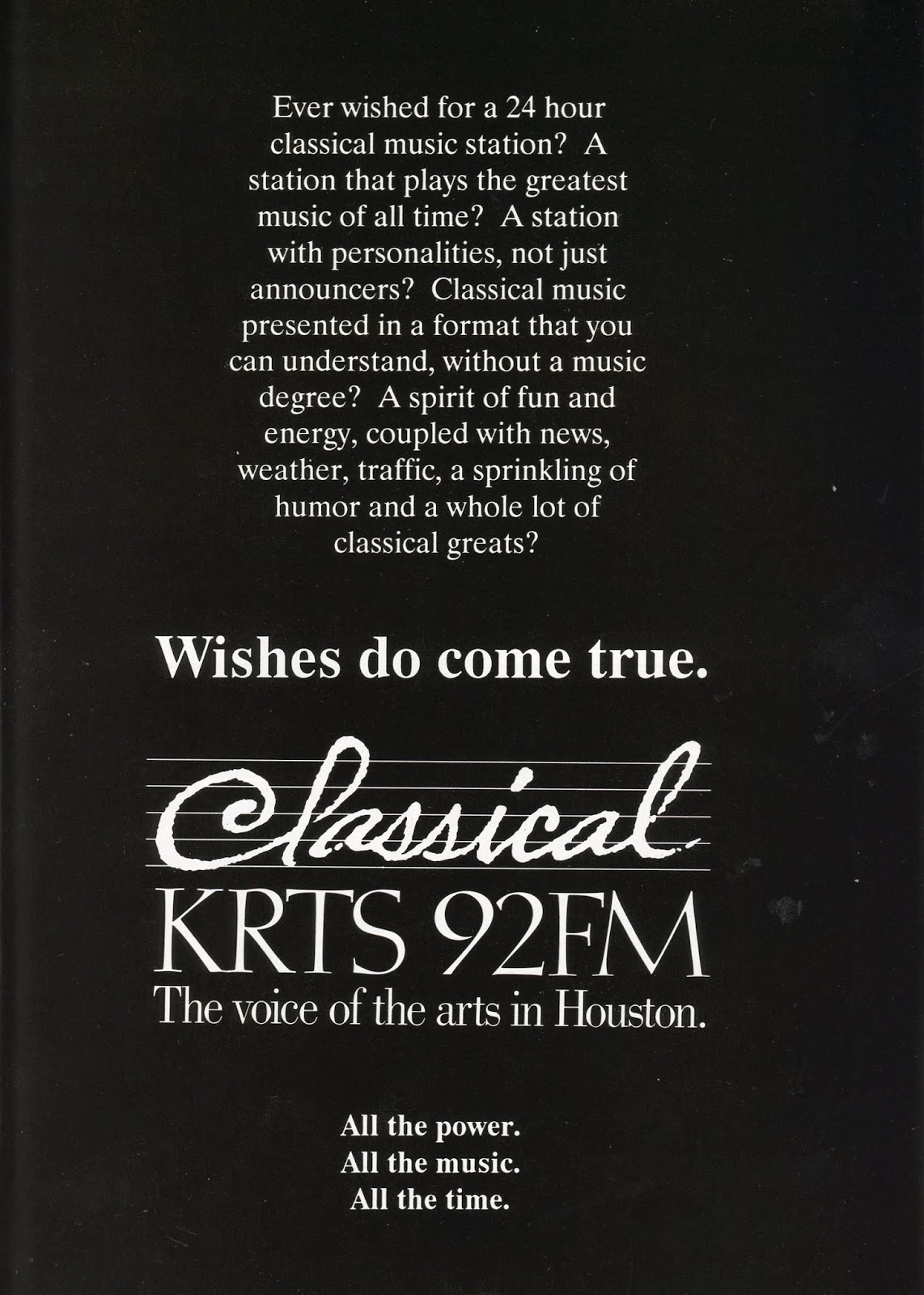
A full page ad for KRTS-FM, 92.1, in Houston Metropolitan Magazine, May, 1992.


KODA-FM Outdoor, ca. 1978-9, after purchase by Group W, Westinghouse

An ad from Broadcasting Yearbook, 1964.

Following are some ads from the broadcasting trade papers sent to me by Chris Huff of the DFW Radio Archives.


KLBS, 1957


An ad for the Veterans Broadcasting group of stations; date unknown but has to be later than late 1961.


KTHT, 1956


KYOK, 1956


A business card for Utah Carl, a Galveston performer on KLUF (1400),KGUL-TV and KTRK-TV, sent to me by Dave Westheimer.

My apologies for the quality of some off the images, the result of over-inked newspapers and the impossibility of getting a decent print off of a microfilm printer sometimes.

KATL and the Press

The Press had been one of the applicants for a station on 1230 kc before the War and was one of the parties notified when the FCC reopened the license hearing on the petition of Roy Hofheinz in 1944, but the Press’ representative was off to the War and didn’t receive the notice until several months later. After getting on the air, Hofheinz formed a close working relationship with the Press and his new station apparently; he did the lion’s share of his advertising for KTHT in the Press and the paper covered station activities much more closely than it reported on the doings of the other stations in town - of course, both the Chronicle and the Post had their own broadcast outlets in KTRH and KPRC. News of KTHT activities, including the use of the first wire recorder, the GI house project, extended coverage of election returns, the cruising radio studio, KTHT-FM and others were frequently the topics of front page stories, or, if not warranting that much coverage, usually would be above the fold on page 2.

KATL
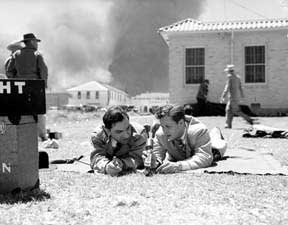
had signed on just after the disastrous explosion at Texas City in 1947 when all the Houston stations distinguished themselves with their coverage, and by late that year had formed its own close working relationship that would give the Press a very large voice on the Houston radio dial and deepen KATL’s coverage of the news.

The KATL - Press agreement was headlined center page on page one on December 2, 1947, heralded as a public service of the two entities. 'See it in the Press, Hear it on KATL' was the catchphrase. ‘Press Time’ was to be broadcast 5 times daily, 3 times on Saturdays and twice on Sundays, live from the Press building at Chartres and Rusk. It would feature freshly gathered news, on-the-scene broadcasts with coverage by both KATL and the Press, ‘flavorsome’ special broadcasts, covering as many interests as the Press did itself, and special sponsorship of certain events such as a spelling bee, election returns, etc. It was described as a public service effort strictly, not for business purposes.

The broadcasts would be 10 to 15 minutes in length except for one scheduled on weekdays from 2:30 to 3pm (the Press was an afternoon paper) which would involve foreign correspondents, Washington reporters, comic strip artists, experts in fashion and cooking, chit-chat with entertainers and more. Saturday programs would be for ‘the kids.’ Sports Editor Clark Nealon, who later went on to be Sports Editor of the Post, would also contribute as would the Press’ popular columnists, Carl Victor Little, Andy Anderson, the Press’ Rambler, and The Stroller, Sigman Byrd.

A lavish reception was held at the Rice Hotel for both staffs to get acquainted and reported on also in the Press.

KATL for its part produced a brochure about the new alliance and blog reader Andrew Brown has shared some images from that brochure which show the announcers and engineers of KATL as well as some glimpses of equipment and the Press setup. I’m very grateful to Andrew for sharing this material.


I have a couple of captures of my own from the newspaper article which I will get around to uploading but they are not nearly as good as these.

Sunday, March 9, 2008

The 1940s - Part 5 - KATL

The next AM station to come on the air in Houston was KATL, licensed to Texas Broadcasters and operating at 1590 kc with 1000 watts. The owners were William Harry Talbot of Houston and Fred Weber and E.A. Stephens of New Orleans, the latter two both associated with WDSU. Stephens was also an auto dealer in New Orleans and Weber had been General Manager of the Mutual Broadcasting System. King Robinson, Chief Engineer at KTRH, came over to serve as General Manager; William S. Newkirk ‘well-known announcer’ was program director. The station had been applied for in March and approved on July 20, 1946. It was scheduled to launch April 1, 1947, but was delayed, ironically, by engineering problems.

On the day KATL was supposed to launch the Chronicle carried a story about the city’s 6th radio station receiving approval - Veterans Broadcasting had received a permit to move onto the 1230 frequency when it was vacated by KTHT but that was not to be possible for months to come. The story also mentioned KATL expected to be on the air within 15 days. On the 13th of April the Chronicle ran yet another story about KATL, saying it would be on the air ‘this week’ and detailed the staff and programming. There was still a lot of concern about jobs for returning veterans and PD Newkirk had taken pains to make sure his entire staff was made up of veterans. Newkirk had served in the Army in the Pacific for three years. Johnny Edwards had been a navigator on a B-17. Larry Blieden served in the Marine Corps while John Wagner was with the First Armored Division and Sid Gervais was a radio technician in the Navy. Houston native Blieden (pronounced blee-din) later became known as actor Larry Blyden. Edwards, who used the nickname ‘the Old Redhead’ even very early in his career, was to spend many years in Houston radio including stints at KXYZ, KTHT and KPRC. This webmaster remembers Johnny Edwards on KPRC as having one of the most beautiful voices I ever heard in Houston radio.

The program staff was said to be taking a survey of Houstonians to determine what they wanted to hear on the radio and the programming would be guided by that survey. The station would operate 24 hours a day.

KATL finally hit the airwaves at 6pm, Monday, May 12, 1947, somewhat surreptitiously after all the stories weeks earlier. It went on the air by special authority, awaiting final FCC approval. The first evening’s programming included play-by-play of the Houston Buffs game that night with Fort Worth - a shutout by pitcher Al Papai - and the station quickly affiliated with Gordon McLendon’s Liberty Broadcasting System which offered mainly sports programming. In addition to sports, the station featured mostly Country music.

Studios were originally located on the mezzanine level of the State National Bank building at 412 Main. The transmitter and towers were on Post Oak Road near the Hempstead Highway.
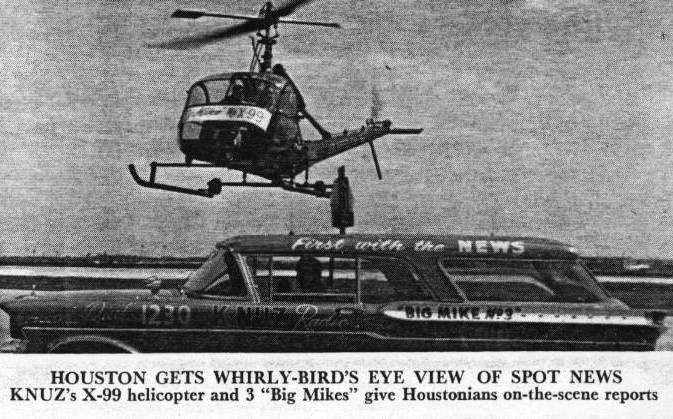
The first mention of the new station in the Post occurred the next morning in a story in the Sports section which advised Buffs fans that their team had returned to the airwaves for the first time since 1938 the previous evening. Peerless Beer also ran an ad telling fans to tune in to the broadcasts, which were to be sponsored by Peerless, a brew from Jax.

The Chronicle gave the station more space in a news story in its Tuesday, May 13 edition and both papers added KATL to their daily printed radio schedules on Wednesday, May 14, 1947.

In the mid 1950s KATL became Houston’s second station programmed for Black listeners and changed call letters to KYOK. Presently the station on 1590 khz is KMIC, owned by Disney.

In less than 12 months, three more AM stations would sign on in Houston, plus several more in suburban communities, and the first four FMs would all be on the air. The competition for listeners and advertising dollars was going to get intense.


Note: Much of this article was previously published on this blog as an anniversary notice, "60 Years on 1590."

Saturday, May 12, 2007

Another Anniversary - 60 Years on 1590 - KATL, KYOK, KMIC

KATL became Houston’s 7th radio station on Monday, May 12, 1947, operating on 1590 kilocycles with 1000 watts, and the station operating on that frequency now is the sixth oldest surviving radio station licensed to Houston. The launch had been postponed several times by engineering problems and the station took to the air at 6pm without much fanfare, operating on special authority since the official license had not been issued. The first night’s programming included a broadcast of the Houston Buffs game with Fort Worth,
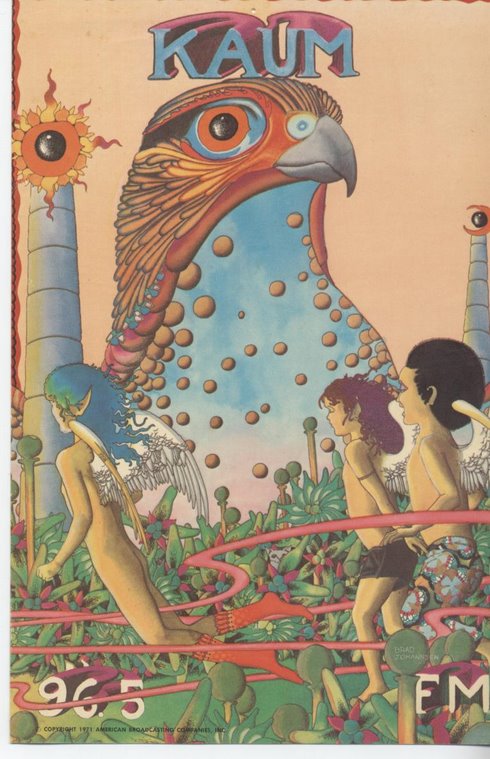
a shutout pitched by Al Papai. The Buffs had not been heard on Houston radio since 1938. The station became an affiliate of Gordon McLendon’s Liberty Broadcasting System.

The original studios of KATL were on the mezzanine level of the State National Bank building at 412 Main and the transmitter was on Post Oak Road near the Hempstead Highway. It operated 24 hours a day and was only the 2nd station in Houston to be on around the clock.

Two of the big concerns of post-war America were housing and jobs for veterans and Program Director William S. Newkirk, himself a veteran of 3 years in the Army, had hired a staff composed entirely of veterans, among them Houston native Larry Blieden (pronounced bleedin’) who had been in the Marines. Blieden had aspirations of being an actor an eventually built a career on Broadway and TV under the name Larry Blyden. Another original staff member was Johnny Edwards who had been a navigator on a B-17. He became host of the station’s popular morning show Chuck Wagon Call and was to have a long career in Houston radio including working at KTHT, KXYZ and KPRC.

The trio of original owners included two investors from New Orleans associated with WDSU. When KATL was sold in 1954 it was bought by two Louisiana businessmen, Jules Paglin and Stanley Ray, for their OK group of stations targeted at Black listeners and the call letters changed to KYOK. The station now on 1590 is KMIC.

There will be more on KATL and KYOK in the section of the AM Chronology on the 40s and 50s and in the station profiles section.