Showing posts with label KRCT. Show all posts

Wednesday, November 2, 2011

Roy Lemons - RIP

I happened across news of Lemons passing on the internet. The name probably does not ring a bell with many in Houston radio today but he was with one of the most important stations in the 60s - KIKK. He wrote me a few years ago and filled in some valuable information on both KRCT and KIKK.

Here is an online obituary.

Friday, August 28, 2009

The 1950s Part II - KILT, KILE, Galveston, KRCT,Pasadena

Updated 6/18/11 to add information about the change of ownership of KRCT.

Around the end of February, 1957, the McLendon Investment Corp. completed purchase of KLBS from the Howard Broadcasting Corporation for $535,000, thus repurchasing the station Trinity Investments had owned from 1952-1954. It was said to be the largest cash transaction in Houston radio history. Glenn Douglass, General Manager of KLBS, told the Chronicle there was much speculation on the part of the staff about what was to happen as McLendon was known for making wholesale personnel changes when he took over a station. The line-up included Bob Yongue doing mornings, Bob Gwyn, Dave Chase, Mark Noble and Mike McKay. The station was airing a number of paid religious programs daily including Rev. Lester Roloff at 7am, an Assembly of God program at 9am, Unity Viewpoint at 9:15 and a Dr. Weber from 9:30 to 10am.

On the fifth of May, Jack Harris, GM of KPRC-AM/FM/TV announced the radio stations would begin Houston’s first regular stereo broadcasts that week, from 9:05 to 10pm, five nights a week. Listeners were to tune one station to the AM, another to the FM to get the stereo effect. KPRC-FM PD Ronald Schmitt had secured more than 80 hours of programming that would include music outside the regular Classical fare of the FM station.

The same day, Bill Weaver, a new GM at KLBS, told the Chronicle changes at that station would be coming in a couple of weeks. Weaver had been brought in from KTSA, San Antonio. The big changes were announced just a week later on May 11 and occurred on May 14, a Tuesday, although the new calls, KILT, appeared in the Chronicle the previous afternoon.

The new line-up included Eliot Field from Boston doing mornings, Bob Stephens of Miami on 9a-12N, Art Nelson from Dallas on early afternoons. Don Keyes of San Antonio was the Program Director and did afternoon drive. The newspaper schedules showed Buddy McGregor, 6-9pm, and Bob Adams, 9pm-12M. Other deejays announced included Tom Fallon of Kansas City, Mike Whalen and Bob Horn of Philadelphia and Joe Long of Knoxville as News Director. Mike McKay and Mark Noble were the only holdovers from the old staff; McKay did overnights while Noble was not listed in any slot for several weeks. All the religious programming was dropped.

A full page ad in the Post was designed to look like a Wanted Poster with six pictures bearing only serial numbers and warned Houstonians to be on the lookout for

‘...these men. They are about to steal the Houston radio audience. These men have begun operations on Color Channel 61 Today. These colorful characters are highly entertaining. Their deep resonant voices will ‘con’ you into listening to KILT, Houston’s new radio voice, around the clock every day.

REWARD: Twenty four full hours of daily listening pleasure
.

After Field left for a gig in Los Angeles, Keyes took over as morning man.

The same week of the big flip, Tim Nolan moved from the job as morning host on KXYZ to the same post at KPRC where he soon was to be teamed upwith Bob Byron, a KLBS-ex, to form Houston’s first duo team in morning drive, Tim and Bob; they were to be together for more than a decade.

For more on my memories as a kid of listening to KLBS and KILT, see my ‘Thanks for the Memories’ segment here:

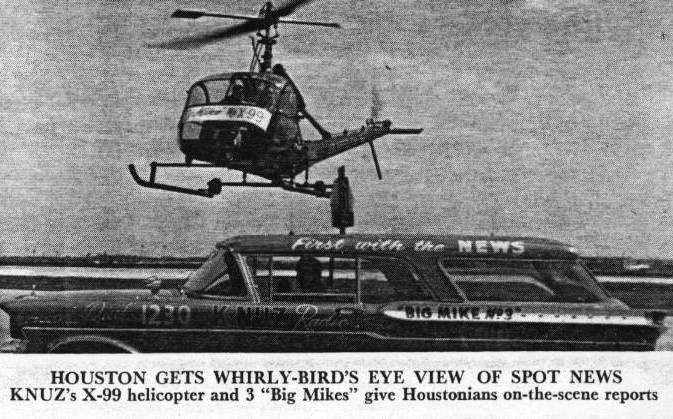
KNUZ, expecting tough competition from the new station, had just purchased a helicopter and ran ads promoting itself as Houston’s only radio station with wings and touting its top ranking. The helicopter had just been put in use when some heavy flooding hit the area and was used in exclusive reports.

Toward the end of the summer a group of Galveston businessmen completed the acquisition of KLUF from it’s founder and owner George Roy Clough and his sons. Clough, whose name was pronounced cluff, hence the call letters, was, even by his own admission, a contentious man who made many enemies and brought a lot of attention to Galveston, not all of it favorable. The son of a telegraph operator and former race car driver, Clough’s knowledge of radio had led him into the field but by this time he was serving as Mayor of Galveston, said to have run initially because he was angered over a city water bill and vowed retribution. He served two terms as Mayor but lost a re-election bid for a third term and a subsequent try for city council. For years he operated a radio and television shop next to his home at 34th and Ave P. He died in November, 1966.


The new call letters for the station were KILE and it debuted on September 2, 1957, at 6am. According to GM Robert. L. McClellan there was all new equipment and programming. Tim Lewis was News Editor and the staff also included Bill Bance, Tom Beck and Warren Anderson. The morning show was called Hit the Deck while an afternoon program was called Teen Tempos. Most old-timers in the Houston/Galveston area will remember KILE as a Top 40 station and it has had many alumni working in Houston radio.

The call letters of this station are now KHCB and it has recently been relicensed to League City.

The first week of October, 1957, KRCT began broadcasting from new studios at 227 East Sterling in Pasadena. The station always ran lots of ads in the Chronicle with the first concerning the changeover appearing on October 2 proclaiming a Grand Opening going on the 3rd thru the 6th with everyone invited to stop by to visit the new facilities. $1000 worth of door prizes were to be given away. The on-air schedule included Hal Harris from 6a-10a, Gabe Tucker, formerly of KATL and KLEE from 10a-1p and Sleepy Bob (Bob Everson) from 1-5pm. Leroy Gloger liked to claim that 650 was Houston’s only ‘clear channel’ station but the clear was assigned to WSM, Nashville, the Houston station was always limited to daytimes only. Over the years the station was also promoted as the ‘Voice of Labor.’ The format was always country.

An application for approval of the sale of the station was announced November 18, from W. D. Christmas to John H. Touchstone and Leroy J. Gloger for $175,000. Touchstone had been a 7 % owner; he and Gloger were to be equal partners under the new ownership. The transfer was approved a month later. In March of 1959 they sought approval of a transfer of the license and CP from Bay Broadcasting to Industrial Broadcasting noting this was a corporate change only, not a change of control. This was granted in mid-May. Touchstone was President, Gloger was Vice President and General Manager.

KRCT was to become KIKK in 1961.

The image above is from the Galveston Daily News
.

Thursday, January 17, 2008

The 1940s - Part 3 - The First Suburban Stations


After the close of World War II, broadcasters expected a lot of interest in FM radio, which had been used by the armed forces during the war and was unavailable for private use, and Congress had taken steps during the war to set up the FM band between 42 and 50 megacycles, then moved it to 88 to 108 megacycles. Instead there was a flood of applications for new AM stations, manufacturers put a lot of inexpensive new AM radios on the market and the development of FM was delayed for many more years. Part of the reason for the cheap AM sets was the shortage of wood brought on by the war; radio manufacturers stopped building big console sets and turned instead to table top models using plastic and metal cabinets due to the shortage of wood. (The chronology of FM in Houston, at least in the early years, is being discussed in a separate series of articles on the sidebar).

Around the Houston-Galveston area, several smaller communities got AM radio stations by the late 1940s. On the 9th of April, 1946, the Chronicle reported that three officials of the Goose Creek Daily Sun had chartered Tri-Cities Broadcasting Co. And applied for a permit for a 250 watt station; no hearing had been set. The principals were Robert Matherne, Publisher, Fred Hartman, Managing Editor, and Sidney S. Gould, Advertising and Business Manager. Fred Hartman later served as Texas Highway Commissioner and the big suspension bridge on Highway 146 is named for him. This application was apparently later withdrawn or amended.

On August 31, 1946, a story in the Houston Post was headlined ‘Tri Cities Radio to take to the air within 3 months.’ A construction permit had been granted by the FCC on Friday, August 30, to Bay Broadcasting Co. for station KRCT, to operate on 650 kc with 250w. C.Q. Alexander, the 6 foot 9 and a half inch mayor of Goose Creek was one of the principals. According to the Post a site had not even been selected yet but the Chronicle story said all the equipment had been acquired and the station expected to be on the air by Thanksgiving. The Chronicle reported the calls were to be either KBAY or KOCT, the latter apparently a typo.


(Photo from the files of the Baytown Library).

It is not clear when this station finally got on the air. On the 4th of December the FCC accepted for filing an application to approve the antenna at a location on Bayou Road, 1.7 miles from the center of Goose Creek, and to specify the studio location in the M. Wilkenfield Building at 106 Goose Str. in Goose Creek. White's Radio Log for Winter/Spring 1947, covering January, February and March, does not list the station but the Texas Almanac for 1947-48 includes KRCT as one of 94 radio stations operating as of April 15, 1947. The earliest mention I have found in the Goose Creek Daily Sun was on p. 2, June 24, 1947, of a radio address on the issue of school consolidation to be aired on the station. The Sun was trying to get it’s own competing radio station on the air and seemed to have ignored the existence of KRCT except in paid advertisements or news stories such as when the station’s 200' tower on Cedar Bayou was knocked down by a strong norther blowing in on November 7, 1947. That story received mention also in the Corpus Christi Caller-Times and Mexia Daily News as severe weather had wreaked havoc across much of Texas and Louisiana.  (The station was back on the air the next day with a temporary antenna).

Other papers, however, provide earlier dates.  On February 27, the Liberty Vindicator, published in nearby Liberty, ran a story about a Baptist revival and stated one of the sermons would be broadcast over KRCT on March 9 at 2:30 pm. There were other mentions in the Vindicator and the Freeport Facts in April and May indicating the station was on the air.  The best guess is that KRCT got on the air sometime between late December, 1946, and mid-February, 1947.

Leroy Gloger became part owner of the station in late 1957. The station moved to Pasadena that year and in 1961 established studios in the Montagu hotel in downtown Houston and flipped the call letters to KIKK.

Roy Lemons, who was a Station Manager and Sales Manager for KIKK in the 60s, e-mailed me to report the original call letters KRCT came from the initials of Robert C. Touchstone, a furniture dealer in Goose Creek, who was one of the owners. He does not know when the station signed on or changed hands but says Gloger was the owner of a service station in Baytown when he bought the station for $110,000 with a $20,000 cash down payment. Roy has also provided information about the choice of the KIKK calls and the famous boots logo which will be included later in this chronology.

ETA:  Before the station got on the air an amended application was filed to move the studio location from the Wilkenfield building downtown to the transmitter site, described as the intersection Texas Avenue and Bayou Road or as 202 Bayou Road by the paper.  There is a 1957 Historic Aerial showing the facilities, just NE of the intersection of Wright Blvd. and Bayou Drive as it is now known.  The site does not allow links to specific images; go to the site and use the search parameters 'bayou drive baytown texas' and select the 1957 aerial.  Turn on the 'All Roads' overlay to identify Bayou Drive and Wright.  If you click on the 1964 aerial you will see that after the station relocated to Pasadena and went on KXYZ's main tower on Texas 225, the original KRCT facilities had been demolished and if you click on the 2004 aerial you can see what's there now - it is an upscale residential neighborhood.

More details on the history of KRCT and KIKK can be found here or by clicking on the labels below.

In its story on the KRCT action the Chronicle also reported Robert Matherne, owner of the Daily Sun at Goose Creek, had applied for a permit to operate a 1000 watt station on 1360 kc. Besides the principles of the Sun, the principles of Tri-Cities Broadcasting included I.G. Sanders, manager of the Culpepper’s Department Store in Goose Creek and Robert Strickland, an attorney. The call letters requested were KREL, because Robert E. Lee High School ‘had been and would continue to be an important part of life in the Tri-Cities.’ The go-ahead was given by the FCC on May 1, 1947.

The Handbook of Texas says that in 1942, Felix Hessbrook Morales first applied for a license for a radio station in Pasadena. Morales, a native of New Braunfels, had produced his own radio programs on a San Antonio station before moving to Houston and had bought time for Spanish language programming on KXYZ. Due to the war, Morales’ application was delayed for four years. The Houston Press reported on November 2, 1946, that Felix Morales of 2901 Canal had applied to the FCC for a 1000 watt daytime station on 850 kc, with the programming to be 80% Spanish and 20% English; there were said to be 40,000 Spanish speaking residents of Houston. Morales was finally to get a station on the air May 5, 1950 with a celebration of Cinco de Mayo. KLVL, “La Voz Latino,” 1480 kc, was licensed to Pasadena and is still on the air at that frequency with those calls, the third oldest radio station in Houston with the original calls. Read more about Morales and KLVL here.

According to the Broadcasting Yearbook, KGBC, Galveston, came on the air at 1540 kc in May, 1947, but the actual first air date was Saturday, February 1. A CP had been granted in August, 1946. James W. Bradner, Jr., was president of Galveston Broadcasting Co.; he had been an engineer with the TVA, with the national war housing administration during the war and City Manager of Waco. The station was only a daytimer at first and was promoted as Galveston’s only 1000 watt clear channel station. It is still on the air on the original frequency with the original calls.

According to Broadcasting Yearbook, KWHI Brenham, signed on April 15, 1947,  on 1280 kc. It was owned by the Brenham Banner Press but the archives of that paper are not available.  The earliest mention in print was an ad in the Bryan Eagle on May 9 and the first mention of the station in the Houston Post was on May 11. For more on the history of KWHI and it's sister FM, go here.

As far as I can tell it is the second oldest station in south east Texas outside of the Houston/Galveston or Beaumont/Port Arthur/Orange markets (WTAW, Bryan-College Station is the oldest).


The image above is from the archives of the Galveston Daily News at the Rosenberg Library, Galveston.

Sunday, June 17, 2007

KRCT, Goose Creek, KIKK, Pasadena

On August 31, 1946, a story in the Houston Post was headlined ‘Tri-Cities Radio to take to the air within 3 months.’ A construction permit had been granted by the FCC on Friday, August 30, to Bay Broadcasting Co. for station KRCT, to operate on 650 kc with 250w. C.Q. Alexander, the 6 foot 9 and a half inch mayor of Goose Creek was one of the principals. According to the Post a site had not even been selected yet but the Chronicle story on the same action said all the equipment had been acquired and the station expected to be on the air by Thanksgiving. The Chronicle reported the calls were to be either KBAY or KOCT, the latter apparently a typo.

The owners of the Goose Creek Daily Sun had applied for a permit for a 250 watt station 5 months earlier but that application had apparently been withdrawn. In its report on the KRCT permit the Chronicle also noted the Daily Sun had applied for a another permit for a full time 1000 watt station to operate on 1360.

I have not been able to pin down just when KRCT got on the air but if a site had not yet been selected it seems unlikely it came about in as little as 3 months. Many new stations in the 40s experienced delays of several months in their efforts to get on the air. The Houston papers reported on FCC actions concerning stations in Houston and the surrounding area and even as far away as Dallas, Austin, San Antonio and the Rio Grande Valley, probably taking the information from an FCC press release or the wire services, but did not regularly cover other news of stations in the suburbs. It would have been up to the station to notify the papers of its progress and I have found no mentions.

As the applicants and then permitees of a competing radio station, the Daily Sun also carried little mention of KRCT unless it was legitimate news, such as in November of 1947 when the KRCT tower on Cedar Bayou was knocked down by a strong norther blowing through the area. Other than mentioning the permit for KRCT in August, 1946, the earliest mention I have found in the Goose Creek Daily Sun was on p. 2, June 24, 1947, of a radio address on the issue of school consolidation in the tri-cities area to be aired on KRCT. Just days later the paper reported on page 1 that Sylvia McKinstrey had resigned as City Clerk to go to work for KRCT.

Fortunately, mentions in other papers make it possible to move the date back.  On February 27 the Liberty Vindicator ran a story about a Baptist revival and said one of the sermons was due to be given over the air on KRCT on March 9 at 2:30 pm.   On April 17 the Vindicator reported on a concert in Liberty by a popular quartet, the Stamps-Times Quartet, which was heard regularly on Sundays at 8:05 am on KRCT and on May 22 ran an ad for The Baptist Hour, heard Mondays, Wednesdays, and Fridays, 3:30 - 4:30 pm, sponsored by the First Baptist Church of Crosby.  Also on May 22, the Freeport Facts ran an ad for a weekly dance at the Surfside Beach Pavilion on Friday nights featuring the Blues Rustlers who could be heard weekdays at 5:15 pm on the station.

Although an exact date still cannot be determined it's clear the station got on the air between late December, 1946, and mid February, 1947.

By the late 1950s the station was owned by Leroy Gloger who may have served as manager of the station before buying it. The first week of October, 1957, KRCT began broadcasting from new studios at 227 East Sterling in Pasadena and the city of license was changed to Pasadena. The station always ran lots of ads in the Chronicle with the first concerning the changeover appearing on October 2 proclaiming a Grand Opening going on the 3rd thru the 6th with everyone invited to stop by and visit the new facilities. There was to be $1000 worth of door prizes. The on-air schedule included Hal Harris from 6a-10a, Gabe Tucker, 10a-1p and Sleepy Bob (Bob Everson) from 1-5pm. Tucker had been a country dj in Houston in the early 50s on KATL and KNUZ and had been one of the last KATL djs after the station switched to KYOK. He spent a couple of years in Nashville managing Ernest and Justin Tubb and the Wilbourne Brothers before returning to Houston to KRCT. His wife was also in the music business.

Broadcasting Yearbook gives the year of origin of KIKK-AM as 1957, reflecting the move to Pasadena.

Gloger liked to claim that 650 was Houston’s only ‘clear channel’ station but the clear was assigned to WSM, Nashville, the Houston station was always limited to daytimes only. Over the years the station was also promoted as the ‘Voice of Labor.’

On May 1, 1961, Gloger opened new studios in the Montagu Hotel at 804 Fannin at Rusk in downtown Houston and changed the call letters to KIKK, again proclaiming the switch in big ads in the Chronicle. A story in the TV section of the Chronicle the previous day advised readers not to worry, it was the same old KRCT, just new calls, and helpfully noted the DJs would refer to the station as ‘Kick, for kicks.’ Gloger told the Chronicle reporter the change came about because research had shown call letter confusion among listeners. The ads just used block lettering for the call letters; it is not known yet just when the familiar boots came to be used for the ‘k’s.

The KIKK calls had previously been used on a station in Bakersfield, CA, which ironically dropped the calls when it changed formats to country music.

The air staff included Hal Harris from sign on to 9am and 12N to 3pm, Gabe Tucker from 9 to Noon, and Tiger Myers from 3pm to signoff. Hal Wallace was the newsman.


The image is an ad for KIKK the weekend the call letters were changed. If anyone has any information about when KRCT got on the air or exactly when it changed hands to Leroy Gloger, I'd appreciate hearing from them.

Anyone wanting more information about the meaning of clear channel stations, not the company, can find an article on Barry Mishkind's Broadcast Archive site listed among the Radio History links on the side-bar (the site does not allow linking directly to individual pages).