Note: The article previously published as The 1940s - Part 4 - KATL has been retitled Part 5 to keep the articles in chronological order.
The only new stations to come on the air in Houston in 1946 were to be FM outlets but there was a lot of activity behind the broadcasting scene as the country and the industry continued the transition back to peacetime activities.
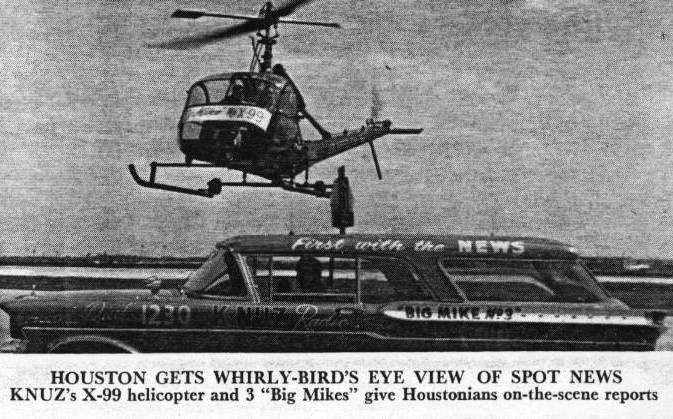
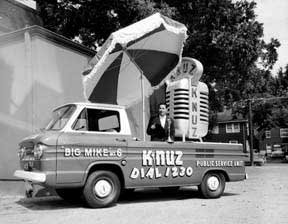
It had been reported in December, 1945, that a group calling itself Veterans Broadcasting had been formed to put Houston’s 5th radio station on the air on the 1230 frequency that was to be vacated by Texas Star’s KTHT; the application was contingent on approval of KTHT’s move. This was a group of Hofheinz associates that had been privately informed of his intentions so they could move quickly on the opening. Apparently the name Veterans had been chosen because all the principals were veteran broadcasters; the call letters KNUZ were to be used but the station was not going to be a news outlet, the calls referred to the fact that a couple of the principals had been newsmen.
One month later, on January 18, 1946, the Press reported not only on Veterans’ application but also the application of Hofheinz to move KTHT to 790 and an application for a station to operate on 610 kilocycles with the call letters KHTN.
The March roundup of FCC actions and filings reported in the Press on the 16th included news that hotelman W. Albert Lee had filed a competing application for a station on 610 kc, veteran Houston broadcaster and advertising man Lee Segall had filed an application for 1230, H. C. Coeblain and San Jacinto Broadcasting had filed for a station on 1470, Fred Weber, E.A. Stephens and William H. Talbot had filed for a station on 1590 and Radio Broadcast Associates, a group mainly based in San Antonio consisting of Eugene J. Roth, Jack. L. Pink and James M. Brown, had filed for a permit for a 250 watt station on 1180. Roth had put a station on the air in San Antonio in 1927 in the back of his auto repair shop on Main and taken the call letters KGRC, meaning Kome to the Gene Roth Company. Two years later someone had pointed out to him that he needed a government license to do what he was doing so he wrote to the Commerce Department and reported himself. According to Richard Schroeder in Texas Signs On, Herbert Hoover wrote back informing him that he was now authorized to operate a station in San Antonio with the call letters KGRC. That station had become KONO.
The Press reported on April 26 that Lee Segall had been granted an FM license; no other details were given. It is believed this license was transferred to the company that bought out Segall when he decided to relocate to Dallas and would have been a proposed KCOH-FM but never made it on the air. However, this was apparently the first license issued for an FM station in Houston in the upper (88-108mc) band.
The paper also noted W. Albert Lee’s and Roy Hofheinz’s applications and identified the head of the company seeking station KHTN on 610 kc as Robert T. Bartley, a nephew of powerful House Speaker Sam Rayburn. It was often speculated in coverage of this story that Bartley’s Washington connections made him a favorite to win the permit.
On May 4th, the Post reported its parent company, Houston Printing Co., had received a permit for an FM station to operate on 99.7 megacycles with 19.6 kilowatts. For more on this, see the FM Chronology. The paper also reported the FCC announced its intentions to hold competitive hearings on the applications of W. Albert Lee and KHTN, Inc. for a station on 610.
During May hearings resumed on Roy Hofheinz’s application to move KTHT to 790 kc and Lee Segall dropped a competing application for the frequency. It took almost 4 years for Hofheinz to win approval for his proposed move and brought him into conflict with one of the largest broadcasting outfits in the country; that story will be reported in a separate post.
On July 20 the Press reported the FCC had issued a permit the previous day for a new Houston AM station, the first since 1944. The operation was to be headed by Fred Weber of New Orleans, a former General Manager of the Mutual Broadcasting System who announced that no studio site had yet been selected. The station would take 10 months to get on the air and take the calls KATL. That is the subject of the next segment of this AM chronology.
Within 2 weeks Houston got a fifth radio station, Texas Star’s KTHT-FM. This is reported on in the FM Chronology. Later that month, the Chronicle reported that Metropolitan Houston Broadcasting Co. had filed for a permit for a full time station on 1060 kc to operate with 5 kW days and 1 kW nights. R.H. Rowley, Glen H. McLain, L.M Rice of Dallas and James A. Clements of Angleton were identified as the principals of the company. Clements was also a partner in Bay City Broadcasting which already held a permit for a station in Bay City, presumably KIOX.
In October a hearing on Radio Broadcast Associates of Houston’s application for a station was postponed. In its article the Press referred to Eugene L Levy, an error I believe, and gave the frequency sought as 1170 and the power as 1000 watts. The paper also noted that Roy Hofheinz and his partner, W.N. Hooper had amended their application for a station in New Orleans to request 50 kw rather than 5 and move the frequency from 1580 to 1540. This project of Hofheinz and Hooper was later scrapped due to cash flow problems.
Rounding out the action on the radio scene in Houston for 1946, the Press reported on November 2 an application had been filed for a Spanish language station in Houston to operate on 850 kc with 1000 watts daytime. Felix Morales had been trying since 1942 to get an AM station on the air in Houston; he would not succeed until May, 1950, with KLVL, 1480.
Just after the first of the year, both the Post and the Chronicle reported that Hofheinz and Hooper had filed for a station in San Antonio on 860. I believe this project did finally make it on the air.